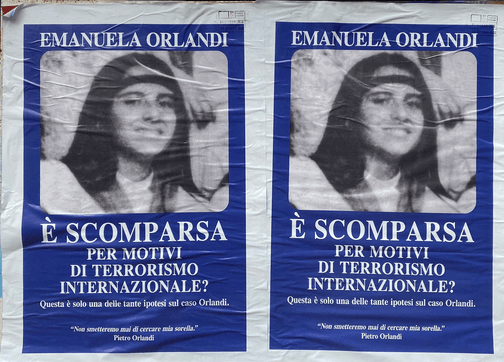
Anyone who has seen the recent (2022) Netflix series “Vatican Girl: The Disappearance of Emanuela Orlandi” (I watched this over Christmas, it’s actually rather good) will know that the story it tells – of how, in 1983, 15-year-old “Vatican Girl” Emanuela Orlandi disappeared – is nothing short of a full-blown mystery.
Many decades later, her family’s search for answers yielded an unexpected result. A five-page document (allegedly stolen from a Vatican safe) was passed to Italian journalist Emiliano Fittipaldi: this itemised many expenses (totalling 483 million lira, or roughly 250,000 euros) incurred by the Holy See in supporting Emanuela Orlandi “through her life phases”. If (as seems likely) this is genuine, it would seem to imply that Orlandi’s disappearance was orchestrated, sustained, and covered up by the Vatican itself over the period from 1983 to 1997.
There are many different sides to this story, but I thought I’d take a closer look at its London connections…
London Connections
For once, there’s a helpful Reddit thread, that contains scans of the 1998 document itself (cover-pages of an as-yet unreleased 197-page dossier). This breaks the Vatican’s funding up into four distinct phases:
- Jan 1983 to Jan 1985 (p.2)
- This includes “Rette Vito e Alloggio 176 Chapman [actually Clapham] Road Londra
- Also include “Secondo Trasferimento”
- Feb 1985 to Feb 1988 (p.3)
- This includes “6 Ellerdale Road London NW3 6NB”
- Mar 1988 to Mar 1993 (p.4)
- This mentioned “Clinica St Mary’s Hospital Campus Imperial College London Mint Wing South Wharf Road London W2 1NY”
- It also mentioned “Dottoressa Leasly [actually Lesley] Regan Department of Obstetrics & Gynaecology”
- This includes “Terzo trasferimento”
- Apr 1993 to Jul 1997 (p.5)
- “Attività generale e trasferimento presso Stato Città del Vaticano con relativo disbrigo pratiche finali”, i.e. “General activity and transfer to the Vatican City State with related final paperwork“.
Note that in the period 1988 to 1993, Dr Lesley Regan was a recently-qualified ob/gyn specialising in recurrent miscarriages (and is now head of ob/gyn there). However, when questioned by reporter Stefano Vergine from La Repubblica (translated here), Regan claimed to have no memory of Emanuela Orlandi.
The document also mentioned two London addresses linked to the Church, both of which La Repubblica’s intrepid reporter visited (though to no avail):
- Casa Scalabrini (Youth Hostel of the Scalabrini Fathers) in Clapham Road, Stockwell
- The Institute of St. Marcellina, a short walk from Hampstead Station.
Without going into too much depth, I think it’s hard not to infer from this that Emanuela Orlandi was very probably in London from 1983 to 1997; and also that she may well have suffered from significant gynaecological problems (such as miscarriages). It also seems likely to me (from the “transfer to the Vatican City State” and “final paperwork” mentioned at the end) that Orlandi died in London.
In 2017, an anonymous tip-off to Laura Sgro (the Orlandi family’s lawyer) alleged that Emanuela’s body had been interred in an old grave in the Vatican’s Teutonic graveyard. Once this grave had been opened, it was reported in the press (a) that the remains of a roughly 30-year-old woman had been found, and later (b) that this was not Emanuela Orlandi. So the mystery continues.
Might Her Body Have Been Repatriated?
If Orlandi had died in London in June/July 1997 (as seems likely to me) but had been buried in a Vatican cemetery, I was a bit surprised that the question of how her body had been taken from A to B (or, rather, from L to V) hadn’t been raised. So I had a brief look at what administrative steps would needed to have been taken to allow this, in case these left any kind of archival paper-trail that could be followed today.
In England and Wales, any request to repatriate a body has to be made by completing a Form 104 and submitting it to the Coroner. The Coroner then decides whether the requested repatriation should be allowed, and (if it should) returns a Form 103 back to the Funeral Director to release the body.
Though the document mentions no address in the period 1993 to July 1997, it would seem reasonable to guess that she hadn’t travelled far from London. Hence it sounds as though we’re looking for any Form 104s that were submitted to a Coroner’s Office in London in June/July 1997 for repatriating a body of a roughly 29-year-old woman to Europe (probably but not definitely Italy or the Vatican). Surely we could call all the Coroner’s Offices in London (there aren’t actually that many) and just ask them, right?
Well… as always with anything to do with archives, I suspect the answer is a mix of yes and no.
Firstly, what happened in 1997 would have been covered by the 1988 Coroners Act, which was then superseded by the 2009 Coroners and Criminal Justice Act: the change most relevant to our search is that Coroner Districts were replaced by (larger) Coroner Areas (presumably to shut down a load of Coroner’s Courts to save money, right?) So since 1997 a great deal of administrative turbulence has happened, which isn’t a great starting point.
Secondly, Coroner’s records are only supposed to be retained for a maximum of fifteen years, after which 10% of those records are randomly sampled and passed on to the archives (which, as I understand it for London, would be the London Metropolitan Archives). So there’s a 90% data-loss at the archiving stage, which (for a historian) is a bit mad. But really, the point of archiving these records was to enable broader secondary studies, rather than for solving individual cold cases: keeping everything is expensive.
Thirdly, my understanding is that the main bulk of Coronial records relate to inquests: and if Emanuala Orlandi died in London, there’s no guarantee that she even had an inquest. Specifically, if she had (say) died in a hospital, she could very well have been given an MCCD (a “medical certificate of cause of death”) by a doctor without ever even being seen by a Coroner. So the June/July 1997 administrative interactions with whichever Coroner’s Office might well have been fleeting (if not indeed minimal).
All in all, there seems to be no shortage of reasons why we should be pessimistic about finding anything. And did I mention anything about confidentiality or data privacy? *sigh*
At the same time, Form 104 (also known as a “Removal Notice”, or sometimes the “Out of England” form) submissions must surely be a relative rarity: and these must surely be recorded by the Coroner’s Office, perhaps in a database (or maybe even a handwritten ledger back in 1998). So there has to be a good chance that this database or ledger is still being actively filled and can be checked, right? However, without specifically asking all the Coroner’s Offices how the handle this, I suspect there’s no obvious way of finding out.
However, what is also interesting (and this is the bit that I think may prove to be of most relevance here) is that part of Form 104 gets detached and sent to the Registrar of Births Deaths & Marriages, where the information on it is presumably recorded somewhere.
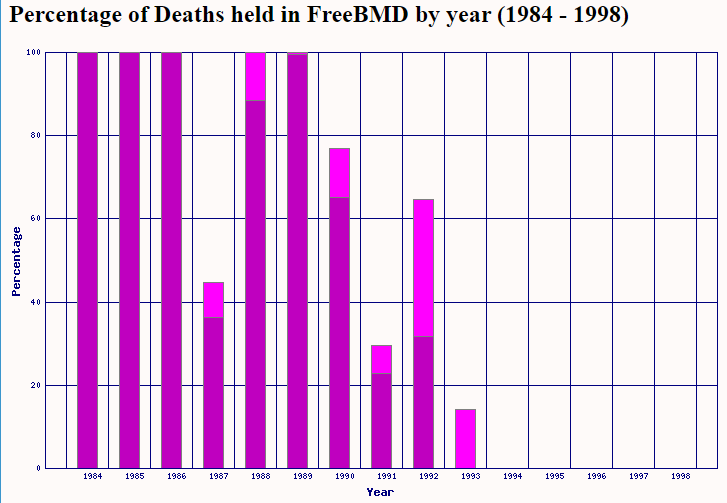
In the UK, freebmd is trying to input the BDM index data and make it freely available to everyone, but it’s a huge task, and they haven’t got anywhere near 1997 yet:
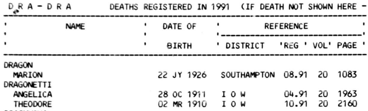
However, the raw GRO index data that freebmd’s heroic transcribers are inputting looks like this (I just entered DRAGONETTI as a random surname, and picked 1991 as a post-1988 example):
From the database field guide listed at the top of this page, each entry includes a reference to the associated District Registrar’s district (e.g. “Isle of Wight”), and the register / volume / page reference to look up there. Importantly, there’s no mention here of anything to do with Form 104, so presumably that’s an extra layer of information that would (I guess) be added to the register itself (or perhaps to a separate register entirely?) by that District Registrar.
Which points to the even more annoying insight that if we were looking for Form 104 submissions for June/July 1997, I’m guessing we would have to look through the London death registers directly (i.e. not by trawling through the GRO index). Well, unless the Registrar of Births Deaths & Marriages in that District just happened to maintain some kind of separate searchable index of Form 104 submissions. Which I guess is possible, but you’d again have to ask them directly if such a pixie-dust index exists.
Which is what I plan to do next (while crossing my fingers hard). Unless anyone here has a better idea?