[*] Well, a bit of it, anyway.

Over the last weeks, my Cipher Mysteries inbox has been inundated with AI-generated theories. But – and with my apologies to the genuine cipher theories that also landed there, which I promise I will get back to – I’ve instead been focused on the Voynich Manuscript. Or, more specifically, on a single line of its text.

And I think I can read it.

The f17r marginalia

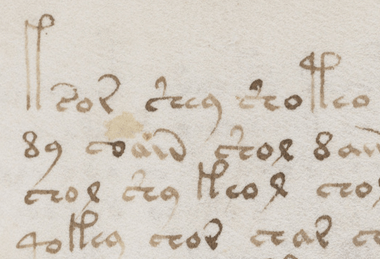
Back in 2006, I was hugely fortunate to be allowed by the Beinecke Rare Book & Manuscript Library’s curators to spend a few days working with the Voynich Manuscript. One of the highlights of that trip came when I borrowed their UV blacklamp to examine the tiny marginalia at the top of page f17r.

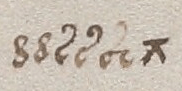
To my huge surprise back then, what the UV light made visible at the end of that line was some Voynichese text. Later on, another group did some multispectral scans of f17r, so here’s what they saw (“Voynich_17r_WBUVUVP_019_F”, auto-equalised in Gimp):

Why was all this important? Because it strongly suggested that there was some kind of direct link between (one of) the marginalia people and the curious Voynichese writing itself. (And also that the Voynichese letters on the final page (f116v) were probably not coincidental). For me, this all suggested that understanding the Voynich Manuscript’s marginalia might not only tell us something about a later owner of the manuscript, it might also tell us about its creator(s).

So the marginalia are a big deal to me. And if you’re interested in the Voynich Manuscript, they really should be a big deal to you too.

Theories about the f17r marginalia

So, what does it say, what does it say? Poundstone thought that the first word might refer to herbal writer Pierandrea Mattioli (1501-1577): Brumbaugh similarly thought it might refer to Mathias de l’Obel (1538-1616). But these both feel quite wrong, because the cursive gothic handwriting is typical of the (mid-)15th century, not of the 16th century.

Since then, there have been plenty of partial readings of the f17r marginalia, most of which seem – possibly emboldened by the apparent fragments of German writing on f116v – to be German-ish. But though such readings typically start promisingly, they quickly fall to pieces when you look more closely.

A special mention here to two good attempts:

For “The Curse of the Voynich” (2006), I had my own proposed reading (on pp. 24-25), but I’ll come back to that in a minute. Still, the important thing I noted was that the second letter of the first word appeared to have been emended: and so consequently the first word actually seemed to have originally been “meilhor“.

The mysterious third word

Also back in 2006, I wondered if the third word might be “lutz” (the Occitan word for “light”). Yet that (and almost all the other theories about how to read this word) failed to explain why there was a macron (overbar) over the end part of that word. In 14th-15th century texts, the macron was widely used as a way of inserting a missing ‘n’. So… why on earth was there a macron over this word?
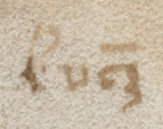
Back in 2017, Helmut Winkler posted this on Voynich Ninja:

I think there are several more ways to read the “lucz”,  e.g. lucem or lucet, but in this contextI I would suggest  luc[ea]m her[bam], one of the Alchemical Herbs

Now fast forward to a July 2025 comment by Marco Ponzi, mentioning some text from Fribourg MS L.52 (f.8v): “oleum lucet, balsamum redolet” (and I have a ton to say about L.52 on another day):

Marco then noted:

For the third word in the Voynich f17r marginalia, assuming that the text is Latin (very doubtful) and that the initial [letter] is ‘L’, a possible reading could maybe be “lucent” (where the macron stands for the missing ‘n’) – “they shine”, third person plural.

You can’t fault Marco’s logic here: even though adding the macron would ‘nasalise’ lucet into lucent, it overall does not look like Latin. So… how can we resolve all this?

Reading f17r marginalia (finally)

The reason I’ve ground through all the above (giving credit to everyone who helped with all the steps along the way) is that the final reading didn’t just magically pop into my head. I started looking at this properly in 2005-2006, so it has taken nearly twenty years to get to (what I believe to be) the end line.

When writing Curse, my tentative reading of this marginalia was that this was Occitan, and that it began:

  • meilhor aller lutz [kou?]…

…which was close, but no cigar. With the benefit of all the above, I am now pretty sure that it is Occitan, and that it reads (using a Latin abbreviation style to render the Occitan “lucent”):

  • meilhor aller lucent ben balsamina [….]

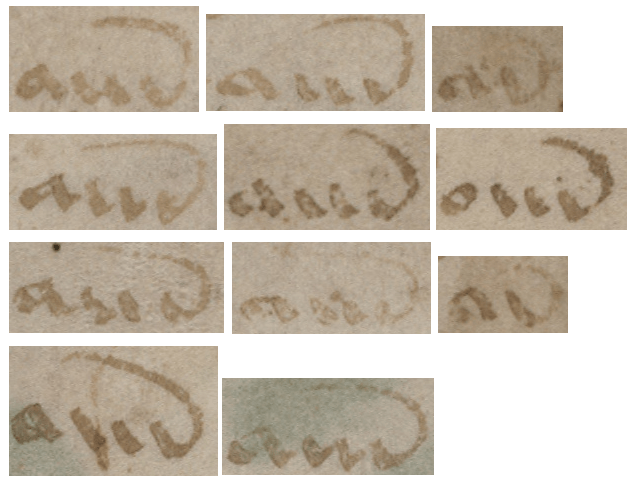
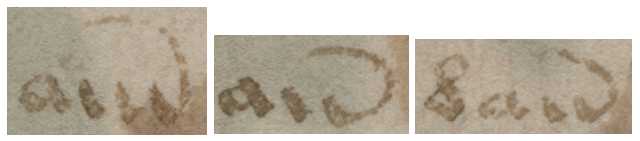
Or, one multispectral block at a time:

meilhor aller
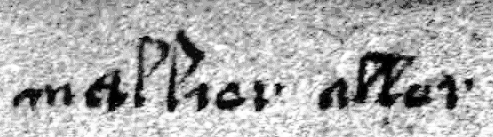
luc[ent] ben
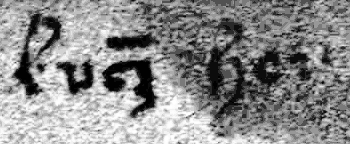
balsamina
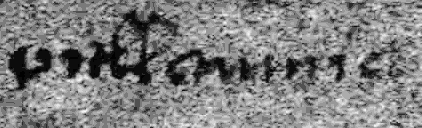
Balsamia / Balsamina

If you look at Wellcome MS.626 (Livres des simples médecines), you can easily find (because it’s arranged alphabetically) balsamia [balsam] on folio xxix:
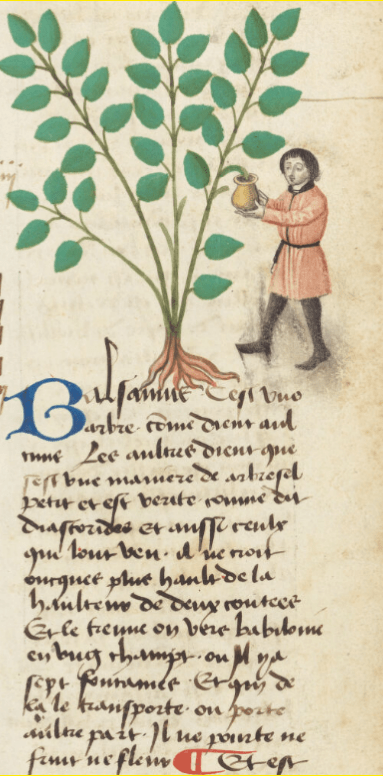
To be precise, this is talking about the original (and mythical, almost unobtainium-like) balsam from the East, a plant known not to anyone by actual experience. So this is reporting – medieval herbal-style – on a plant without flowers yielding a kind of resin, and the artist is just guessing at what it might look like. It’s really not a literal drawing of a tree.

And yet a century later, Leonhart Fuchs in his 1542 Hist. Stirpium was using the word ‘balsamines’: “Duo Balsamines genera damus“, and the word balsamine was being used in French in 1545 to mean “balsam-like”. So even though this isn’t “balsamina” in its modern sense (e.g. impatiens balsamina), it is a word that is specifically being used to evoke balsam-like qualities.

And I think the word we’re seeing at the top of f17r is “balsamina”.

Occitan marginalia. Really? Really.

So, my argument here is that the marginalia at the top of Voynich manuacript page f17r is written in Occitan. And guess what? Back in 2006, I argued long and hard that the Voynich zodiac roundel month names (which also appear to be marginalia) were also in Occitan. So this should, in theory, be the least surprising marginalia language identification ever.

And yet I already hear every single Voynich Ninja commenter disagreeing. Pffft. It is what it is. It’s Occitan.

If the Voynich Manuscript was written by people who appear to have been writing natively in Occitan, the first thing we should now be doing is looking at every single Occitan herbal-related manuscript from the period, such as BNCF Manuscript Palatino 586. Roll with it for a change.

Diving ever further down the Jehan le Bègue / Giovanni Alcherio rabbit hole, I found an exceptionally solid and persuasive paper by Inès Villela-Petit, who did a full modern transcription of the le Bègue manuscript as part of her doctoral work. Her reason for doing this was that the partial edition in Merrifield (1849) was inadequate, and that too many of Merrifield’s guesses had become ossified through unthinking repetition in the literature (my phrasing, not hers). A fresh pair of eyes was long overdue!

Hence her paper “Copies, Reworkings, and Renewals in Late Medieval Recipe Books” (translated well into English by Jilleen Nadolny) helpfully summarises a lot of Villela-Petit’s conclusions, while also situating them in a broader recipe manuscript context. I highly recommend it as a – modern – basis for approaching Paris BN Lat 6741. Her core argument is that le Bègue was much more of a copyist than Merrifield thought, and that the actual compiler was Giovanni Alcherio in Milan.

Quaterni

For a long time, I had been labouring under the incorrect impression that Alcherio had compiled a vernacular Italian treatise that le Bègue had translated into Latin. Certainly, seventeen of the recipes had originally been in Italian: but with Villela-Petit’s revised reading of Alcherio as the actual compiler and le Bègue as the copyist (with only a tiny number of recipes added by le Bègue at the end), this falls down. So it seems that Alcherio compiled his recipe collection in Latin after all.

Another important thing Villela-Petit helped me pick up on was that the original (i.e. pre-le Bègue) document organisation was what le Bègue called quaterni – loose bifolios, arranged in sequence, but unbound. When I first saw that word, I thought it meant something more like pecia (typically four leaves unbound/bound into a single quire/gathering, and rented out to students). But no, her close reading of the text reveals that a quaternus here refers specifically to a single loose bifolio.

So it turns out that quaterni may be a feature of Northern Italian workshop recipe manuscript culture in the 14th and 15th centuries. Baroni and Travaglio’s “Considerazioni e proposte per una metodologia di analisi dei ricettari di tecniche dell’arte e dell’artigianato. Note per una lettura e interpretazione” (published via the awesomely bodacious peer-reviewed open source journal Studi di Memofonte) discusses this in pp. 52-53. They point out that this kind of workshop (quaternus-based) order of recipes can give rise to a series of phenomena that “frequentemente passare inosservata” (often pass unnoticed), most obviously when the same quaterni later get (mis-)bound for preservation.

Mainly, though, Baroni and Travaglio highlight composite forms of what is often called “booklet” structure, which sits halfway between quaterni sequences and pecia. Codicologically, a “booklet” is a self-contained quire covering a single topic, often with pages left blank at the end. These too seem to be a typical workshop layout for practicality. Examples of manuscripts with booklet-based structure include:

  • Milano, Biblioteca Ambrosiana, MS D 437 inf.
  • Torino, Biblioteca Nazionale, MS 1195 (Liber de coloribus qui ponuntur in carta)
  • Ferrara, Biblioteca Ariostea, ms. Cl.II.147 (the pseudo-Savonarola recipe book)
  • Bologna, Biblioteca Universitaria, MS 2861 (the Manoscritto Bolognese)

But the direct parallels with le Bègue and Alcherio would be in manuscripts exhibiting signs of having originally (pre-binding) had a more obviously pure quaterni structure. And these will take a little time to dig up (though I believe that when we do, we will end up with at least five clear examples). At the very least, I think we can all agree that though it’s a rare thing, it did actually exist.

Lisa Fagin Davis’ “Singulions”

The reason this is interesting for cipher mysteries aficionados is that Lisa Fagin Davis recently proposed a similar sequential-bifolio arrangement for the Voynich Manuscript. Her (as yet unpublished) paper suggests (or, rather, will suggest) that an LSA analysis of page adjacency text metrics implies that some (if not all) of the Voynich Manuscript was arranged as a sequence of “singulions” (a fairly rare codicological term meaning “single bifolio quires”). Though at the time of the lecture where she announced this, she had only been able to find a single example of an actual codex with this specific structure (from West Africa).

But this appears to be the same thing that le Bègue called quaterni in 1436! Which may or may not be an extraordinary coincidence.

Now, I’m not yet convinced that the whole of the Voynich Manuscript was compiled in this way, but it would seem to be a good fit for Q20 (the starred paragraph section) at the very least. Perhaps if we can find more manuscripts with physical codicological evidence of having originally (pre-binding) been formed of a sequence of quaterni, we will be on more solid inferential ground here. Studi di Memofonte 16 (2016) was devoted entirely to articles relating to recipe manuscripts, so that’s probably a good place to start.

For some years, I’ve been wondering about Italian vernacular recipe collections similar to the one by Alcherio translated into Latin by Jehan le Begue in Paris in 1431. This is simply because I have a strong suspicion that the Voynich Manuscript’s Q20 (which is made up of starred paragraphs, each of broadly recipe-like size) contains a set of (you guessed it) Italian-language vernacular recipes. And if I can identify an Italian plaintext for a good selection of these recipes, I might be able to use that as a way to launch a “block paradigm” attack on Q20 (i.e. figure out a probable plaintext for even one of the paragraphs).

But… the problem here was always not about what I want to know, but about how to find it out. Even if you dive into the De Coloribus et Mixtionibus (“DCM”, a well-known family of Latin recipe mss) literature (e.g. Rozelle Johnson in the 1930s), the overwhelming majority of that relates to textual derivations between Latin recipes. (Johnson mentions briefly that an Italian-language copy of DCM recipe A1 appears in MS Ashburnhamiana 349, but never goes further than that.) Even Travaglio doesn’t really delve significantly into Italian vernacular translations of DCM recipes, essentially taking Johnson’s Latin-centric framework as a given only to be explored.

However, a few days ago I suddenly remembered that a few years back I had bought a copy of Mark Clarke’s (2001) “The Art of All Colours”: and when I (finally) read that properly, this whole unclear research landscape fell into sharp focus. Clarke lists more than 400 medieval manuscripts, giving proper shelfmark and language notes, plus references to textual editions and references where he is aware of them. (This is a biiiiig landscape for a single book to cover.) And so I now have a modest (but usable) set of 14th-15th century Italian language recipes to try to understand.

Italian-language recipe mss listed in Clarke (2001)

Here’s my work-in-progress list of pre-1500 Italian-language recipe mss extracted from Mark Clarke’s most excellent (2001) “The Art of All Colours”. The numbers (155, 160 etc) are Clarke’s numbering scheme.

  • Lehigh University
    • 155: Ms. 57 – in Latin, Catalan, and Italian (see Wilson 1936)
  • Bologna, Biblioteca Universitaria
    • 160: Ms. 1536, the “Bolognese Ms.”, 249 fols, in Latin and Italian (ED and TR in Merrifield 1849)
  • Ferrara, Biblioteca Communale Ariostea
    • 582: Ms. Cl. II 147 ff. 64r-194 (pseudo-Savonarola) in Italian and Latin. ED: Torresi 1992
    • 585: Ms. 861 ff. 84r-95v, in Latin and Italian. ED: Torresi 1993b
  • Florence, Biblioteca Medicea-Laurenziana
    • 590: Ms. XXIII, plut 78. Cennino Cennini, “Il Libro dell’Arte” (For TR, see Thompson 1933a)
    • 630: Ms. Ashburnhamiana 349. ff. 55f & 84r have ink recipes in Italian
    • 655: “Ms. 2558” (in Brunello): dyeing recipes
  • Florence, Biblioteca Nazionale Centrale
    • 660: Ms Magliabacchi XV 8 b
    • 700: “Magliabacchi 60” (?) (in Brunello): dyeing recipes
    • 705: Ms. Palatina 567, (in Brunello): dyeing recipes
    • 708: Ms. Palatina 718, recipes to dye wood, ED. Pomaro 1991
    • 720: Ms. Palatina 763, in Italian and Latin, ED. Pomaro 1991
    • 750: Ms. Palatina 796, ED. Pomaro 1991
    • 755: Ms. Palatina 811, in Latin and Italian, ED. Pomaro 1991
    • 770: Ms. Palatina 850, ED. Pomaro 1991
    • 790: Ms. Palatina 857, ED. Pomaro 1991
    • 800: Ms. Palatina 860, recipes from the Mappae Clavicula, in Italian and Latin, ED. Pomaro 1991
    • 810: Ms. Palatina 862, ED. Pomaro 1991
    • 820: Ms. Palatina 865, ED. Pomaro 1991
    • 825: Ms. Palatina 885, in Italian and Latin, ED. Pomaro 1991
    • 830: Ms. Palatina 886, in Italian and Latin, ED. Pomaro 1991
    • 840: Ms. Palatina 916, (ff. 50r-162v), ED. Pomaro 1991
    • 870: Ms. Palatina 934, ED. Pomaro 1991
    • 875: Ms. Palatina 945, ED. Pomaro 1991
    • 878: Ms. Palatina 949, ED. Pomaro 1991
    • 900: Ms. Palatina 1001, ED. Pomaro 1991
    • 905: Ms. Palatina 1021, ED. Pomaro 1991
    • 912: Ms. Palatina 1026, ED. Pomaro 1991
    • 920: Ms. Palatina 1072, in Italian and Latin, ED. Pomaro 1991
    • 928: “Strozziano 181” (?), dyeing, in Brunello
  • Florence, Biblioteca Ricciardiana
    • 990: Ms. 1246, ff. 13r-92v
    • 1000: Ms. 1247, ff. 9v-49r
    • 1020: Ms. 2190 (late copy of Cennino Cennini)
    • 1032: Ms. 2142, dyeing, in Brunello
    • 1034: Ms. 2558, dyeing, in Brunello
    • 1036: Ms. 2580, dyeing, in Brunello
  • British Library
    • 1770: Ms. Sloane 416 “The Venetian Manuscript”, in Netherlandish, Italian, and Latin (ED Italian in Tosatti 1991)
  • London, Victoria & Albert Museum
    • 2007: Ms. A.L. 1496/1893, ff. 13-16v, in Italian (said to be Venetian dialect)
  • Lucca, Biblioteca Statale
    • 2055: Ms. Cod. 1286, ED: Arrighi 1967
  • Oxford, Bodleian Library
    • 2460: Ms. Canonici Ital. 183
  • Paris, Bibliotheque Nationale
    • 2945: “Paris BN No. 916” (??), dyeing, in Brunello
  • Rome, Biblioteca Casanatense
    • 3040: Ms. 1477 (no language specified)
    • 3050: Ms. 1793, ff. 10v-13v and 15v-20v
  • Siena, Biblioteca Communale degli Intronati
    • 3110: Ms. I.II.19, ff. 99r-106r, Ricepte d’Affare piu Colori, by Ambrogio di ser Pietro da Siena, 1462 (ED: Thompson 1933b and Torresi 1993b)
    • 3120: Ms. L.XI.41, ff. 34v-41, ED: Tosatti-Soldano 1978 pp. 139-149
  • Vatican, Biblioteca Apostolica Vaticana
    • 3300: Ms. Vat. lat. 6852, Praecepta Colorum of Felice Feliciano, in “Italianate Latin”, 1433-1479
  • “Location Uncertain”
    • 3580: “a treatise in Italian on several art techniques…”, ED Malaguzzi Valeri (1896)

As I’m sure you’d guess, this is the point in my research where I typically start to fill up a bookshelf with obscure monographs. Oddly, here, most appear to be tightly clustered around 1991-1993 (so it’s clearly what all the cool kids were researching back then):

  • For most of the recipes in the Biblioteca Nazionale Centrale, see:
    • Pomaro, G. (1991) “I Recettari del Fondo della Biblioteca nazionale centrale di Firenze. Inventari e cataloghi toscani: 35″
  • For the Italian parts of the Venetian Manuscript, see:
    • Tosatti Soldano, B. S. (1991) “Il Manoscritto Veneziano
  • For Pseudo-Savonarola (later, but I believe the book looks backwards to Alcherio etc)
    • Torresi, A. P. (1992) “A far littere de oro
  • For Ferrara Ms. 861 ff., see:
    • Torresi, A. P. (1993) “Il taccuino Antonelli : un ricettario ferrarese del Quattrocento di tecnica artistica e fitoterapia

Unfortunately, these are all obscure/rare enough to make Bookfinder weep. Sure, I was able to order Tosatti Soldano’s “Il Manoscritto Veneziano” from FirenzeLibri, but as for the rest? Fat chance.

So, the good news is that there is a pre-existing literature for me to grind my way through. The bad news is that it seems I can’t buy my way into it at any price. *sigh*

Thanks to a tip from the ever-busy Mark Knowles, here’s a recent presentation by Lisa Fagin Davis on the Voynich Manuscript to the University of Toronto’s Medieval Studies department:

She notes that the first 14 minutes (it’s about an hour and a half, including the Q&A) should be familiar to most Voynich researchers, so feel free to fast forward to there without missing anything new.

So: is there anything new?

Well (and inevitably), yes and no. The recent Yale X-ray fluorescence imaging of folio 1 (it’s an X-ray, so you see both sides of the folio) is certainly interesting. For example, it’s good to know for sure that (probably) Marci’s ink down the right-hand side of f1r (the attempted decryption column) is zinc-heavy rather than iron-heavy, and that Wilfrid Voynich used a sulphur-based reagent to try to bring out Sinapius’ (not “Tinapius”, sigh) marginalia. But that’s only really an imaging confirmation of what Voynich researchers have collectively thought for 20+ years, there hasn’t really been much disagreement around that aspect of the manuscript’s materiality.

She also reported on an ongoing project to use the receding size of the waterstains at the top of lots of the early pages to (weakly) predict the original quiration / nesting order of the bifolios. No strong results yet, but work is still ongoing. My prediction about the prediction (I looked at this topic 20 years ago): it’s too weak to really be sure, but perhaps it will produce results that can be combined with other results.

The big news, though, is what she didn’t say. I remember asking Lisa several years ago about why she – a codicologist – hadn’t taken on what I considered then (and, to be fair, still do) the Voynich Manuscript’s #1 codicological challenge, which was to reconstruct the original page/folio/bifolio order/nesting. (I recall calling this “the Everest of codicology”, for what it’s worth.) She basically slapped me down, saying that this was a waste of time, and that it would not produce any worthwhile results. I remember thinking at the time that this sounded like the worst example of codicological reasoning I’d heard for a long time. But now – mirabile dictu – she’s citing Glen Claston and me, e.g. trying to test our hypotheses about Quire 13 (Q13A and Q13B) and Quire 20 (Q20A and Q20B). So if it is a codicological rabbit hole I’ve been down for decades (since long before the Frascati meeting), I at least now have some esteemed company.

To be fair, she did invest a little bit of time in the presentation rubbishing my Curse of the Voynich reasoning that (at least) one of the bifolios in Q13 has been bound back to front (or inside out, depending on how you look at it). But because my reasoning there was flawless, I can only deduce that her evidence against it is marginal (and wrong). *laughs*

The problem with the presentation (and there is indeed a problem) is that she’s been trying to use text similarity metrics (you know, the same kind of thing that Rene was compiling 20+ years ago) to predict page adjacency, which I’m really not sure has the kind of predictive strength it would undoubtedly have when applied to Vincent of Beauvais’ Speculum, or indeed any text you can actually read and understand. We have reconstructed so little of the way the Voynich was constructed that I think this is wobbly in the extreme: were the bifolios written free-standing (i.e. one at a time), or folded into gatherings? If the text was enciphered, is the text analyis picking up encipherment artifacts or underlying text artifacts?

Really, my opinion is that while the text similarity metrics are pretty good for broadly clustering pages together, they’re extremely shaky as codicological support (if you’ll forgive the pun).

In the end, LFD’s presentation swings round to the hypothesis that maybe Q20 (and indeed many other parts of the Voynich Manuscript) was originally a bundle of “singulions” (a fairly rare term meaning ‘a single-bifolio gathering/quire, I’d personallly have preferred “singletons”), i.e. that it had no nesting structure at all. This is, of course, quite bold, but because it rests on a wobbly foundation of text similarity metrics, I’m not at all comfortable. It’s new, it’s interesting, but given its reliance on wibbly stats, is it really codicology? Personally, I think not, but it may yet point the way to future real codicology. Perhaps this is the start of something interesting, but caveat lector nonetheless (who was Hannibal’s bookish brother).

Nick’s own commentary

There are a few places in the Voynich Manuscript where we can see drawings going from one side of a bifolio to another, most famously in the balneological quire Q13, which has water flowing from one side to the other on two halves of a bifolio that it seems safe to say was probably at the middle of a gathering in the original unbound state. But if everything is singulions, this means nothing at all. Still, we can all look forward to the peer-reviewed paper on the subject. (Reviewer #2 says hi.)

Another example that doesn’t get a lot of online love is between f33v and f40r: here you can see the drawing extending slightly over the bifolio centre (and also the ‘heavy’ blue paint leaching into the pages now bound opposite both of them). Does this mean that the f33-f40 bifolio was originally the centre of a gathering/quire, or was this just a byproduct of the way that the bifolios were (hypothetically) written unbound? This is the kind of difficulty you face when trying to do codicological reasoning to try to reduce the vast combinatorial space to something more reasonable, and progress has been slow.

Looking for contact transfers of ink or paint (and I don’t think the blue paint tells us anything useful) remains one of the few non-text-based avenues that yield anything, but without spectrography this is still difficult. For example, did the red paint mark on the top left f27r come from f53v or even from f87v, or was it just a stray drip? Multiply that uncertainty by a thousand, and only Bayesians will still be happy.

Personally, I still think that cross-referencing the DNA of the bifolios stands a good chance of massively reducing the search space, and that this is one of the few genuine routes that codicologists such as LFD should be pushing for. Of course, there’s a (tiny) chance that this will tell us nothing, but I have to say that I remain mystified that LFD remains so dead against it (and I thought her codicological reasoning there was extraordinarily suspect). Perhaps in a decade’s time she’ll join me down that rabbit hole as well, who knows?

I’ve spent twenty-odd years thinking about the mystery of the Voynich Manuscript’s gallows glyphs; and I thought I’d post about how I believe these glyphs evolved. Whether or not I’m right probably doesn’t matter much, because I suspect I may be the only researcher looking at this particular mystery.

The only similar attempt I can recall was when Steve Ekwall posted about the “folding key” (that had been revealed to him by an Excitant Spirit), plus his other page here. What I’m doing here isn’t remotely like that, but seeing as nobody has mentioned Steve in a decade or more, I thought his pages could do with a bit of link love.

My Core Beliefs (About Voynichese)

Cryptographically, my core beliefs about how Voynichese happened are:

  • Voynichese did not appear ex nihilo (it’s far too sophisticated and tricky)
  • Rather, it was an evolution and a merging of earlier fifteenth century cipher systems / tricks
  • If we look carefully, we can catch glimpses of those earlier cipher systems / tricks
  • Its structured glyph patterns point away from mid-fifteenth century homophonic ciphers
  • Instead, its small cipher alphabet points to other tricks, e.g. steganography and transposition ciphers
  • As far as arbitrarily complicated transposition ciphers go, there is a single reference (in Alberti), but we have no matching transposition ciphertexts or other contemporary references to rely on

As far as what the other component cipher systems might be, my inference has long been that one of them was originally a verbose (paired glyph) cipher designed to steganographically conceal the visual presence of Roman numbers. For example, if CLXVI were each encoded as or [C], ol [L] / am [X] / al [V] / ar [I], the number LXXXVII would encode as olamamamalar. Note: this may not be quite how it ended up being used in the Voynich Manuscript, but my guess is that this is where these verbose pairs came from.

What, then, of the gallows glyphs? Where did they come from, and what happened to them along the way? These are the kinds of questions this post is trying to answer (however imperfectly).

Oh, and before I launch into the different evolutionary stages, my core belief is that the gallows glyphs have retained their original shapes throughout all this, but that their function has expanded and developed. Just so you know.

Evolution #1 – Cipher Alphabet Selector (x2)

In the first evolution, I believe there were exactly two gallows glyphs, and that they had the same shapes as the Voynich Manuscript’s EVA t and EVA k. These would have been used only in the first character of a paragraph of ciphertext to indicate one of two cipher alphabets to use, visually concealed as a scribal flourish. We still see echoes of this earliest evolution in Herbal A pages (but mainly p-glyphs), such as the page-initial glyphs on f8v (EVA t) and f27r (EVA k):

The specific reason I think this is because of their shapes: I believe the shapes of these glyphs signalled to the decipherer not only which of two cipher alphabets to use, but where on the cipher ledger page to look for that cipher alphabet. That is, the cipher ledger page for the overall cipher would have contained two ciphers, one written out horizontally (EVA t) and one written out vertically (EVA k).

In a way, this would have been like an early homophonic cipher, but crossed with steganography. It feels like a branch of cryptography that had not yet hit its mid-fifteenth century stride, but as an evolving practice of secret writing whose history had yet to be written. Hence I’d tentatively date this first layer to the 1420s or maybe the 1430s.

Have I or anyone else seen a page of a cipher ledger with both a horizontal cipher key and a vertical cipher key? No, I don’t believe so: but nonetheless I still believe this was the first stage of the glyph evolution.

Evolution #2 – Fake Cipher Alphabet Selector

The next evolution introduced fake cipher selector glyphs at the start of paragraphs and pages – EVA p and EVA f. I believe that this usage is a feint, designed to make code-breakers suspect (wrongly) that the ciphertext they’re trying to crack uses the older cipher system: and that this is exactly what we see in the Voynich Manuscript.

But… why introduce fake cipher selector glyphs at all? My belief is that the cipher creator introduced the (stage 2) fake gallows glyphs to replace the (stage 1) original gallows glyphs, because they wanted to reuse the original glyphs for a different (but related) cryptographic trick, which we’ll see in the next section.

Also: I believe this second stage implies that the cipher creator had shown the first evolutionary stage to multiple potential patrons, in an attempt to sell his cryptographic / intelligencer services to them: or else there would have been no need for tricky misdirection. So I believe this tells a story not of a complete outsider, but rather of someone on the periphery of one or more fifteenth century courts, trying to use their cryptographic smarts to gain patronage.

Evolution #3 – EVA k = Vertical Transposition Cipher Token

In this third evolution, EVA t still referred to a horizontal cipher key and EVA k still referred to a vertical cipher key. That is, the glyph shapes retained the original visual cue to where on the page to look for the key, but the keys had moved to a new place (and on a new page).

So, where are these putative keys? I’ll start with the vertical key: it’s the first token (which might be a glyph or a glyph group) inserted at the start of each line. The idea that there is some kind of insertion going on at the start of lines is an idea that has been floated for decades, e.g. supported by statistical studies indicating that the first word of a line is normally a little longer than the second word. This of course plays havoc with vocabulary (because it yields lots of unique words) and any proposed explanatory grammar (because line-initial words mess up nice neat models).

All the same, few have proposed explanations as to what this vertical key might be for. Philip Neal in particular talked about this a lot: in his honour, these letters are often described as a “vertical Neal key”, though I believe he never felt comfortable hypothesizing about what that might mean cryptographically.

Me, I’m far more comfortable with hypotheticals, because otherwise we keep on hitting Wittgensteinian “whereof walls”. Here, my hypothesis is that EVA k is a transposition token that decipherers should replace with the token inserted at the start of the line. This makes this mechanism it very much a transposition cipher, but rather than a rail-fence cipher (which kind of relies on seeing letters as movable type, and is therefore more of a post-Gutenberg transposition cipher) it is a line-centric transposition cipher.

For an encipherer, then, the sequence would be something like this:

  • Scan though the whole of a single plaintext line
  • Find the (I imagine) single consonant that appears the most on that line
  • Insert an enciphered version of that letter at the start of that line
  • All instances of that letter within the line would then be replaced by EVA k

Let’s try this on a concrete example:

TO SLEEP PERCHANCE TO DREAM AY THERES THE RUB
FOR IN THAT SLEEP OF DEATH WHAT DREAMS MAY COME

OK: the most common consonant in the first line is R or T (four times each), and in the second line T (four times). So, replacing the first line Rs and the second line Ts with $ (standing in for EVA k) gives:

RTO SLEEP PE$CHANCE TO D$EAM AY THE$ES THE $UB
TFOR IN $HA$ SLEEP OF DEA$H WHA$ DREAMS MAY COME

Now, on its own, this cipher trick is far from fearsome: but when arrayed as one of a carefully chosen set of cipher tricks, I think it can be quite the monster.

Evolution #4 – EVA t = Horizontal Transposition Cipher Token

Whereas the third stage was a line-centric transposition cipher (i.e. you didn’t need to look beyond the current line to encipher or decipher the text), this fourth evolution is a paragraph-centric transposition cipher. What that means is that a horizontal key is concealed somewhere in the paragraph, and that each time a decipherer encounters an EVA t in the text, they replace the EVA t with the next token along from the horizontal key.

OK, so where is this horizontal key? There seems little doubt to me that it will always be found somewhere on the top line of a paragraph. My suspicion is that in the earliest iterations of the cipher, this horizontal key may well have been placed right at the start of the paragraph. But as time went by, this was seen as a weakness, and so the encipherer would have needed to (what code-makers call) “bury” it inside. (For example, Typex used “buried codresses”, though this always sounds to me like an elaborate fish funeral.)

So, where on the top line of a paragraph should we be looking for these horizontal keys? In my previous post, I went looking for model-unfriendly long words: two of these (highlighted by Mauro) were in Q20 on the top line of paragraphs – chkaidararal on f115v, and shoefcheeykechy on f104v. These could very easily be horizontal keys, right? While that’s indicative, that’s really not systematic enough.

Once again, Philip Neal possibly comes to our rescue. One Voynichese behaviour he has long been intrigued by is the presence of pairs of words on the top line on paragraphs where both words contain EVA p. Philip wondered whether these pairs might somehow be signalling or bracketing a key phrase of some sort: though, as before, he remained hesitant about lurching forward from there into some kind of cryptographic hypothesis. But all the same, it has to be said that these p-paired horizontal Neal keys feel a lot like some kind of metatextual feature, whether a concealed title, or colour hint or what.

Whatever the actual explanation for these Neal keys, they feel almost consciously designed to disrupt nice neat statistics and/or linear language hypotheses about Voynichese. For if you take out all the paragraph-initial EVA p instances, as well as all the EVA p instances in p-paired horizontal Neal keys, then the number of EVA p instances remaining in the text drops down to almost none.

So… where exactly on the top line of a paragraph are the keys? What is the tell for a cipher key? I… don’t know. Yet. But I continue to look. Today I’m wondering whether I might be able to work backwards from odd words like chkaidararal and shoefcheeykechy to understand the visual cues on the page placed there to help a decipherer see the key. And the final answer may well have something to do with horizontal Neal keys. Hopefully we’ll get there before too long.

Evolution #5 – Where Transposition Doesn’t Work

A key problem with these two transposition ciphers is that they rely on you having neat lines and neat paragraphs to embed keys in. But what about pages built around circular diagrams? Here there is neither an obvious top line, nor an obvious line-start to insert before. So I believe a different kind of key would be needed.

For what it’s worth, I believe that an additional verbose cipher was introduced for these pages: ok / yk / ot / yt. Just to make things difficult for you. So I therefore think that “ok” is a verbose cipher, but “k” is a transposition cipher. But I might be wrong.

OK, So Where Next With All This, Nick?

I first suggested much of the above in “The Curse of the Voynich”, nearly twenty years ago: so for a fair few Voynich researchers this is far from breaking news. All the same, there’s lots of other stuff here that is new, so I think it was worth bringing the thread a bit more up to date.

Really, the big ‘where next‘ step here is simply to see if there’s some kind of visual cue (or an evolving set of visual cues) that signals to the decipherer exactly where a horizontal key is buried (e.g. on the top line of a paragraph). But if I’m the only person searching for this stuff, you better not hold your breath waiting for the next update, because it might be some time.

As I posted here a few days ago, it’s possible that unusual-looking (and probably longer) Voynichese words or phrases are actually unusual plaintext words (perhaps proper names) that needed to remain unabbreviated in the ciphertext, because they were so much less predictable than the rest of the words.

So: who has previously gone looking for unusual plaintext words? The indefatigable Byron Deveson helpfully pointed to a long 2025 comment chain on Voynich Ninja started by Rafal [Prinke], which ultimately harked back to a list compiled by Jorge Stolfi many years ago. (Which was probably the list I was thinking of in the first place.) Rene Z’s favourite ‘bad’ Voynichese word is certainly quite a stinker:

Stolfi’s list yields such words to play with as:

  • chesokchoteody [f68r1, outer ring, near the bottom]
  • oepchksheey [f93r, top line, but looks like half of a Neal key]
  • qoekeeykeody [f105r, which I’d note is possibly the original first page of Q20A]
  • soefchocphy [f102r2, right edge, but right on the fold, very hard to read]
  • ykcheolchcthy [f68v3, first word of second line]
  • shdykairalam [f106v, last word of a line]
  • shetcheodchs [f43v, first word of a line]

and so forth. Mauro’s post in the thread suggested other annoyingly interesting words:

  • cpholteedycfhoepaiin [where is this?]
  • chkaidararal [f115v, near the end of the top line of the penultimate paragraph]
  • shoefcheeykechy [f104v, near the start of the top line of the penultimate paragraph]
  • psheykedaleey [f41r, first word, so initial ‘p’ is probably spurious]
  • opalkechckhy [f50r, bottom line, might possibly be part of a floating ‘title’]

All of this was very helpful, because it made me grasp that what I’m looking for isn’t just non-model-friendly words, but longer words that kind of ‘muck up’ the normal (I suspect abbreviated) system we have all got so used to looking at over the years.

Mark Knowles wondered in this thread whether such unusual Voynichese words might well be enciphering real words, while all the other (more ‘conventional’, rule-bound) Voynichese words are just filler: but this seems unnecessarily pessimistic to me.

As an aside, I’m very receptive to BlueToes101’s suggestion of “olaiior oloro eeeoly” at the bottom of f23v as being an interesting block. Given that this has more half-spaces than spaces, I would agree – from the positioning – that it could easily be a signature / attribution. Though with my Voynichese modelling hat on, I might speculate whether this should have read “ol ainor olory cheoly” (i.e. copyist’s fatigue):

I half-remember two other suspicious word blocks I found years ago, one in a long (fake star?) paragraph in Q20 and the other somewhere in Q19. But searching Cipher Mysteries hasn’t helped me find them: I’ll look another day when it’s not quite so stiflingly hot here.

The key issue here is that I think I need to look at each of these curious long words in context. Some of them may just be two or more words rolled into each other: others are certainly not so easy to explain away.

I’ve just thought of this trick, and I don’t remember anyone suggesting it before. So here goes…

I’ve long suggested that the Voynich Manuscript was written using a combination of the latest (for the 15th century) techniques – abbreviation, verbose cipher, steganography, etc. And (I believe) a good part of the practical problem that this combination of techniques presents to codebreakers is that our analytical tools often assume that these techniques only happen one at a time: and also that they don’t interfere with each other.

Specifically, I strongly believe that Voynichese contains many verbose cipher pairs (qo / ol / al / or / ar / am) and even some verbose cipher blocks (ain, aiin, aiiin, air, aiir), and that the expansion this introduces is largely counterbalanced by abbreviation – truncation (“truncatio”) and contraction (“contractio”). There are a ton of other annoying tricks (e.g. horizontal Neal keys, vertical Neal keys, line-final -m, etc), but verbose cipher and abbreviation are arguably the Big Two.

Now… abbreviation is all very well, but as a technique it relies on the plaintext being very predictable. While this is true for normal text, what I’m pointing out is that there are always going to be a handful of places where an unpredictable name or string pops up in the plaintext, one that the encipherer isn’t convinced that the decipherer will know (even if the encipherer and decipherer happen to be the same person).

In the same way that cartouches highlighted the names of Pharaohs in the Rosetta stone (which led to hieroglyphics being deciphered), perhaps we can use statistics to identify unpredictable-looking blocks of letters. What I’m proposing here is that I suspect such blocks – virtual cartouches, if you like – may well be enciphering unpredictable names or strings in the plaintext. To be fair, I don’t believe that there are more than 10-15 of these scattered through the text: but all the same, this might be a hugely productive place to launch a fresh kind of cryptological attack from.

Now, I have a vague memory from 20-odd years ago of a heroic ‘Voynich whisperer’ who went out of their way to identify unpredictable looking blocks of text. I don’t believe it was Glen Claston (Tim Rayhel), but I might be wrong.

Can anyone remember who this was? Or has someone perhaps repeated the same process more recently? I don’t want to launch into this myself if someone has already done this. Thanks!

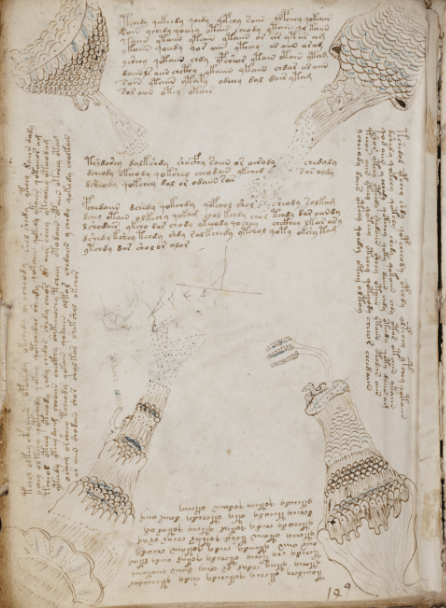
I’ve just bee(n) reading Gene Kritsky’s “The Quest for the Perfect Hive”, which, though it covers many different sides of apiculture, ultimately focuses on the evolution of hive technology. This, of course, brought me back to thinking about the Voynich Manuscript’s ‘Bee Secrets’ page that I discussed briefly in The Curse of the Voynich.

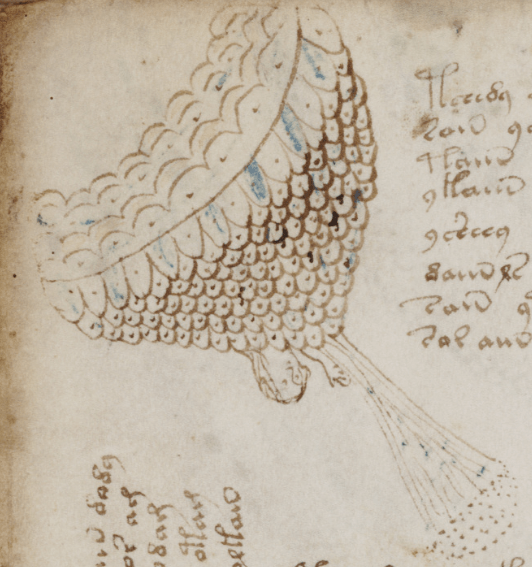
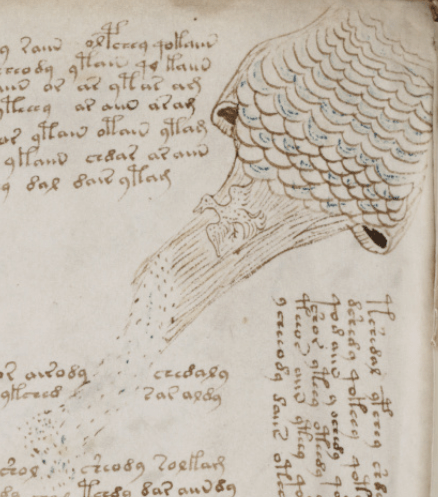
Back then, I’d wondered whether the page (one of the panels on the reverse side of the nine-rosette page) might have been an enciphered version of Filarete’s book of secrets relating to bees (along with water, machines, agriculture, etc). And so I had discussed the drawings on this page with the tippitty top bee expert Dr Eva Crane (who I’m sad to say died in 2007): she pointed out that the hives apparently depicted there were conical skeps. This is a type of hive thought to have originated in Germany and which beekeepers south of the Alps almost never used (they instead used horizontal log hives).

The Four Skeps

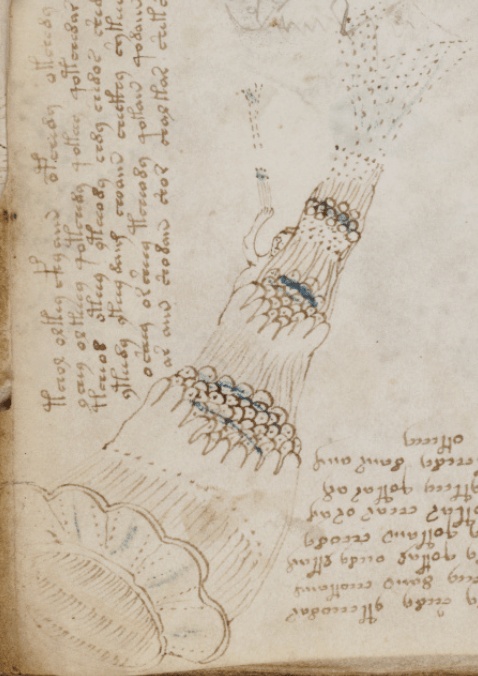
In the top left ‘skep’, the beekeeper might possibly be smoking the bees out of a hole in the top:

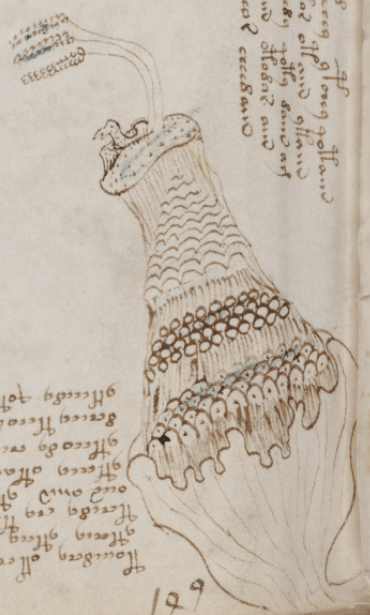
In the top right ‘skep’, we see a stylised bird (not sure what this represents) and bees going in or out of the bottom (this is one of those Voynich drawings where we seem to have an original layer and an obscuring layer on top, others like this are in Q13):

The bottom left skep is oddly stylised and apparently multi-stage, and it’s not clear what the beekeeper is doing (perhaps smoking the bees out?). The dots in the body, however, appear to be where the honey / honeycomb would be, so perhaps some kind of honey extraction mechanism is what is intended here:

Finally, the bottom right skep has the mysterious bird again, and again the inner (dotted) honeycomb seems to be exposed:

What Does It All Mean?

Oddly, Dr Crane’s observation hints that this single page might offer us a microcosm of the secret history of the Voynich Manuscript: a German bee-keeping technique, perhaps with a mechanical innovation added by the author, all concealed in plain sight, and being re-presented for an Italian audience. And this doesn’t necessarily have to have anything to do with Filarete (whose personal motto was the industrious bee) for it to be true.

What I learned from Gene Kritsky’s book (pp. 160 ff.) was that accounts of bee-keeping often included “bee calendars”, that told bee-keepers what to do in different months, zodiacal signs, or seasons. And I’m now wondering whether that accounts for the way the writing on this page appears in four directions, i.e. the four seasons of bee-keeping:

In terms of a block paradigm match, therefore, I currently believe the source material for this page will turn out to be an early (1380-1450) account of conical skeps written in Italian (or possibly Latin), derived from Northern European sources (probably German, possibly Swiss), and with four paragraphs corresponding to the four seasons of bee-keeping.

I first asked the question of whether there might be a mapping between the alchemical herbal manuscript tradition and the Voynich Manuscript in a 2019 post, having not long previously put up a post trying to link to scans of alchemical herbals. The fact that the Voynich Manuscript’s Herbal A pages originally (as far as we can tell) contained 97 plants and also that the (yes, very badly named) alchemical herbals list of plants has 98 plants is a coincidence I pointed out that is somewhat suspicious (but far from conclusive).

Always useful here is Philip Neal’s page on alchemical herbals. And more recently, Marco Ponzi published the Latin text of the alchemical herbals (compiled from various individual herbal manuscripts, because of various textual inconsistencies and lacunae). Minta Collins’ Medieval Herbals: The Illustrated Traditions is always good to have handy (though more to do with herbals than alchemical herbals).

And even though the book where this all really started was Vera Segre Rutz’s (2000) Il giardino magico degli alchimisti, I’d also now happily add Bryce Beasley’s 2024 thesisFantastic Herbals and Where to Find Them: Contextualizing and expanding the Alchemical Herbal tradition” to the list of resources I’d strongly recommend everyone interested read, particularly because it is downloadable online, and in English rather than Italian.

Beasley vs Segre Rutz

The first thing to note is that Beasley builds solidly on Segre Rutz: and while he is critical of various aspects of Segre Rutz’s foundational work (e.g. he argues that the suggested link to alchemy [e.g. via lunaria and herba folio] was inherently weak, whatever Aldrovandi thought; and he isn’t at all convinced by Segre Rutz’s use of hermeticism as a framework), his thesis is a complementary text rather than a replacement. Whereas Segre Rutz characterises the alchemical herbal tradition as having seven direct manuscripts and seventeen indirect manuscipts, Beasley extends this to 38 (though this is still far short of Toresella’s claimed 70). Note that (according to Beasley p.14, footnote 30) Segre Rutz seemed unaware of Toresella’s 1996 article on alchemical herbals.

Beasley, more generally, sees the alchemical herbal plants as falling into Jerry Stannard’s (1977) “magiferous” plants category, halfway between “magical” (fantastical) and “mundane” (real-world). For me, I suspect that Stannard’s three pigeonholes may be a little too neat, and that a lot of medieval manuscript copying was often done without any critical appreciation of the subject of the text (e.g. whether it made sense or had been miscopied), rather than a purely imaginary / fantastical plant.

Beasley’s list of 14 new manuscripts that would need to be added to the stemma codicum:

As an aside, Cipher Mysteries readers may possibly remember Ms. Chig. F.VII.158 from Alexandra Marracini’s work.

What next?

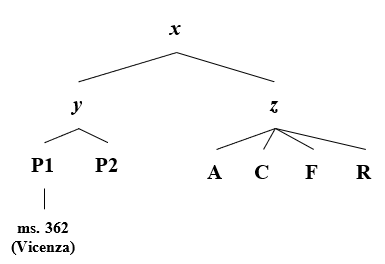
As is so often the case, even though Beasley’s thesis collects together a lot of useful information and makes it accessible, he doesn’t attempt to build up the tree of manuscripts and their (often hard to pin down) relationships. Hence, there as yet is no definitive (or even semi-definitive) ‘map’ of which herbal begat which other herbal etc: all we have is Segre Rutz’s tree for the seven direct tradition manuscripts (Beasley, p.40):

Here (as per Segre Rutz, p. XC):

  • P1 = MS Lat: 17848
  • P2 = MS Lat: 17844
  • A = MS Aldini 211
  • C = MS Canon. Misc. 408
  • F = MS 18
  • R = MS 106
  • ms. 362 = Vicenza MS 362
  • x, y, z = (missing manuscripts)

Beasley does point (p.66) to evidence that MS LJS 46 is “likely a descendant of” MS 106. Similarly, he does suggest that München, Bayerische Staatsbibliothek Ms. Cod. It. 149 may be “similar to Ms. Pal. Lat. 1078 and other manuscripts from the indirect sub-tradition” (p.60).

There are also lots of other nice details: for example, on Lucca MS 196 fol. 106r, a “left flower has a small note of a “bi” which likely is a note telling the painter to leave the flowers white or bianca in Italian”. (p.58)

What specifically set me thinking today was Beasley’s note on the Natural History Museum herbal (Mss. Her.) on p.56 that discusses the order of the alchemical plants, which I knew about but hadn’t really thought about for a few years:

The beginning 16 herbs perfectly copy the order of manuscripts Ms. 18, Ms. 106, Ms. Lat. 17848 and Ms. Aldini 211 and with a couple of exceptions Ms. Canon. Misc. 408, Ms. 17844 and Ms. 362.

And so my thought for the day is this: has anyone tried to form candidate mappings between pairs of Voynich Manuscript herbals pages (i.e. on the two sides of a folio) with pairs of adjacent numbered images in the alchemical herbal tradition? That is, it has always been easy to speculate about a single-page connection between (say) the snakes / worms in the roots of the plants on Voynich Manuscript f49r and alchemical herbal plant 74 (herba forus, which also has snakes / worms in some manuscripts): but it’s hard to go beyond mere speculation with any confidence. So my point is that in this example we should perhaps also be thinking about f49v (on the rear side of the same folio as f49r) and alchemical herbal plant 75 (the next one along) to see if there’s a connection there too.

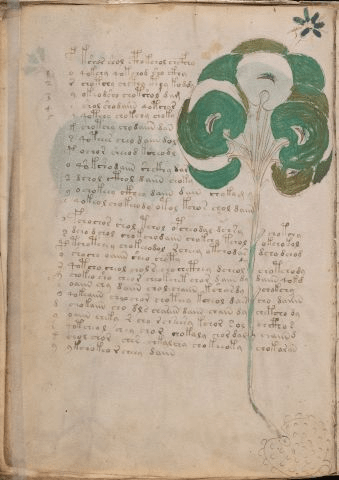
So, let’s have a quick look. Voynich Manuscript f49v looks like this:

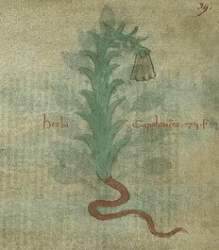
Alchemical herbal plant 75 is herba capalarices, which (in the manuscript used by Marco Ponzi) looks like this:

In this case there’s no obvious match, sure: but it would only take a single unexpected pair of images to be matched for us to smash through this wall. Well worth a further look? Yes, definitely. Definitely!

For a change, I thought it might be interesting to take a fresh look at the -n words solely in f1r. If you recall Lisa Fagin Davis’ (2020) paper, she describes (p.173) how her five putative Voynich scribes write the -n glyph in different ways:

  • Scribe 1:The word- end [m] and [n] glyphs conclude with a backward flourish that stretches as far as the penultimate minim.
  • Scribe 2:The final backstroke of [m] and [n] is short, barely passing the final minim.
  • Scribe 3:The final stroke of [m] and [n] curves back on itself, nearly touching the top of the final minim.
  • Scribe 4:The final stroke of [m] and [n] is tall, with only a slight curvature.
  • Scribe 5:The [m] has a long, low finial that finishes above the penultimate minim.

f1r is right at the start of Quire 1 (Q1), and is a Scribe 1 Herbal-A page (“Quires 1–3 are written entirely by Scribe 1”, p.175). So let’s have a look for ourselves:

f1r Paragraph #1

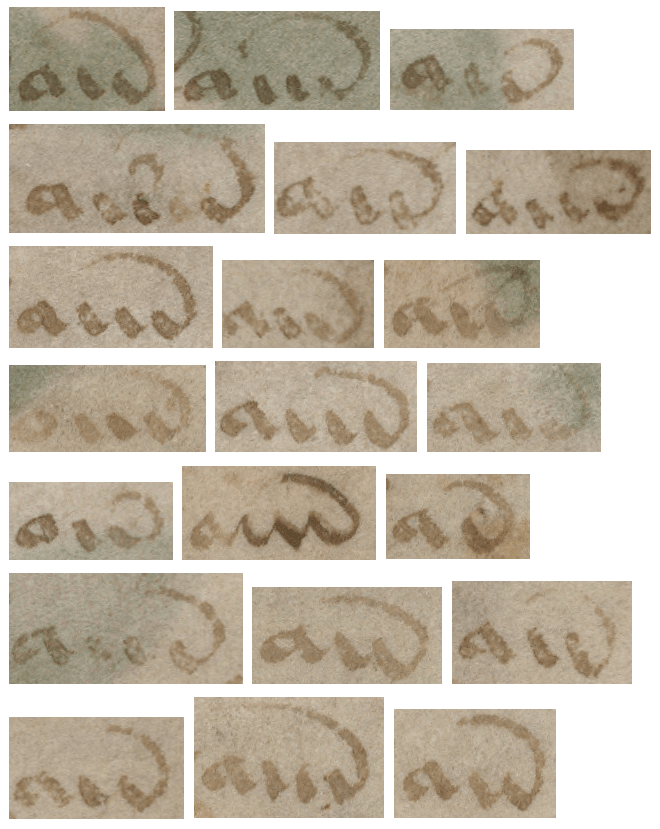
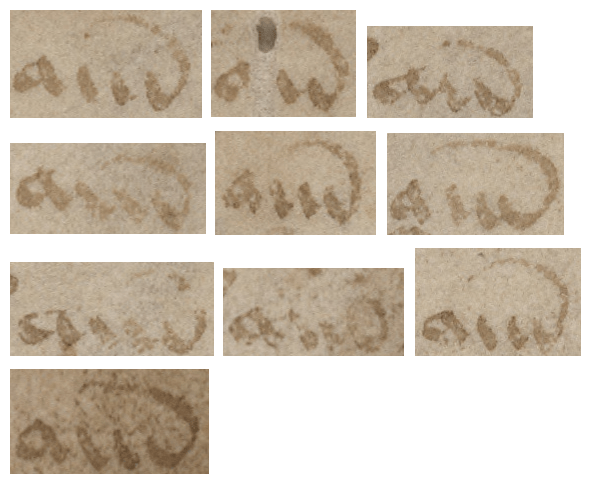
Personally, I’m not seeing a huge amount of scribal consistency here: some of these -n glyphs do indeed stretch as far as the “penultimate minim”, but others reach much further back or not as far back at all.

f1r Paragraph #2

Same for this (short) paragraph.

f1r Paragraph #3

Same for this (much longer) paragraph. Note that the 14th instance seems to have been emended by a later owner. Also, the 4th instance appears to be “airin” (a Voynich ‘word’ that voynichese.com says appears only four times), but where the loop of the terminal -n goes back as far as the first [i] glyph.

f1r Paragraph #4

Same for this paragraph, though (to be fair) the scribal -n flourishes are perhaps the most consistent here. Note that the 2nd instance has a wormhole running vertically through it, which (as Rene Zandbergen likes to point out) probably implies that this page spent a good amount of time close to a wooden book cover (because woodworms like eating wood, and don’t like eating vellum), now long gone.

Your thoughts, Nick?

On the one hand, I’m not at all against the idea of Lisa Fagin Davis’ proposed Five Scribes (even if it does sound to me not unlike the name of a medieval burger restaurant).

But on the other hand, when I look at the actual -n instances that appear on the very first page of the manuscript all side by side, I’m not getting a hugely consistent scribal vibe off that ensemble.

At the same time as all this, it’s hard for me to look at a block of words such as “dain oiin chol odaiin chodainwith four different scribal -n flourishes and not think that something pretty fishy is going on. My code-breaking third eye keeps telling me that something is being hidden in plain sight (perhaps four plaintext digits, so maybe a date?), but the precise details evade me (and everyone else). Oh well.