
For over a year, I’ve been collecting links to modern versions of the Mona Lisa made of weird materials – leaves, make-up, chocolate, meat, Lego, coffee, toast, pasta, buttons, jelly beans, mushrooms, Rubik’s cubes, dominoes, ketchup… all sorts of odd stuff.
As such lists go, it’s not even remotely complete (in fact, there were about twenty ASCII Art versions, so I just chose the one that impressed me most). But the fact that I’ve collected over forty different types of Mona Lisa would surely have Leonardo da Vinci squirming in his wormy Renaissance repos. If that were possible. Which it’s not. (Hopefully.)
Just so you know, my favourite (so far) is #23 Buttona Lisa (below), a 3d version covered in buttons, on permanent display at the Hankyu Shopping Centre in Kobe, Japan. Please let me know if you find anything better!
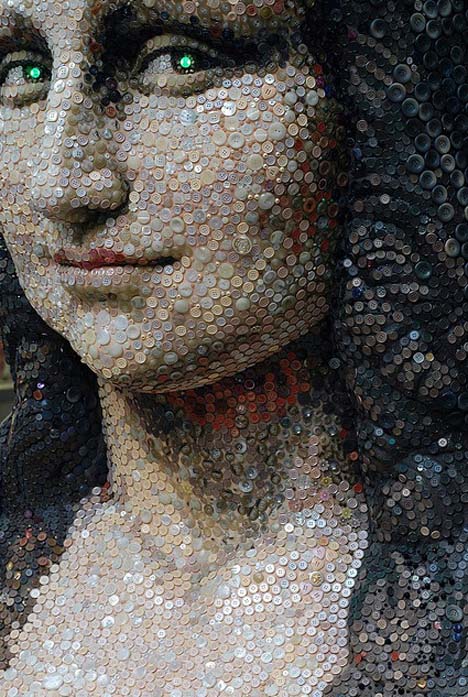
What, is that a sly wink I’m blinking at, instead of your usual smiley? Talk about enigmatic smiles!
Just recently, my husband and I rented a NetFlix of Sherlock Holmes series. Professor Moriarty and the mixed up missing Mona Lisa and a copy. Fun!
I still think that is one of the most insipid portraits ever painted! Just recently, San Francisco’s De Young Museum was featuring “Girl With a Pearl Earring” — fabulously beautiful.
So, that is all the discussion I have to offer. Bye!
bdid1dr: there was a make-up version of “Girl With a Pearl Earring” too – here’s a link to a reasonably large scan of it. I think you’ll like it! 🙂
非常に敏感ではないですか?
Very sensitive indeed.
nick,
I’ve just written a pretty savage review of the updated wiki article. It only now occurs to me that you may be one of the wiki writers. If so, please consider yourself exempt from the major charge. You are far too well trained as an historian to neglect your footnotes.
Diane: a while back I did go through a phase of trying to tighten it up and straighten it out, but just about all my changes have since been removed (or edited into mush) by a long succession of well-meaning editors. In fact, my description of the Voynich Manuscript as a cryptological ’cause célèbre’ was removed by a bot only a few days ago… that may have been the last one, it’s hard to tell.
In general, the last thing I wrote about it was suggesting that every trace of speculation be stripped out and moved to entirely separate pages. But that was far too radical for just about everybody. Certainly, if the current superbloated page were to be deleted, few would miss it. But you knew that already. 😉
Nick
It hardly matters, i think.
I’ve just been to the Japanese Voynich site. Over 6 million visitors
(checks)
yes – six million.
With the Germans, English, Americans and Japanese at work, I hardly think the contributions of one Australian (total readers a couple of thousand) is going to do much to move things forward.
*sigh*
and if I can’t support my fantasy of being one of the field’s Florence Nightingales how can I expect anyone else to?
– have you quit Vms studies too?
I’m very much alive and kicking in Voynich research, though almost certainly not in the way you think! Personally, I’m aiming for 10 million visitors, aren’t you? 🙂
I admit, the culture in Vms studies, at least on the mailing list is actively opposed to researchers acknowledging their sources, or any precedents except – maybe – voynich.nu or some work in print such as d’Imperio’s study.
I can’t understand it. It goes against the most basic principles of academic training. But there you go.
No – I’m thinking of a quiet departure, actually.
I asked on the list if anyone had done work on the possible meaning of the nymphs gestures – as prelim to getting into that myself.
Whooh – not only an absence of information about work done, but an implication that I shouldn’t ask.
Perhaps that’s so.
As far as nymph gestures go, there is quite a literature on the (alleged) symbolism of statue poses. It was certainly mentioned on the Voynich mailing list a few times, back in the days when there was more signal than noise…
I’ll see if I can’t find it using the Wayback machine. Unless there’s an easier way to search it?
A huge amount has been published on other systems: monastic gestures and imagery in Renaissance painting, for example. I’ll acknowledge any list-references I find because directly related to Voynich studies, but I rather think I’ll have to begin from scratch in this case, as with the others.
Not because earlier research wasn’t well done, but because it assumed parameters in medieval and later western Christendom, an assumption not supported – for the imagery – by the content of the work, either in its sections or as a whole.
SantaColoma reported on the mailing list that he has investigated all sorts of imagery, including European folk-dance gestures; those relating to agriculture and so forth. If he gets around to telling me where he published his research and observations, it should make interesting reading.
I think monastic handbooks could be enlightening but otherwise an earlier time and non-European locus would be more likely – especially given the context in which the bathy-section figures appear.
Oh – and James Curry also considered the idea of gestures as meaningful – related them to music, I gather. V. interesting indeed – if I can get the pdf to work! 😀
Should be fun, no?
Diane: I half-remember statue gestures being discussed on the old (pre-Voynich Monkeys) phase of the list. I’ll have a look for that in the archives this evening…
I have just found, that you are interested in the Mona Lisa in weird materials, but I would like to tell you something about the real Mona Lisa, which has not been published before and which may reveal the real identity of the lady. The matter is, that this lady posed with a small dog in her arms, while Leonardo da Vinci was drawing and painting her. This small dog reveals the real identity of Mona Lisa, not La Gioconda (that portrait was never finished), but Isabella d’Este (1474-1539). In the same year ca. 1500 she was portrayed by Lorenzo Costa (1460-1535) with dog, and by Gian Christoforo Romano (1456-1512). Just cfr. the Lady with hermelin by Da Vinci as well. By the way, Isabella d’Este was a coaevum of Gerolamo Cardano (1501-1576) who has written the Codex Voynich (see my earlier message). Leonardo da Vinci, painter of the Mona Lisa, was a friend of Lazio Cardano (lawyer and mathematician) at the University of Pavia, father of Gerolamo Cardano.