
Unless you’ve been in something dangerously close to cryogenic suspension for the last year, you’ll know that these have been troubled times in Egypt – but you may not have heard that these have also been troubled times for Egyptology. Adding to 2011’s regime-changing brouhaha, Zahi Hawass, the Egyptian government’s 64-year-old ministry-level head of Ancient Egyptian stuff (and owner of a hat that practically has its own Discovery channel), has been fired/resigned then reinstated then fired/resigned again.
It’s a tricky one to balance: though tourists love him, I think it’s fair to say that Egyptologists basically don’t – it has often been alleged that to work for him has been to sign any chance of historical research glory over to him (oh, and to his TV channel partners too). Is he charismatic, thoughtful and generous, or egotistical, controlling and bullying? Or perhaps some combination of the above? If you track this area, you probably have your own opinion… I certainly have mine.
From an alt.history perspective, one of Ancient Egypt’s splendidly enduring unexplained mysteries is the internal structure of the Great Pyramid – in particular, the function of the four narrow shafts leading upwards from two chambers. The upper (“King’s”) Chamber has two shafts leading off right to the exterior of the pyramid: but the lower (“Queen’s”) Chamber’s two concealed shafts (only discovered in 1872 through a mixture of intuition and persistance) do not apparently reach the outside of the pyramid. So… where do they go to?
Countless theories have been devised to try to explain these curious shafts, frankly none of which I believe for a moment. Yet the shafts’ first proper unveiling moment came in 1993, when German engineer Rudolf Gantenbrink’s “Upuaut-2” robot at last crawled right to the top of the lower southern shaft, where its newly-installed video equipment discovered… “a finely-worked slab of special limestone, of a kind otherwise used only for the pyramid’s exterior sheathing and its interior chambers. And that slab is adorned with two copper fittings.”
Of course, the question on everyone’s lips suddenly became “what’s behind that slab?” However, because Hawass (so the story goes) took some kind of dislike to Gantenbrink, these efforts of 1992-1993 were only followed up by a second (different) team’s robot crawler in 2002, which again crawled right up to the top, drilled through to the other side, poked a tiny camera through, discovering… another block just beyond the first one, with a cavity between the two.
Then in 2011, yet another robot from yet another team crawled its way to the top and peered through the previously drilled-out hole with a bendy camera, to try to get a proper look at the cavity: this revealed (arguably) a cipher mystery aspect to all this. For on the floor in the cavity there is a set of unidentified red markings. What do they mean? What could they mean?
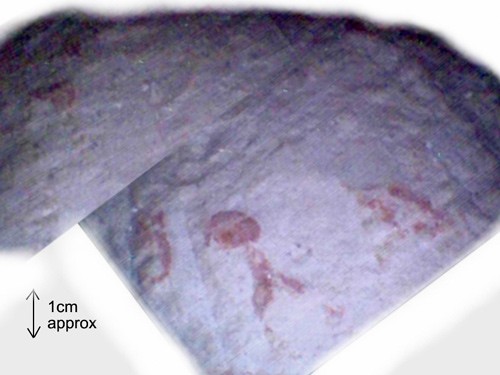
Of course, I have really no idea – it has been noted that other red measuring marks (presumably put down by Egyptian masons) have been seen elsewhere, so this could very plausibly be what we’re looking at here. But that’s basically as much as we can sensibly say for the moment.
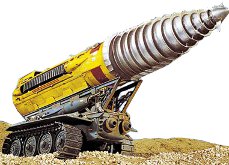
Perhaps 2012 will see yet another team with yet another robot crawler, perhaps this time with a super-duper-mega-drill. Could it be that Rudolf Gantenbrink will finally be drawn back to the Great Pyramid, with his Upuaut robot now expanded with something like a miniaturized Thunderbirds “Pod 5” Mole? We shall see! 🙂
Total waste of time and money when FARK has a sonic screwdriver on sale at the mo’.
Diane: 🙂
I suspect y’all may be somewhat younger than me; so I’ll try to be brief. Pre-Hawass info on the alignment of the Great pyramid complex: The stars that make the “belt” of Orion. Several years ago there was a great website that discussed this.
The one figure in this latest camera excavation resembles the hieroglyphic portraits of very young children who have had their hair shaved except for a “ponytail” at the crown.
I’m not sure if the camera excavators/explorers have followed up on earlier findings. Hawass and Egyptian politics/military–I
won’t go there!
Bobbi: I’m well aware of pyramid orientation theories and Orion etc, thanks. Hopefully my opinion (that they’re no more than wishful thinking) isn’t yet heretical! 😉
There’s no reason the pyramids wouldn’t be aligned to Orion, or any other of the stars known to the Egyptians. Tombs are filled with recognisable astronomical figures; we know that sideral surveying was a common method. The Pyramid texts refer to Orion, and depict it. And it was a national emblem, used since the time of unification – so why not? Most of the expectation it can’t be so is due to residual western superstition about pre-classical astronomy, combined with a surreptitious sense that we ourselves represent the pinnacle of human advancement. It’s a curious character in older western scholarship. But perfectly mainstream works now accept the fact of some pyramids’ alignment to Orion (and a couple of other stars).
Diane: yes, the Egyptians knew about Orion. But the whole Bauval-Hancock Orion-pyramid claims were dismantled years ago by Ed Krupp and others. The angle B-H claimed is wrong (precession changes the angle over the centuries, so what we see now is not what Egyptians saw then), the mid-row bulge is the wrong way round, and if the Nile is the Milky Way then the pyramids are on the wrong side of it, etc etc. If – in my opinion – they had got the basic astronomy right, I’d treat their claims very differently: but you can’t build a brick house out of straws.
But we also know that the Egyptians saw the heavens as a kind of bowl, and reversal of celestial and terrestrial direction (as a result) was an established convention. it survives in Manilius, and according to al Biruni was commonplace among the ‘ordinary people’ as late as his own time. So I’m not convinced by the reversal argument at all. As for the effects of proper motion – well that has more going for it, but we know too that as time went on, people adjusted to the changing forms. So, for example with the figure of Ursa Major, which progresses from the shape of a bird’s beak to that of the old ‘birds-beak’ plough/hoe, to the wider adze, and finally to the shape of a thigh.
I expect, though, that I should re-read some of those references. It’s been a while since I needed any of this. Still and all, the article by Faulkiner has held its value over the years. The earliest religion of Egypt was a stellar religion, and worship of the sun came relatively late.
I’m afraid I don’t know of Bauvel or Hancock, but I expect I’ll find them too in JSTOR?
Zahi Hawass
He may have been a political appointment by whatever regime. Howsomever, I can’t remember any previous Egyptian government representative who has done more pro-active “dickering” with other governments to return Egyptian relics to their origins. Yes, there are a whole bunch of tomb-robbers “out there” who will be robbing the current administration blind, now that Hawass has been “let out to pasture” so to speak. Have you visited the V & A lately?
bdid1dr: while I applaud Zahi Hawass’ desire and ability to get plainly purloined relics back to Egypt, there’s a lot more to Egyptology than just that – there has long been a debate about whether Hawass has on balance been a good thing or a bad thing for Egyptology, and I thought I’d highlight some of that debate in the post.
Another advancement in Egyptology initiated by Professor Hawass were the DNA studies and CAT scans that he had done on several of the mummies whose remains had been shuffled around and, in some cases, “lost”.
While all of his efforts may have cost the Egyptian government considerable money, his efforts to close down much of the thievery and damage ( that is still ongoing) may be appreciated by generations of Egyptians to come.
I surely hope so!
Nick,
Dare I even mention the words “C-pp-r Scr-ll”? Believe me, too many people whip “right by” Dr. Feather’s attempts to clarify the huge difference in the Egyptian measures of precious metals (gold and silver) than was translated by archaeolists. He also points out that the scr-ll itself was probably more precious (money-wise) than the artifacts it described. Fascinating!
archaeologists! (Just to show, I can spell!
One parenthesis, two parentheses, three….
I shall start using brackets instead!
%^ bdid1dr
NOT a single hieroglyph in the entire remarkable structure of the Giza pyramid.
So…..NOT a tomb.
What then ? Like everyone else I don’t know, but perhaps what is under the pyramid (there are known tunnels) is more important than what is inside it (above ground).
Re:Hawass. His intentions are good, but then we all know what the road to hell is paved with. The net effect is that his obstruction of research and hig gigantic EGO, despite his love of the field, has resulted in a paralysis of real research with just some exceptions noted above.
Re: Orion. There was an old DOS program called “Dance of the Planets” written by a graduate Astronomy student (now a Professor of Astronomy somewhere) which allowed the user to move forward or backward in time to see how the sky would appear. Don’t know if this would be useful or accurate – it should be.
But, one wonders, is that the only software of its kind that does this ?
Does anyone know of something written for modern computers that does it ?
Final observation: Re Voynich: Interestingly several Voynich like symbols appear in Egyptian Demotic writing including the “9” symbol, and if I recall, one or two others. Likely coincidence, of course.