
In the pub after the Kingston Round Table of Inventors meeting this evening, a nice guy from Kingston Uni told me that he had recently had two “dry migraine” attacks, and that he was waiting for the results of the follow-up CT scan. This reminded me that I had a German Voynich explanation (i.e. not quite a theory, or perhaps a meta-theory) to post about here…
In Gerry Kennedy & Rob Churchill’s book, they float the hypothesis that the Voynich Manuscript might possibly have been written by someone suffering a prolonged (months- or years-long) migraine attack; and point to the streams of stars and the repetitive series of nymphs as vaguely supporting (if far from smoking-gun causal) evidence. However, nobody (to my knowledge) really took the notion particularly seriously until German blogger Markus Dahlem decided to carry their conceptual baton a little further in the general direction of… Hildegard of Bingen.
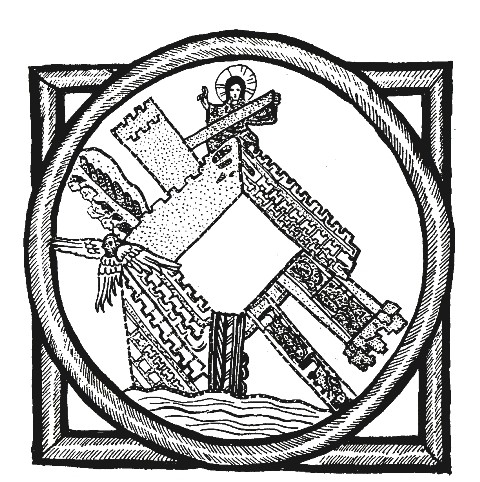
Might the castle in the nine-rosette page actually be a representation of the Aedificium, the piously hallucinatory City of God drawn by Hildegard in her Zelus Dei or her Sedens Lucidus? Are the Voynich’s stars simply “showers of phosphenes” cascading wildly through Hildegard’s retinal circuits?
I saw a great star most splendid and beautiful, and with it an exceeding multitude of falling stars which with the star followed southwards … And suddenly they were all annihilated, being turned into black coals… and cast into the abyss so that I could see them no more.
To me, the fact that Hildegard is discussed by both Charles Singer and Oliver Sacks is no more than an expression of her outlierness: she not only had the repeated experience of migraine auras, but also had the literary imagination to stitch that into her religious worldview. Basically, I’m pretty sure that there is almost no real chance that the author of the Voynich Manuscript was a migraine sufferer.
And besides, Hildegard drew square merlons in her City of God, not swallow-tail merlons. D’oh! 🙂
A male poet and artist, now: I wonder whether people would be looking for similarly impersonal explanations for what he produced? It seems to be that for all it’s being a little dated, Dorothy Sayers’ “Are women human” should be required reading for *some* people.
(hope the nice chap is ok, too)
Diane: it’s the “are poets poetic?” question that has me more vexed. 🙂
depends on their sense and balance.
Hi Nick! I’m a headache (though not migraine) sufferer, and I read Churchill and Kennedy’s speculation with interest. There’s some but not a lot of fortification imagery in the VMs. There are rather more phosphenes. It’s possible but hardly proven that the VMs author was a migraine sufferer.
Dennis: I suspect the ‘Voynich=Migraine’ hypothesis needs a lot more fortification! 😉
Having been long contemplating this manuscript I am compelled to comment on a number of things. As an artist and librarian two issues seem paramount. One – surely the ‘colouring in’ is much later than the original drawing and curiously done with some sort of ‘crayon’ as opposed to brushwork? Two, why has no one that I know of made much of the extreme costliness of the materials used. It seems unlikely that anyone outside a scriptorum of some sort would have the skills or means to produce this book. So has anyone ever wondered if this manuscript artist was perhaps an accomplished cleric with a position of power who became mentally afflicted but still was able to access the materials needed to produce the artifact. Was he/she left to do this as an early ‘therapy’? I suppose those who call up the idea of migraine are on a similar tack with Hildergard.. I suspect the only person for whom the ‘script’ will ever have any meaning is the author. And even if a translation ever occurs it will be wild gibberish. Far more important to me are the illustrations which occasionally seem to align with Inca/Aztec iconography. In particular the curious ‘vases’. Then there are the calendar wheels and star charts. I am often reminded of the early attempts at drawings of American Indians. Might this even be an attempt to reproduce some other book by someone unable to read or understand the document in question? Thereby producing something tantalsingly credible but entirely ‘out of context’? A monk in some reote monastry trying to reproduce a ‘Mayan’ manuscript.
Of course it could just be a very pleasing bit of outsider art . There’s plenty of stuff like it in the collections of places like the old Bethlehem Hospital in London…
Mary: have you read about Jorge Stolfi’s “heavy painter” theory? He concluded that the Voynich had originally been extraordinarily plain, but that a later owner (or owners) had overpainted it, somewhat inelegantly in many places. Nothing I’ve yet read seems to contradict this, so I think you’re on the right track there. 🙂
The cost of the materials is indeed hard to account for: yet the problem with all “mad writing” theories is the peculiarly fractal level of patterning in its text – that ‘Voynichese’ is replete with unusual (yet oddly consistent) patterns wherever you look, whether at word/line/paragraph/page beginnings/middle/ends. That, to me, speaks loudly of something deeply systematic – hyperrational rather than irrational.
May I ask what sources of Voynich-related information you have relied upon? I’m always interested to know what people do once they arrive at the Voynich ‘sphere’. Thanks!
How long have you got? 🙂 I have been reading around the subject (and related Fortean stuff since about 1962 ish!) I bought ‘Man Myth and Magic’ off the shelves of Smiths! I harbour about twenty years worth of Fortean Times in my house plus loads of other loopy off the wall stuff in many, many bookcases. However I am not some ageing hippy crank who takes flower remedies and channels past lives but more an intrigued sideliner… So therefore I have read – I would imganie – most published stuff on the Voynich and probably forgotten more than I remember. However I do keep returning to it as it seems to have some sort of charm. One day I can see Tarot cards in it, the next it’s Cranach nudes, Then I wonder if it was some mad faker (like the protagonist in the latest Umberto Eco) sitting smirking to themselves with their authentic materials in an attic in Prague in 1919….
The text doesn’t interest me that much as I haven’t the linguistic ability or the right sort of mathematical brain for codebreaking. Though I had noticed years ago that the zodiac signs seem to be roughly overwritten in French. What intrigues me is the art and having thought about it carefully I think a child coloured it in. I also think it’s quite resonate of Bruegel and Bosch but have never found any other thing with the strange ‘tubes’ anywhere. Has anyone else? Must stop…
Actually to answer your question my sources have been any books I could extract from B’ham Libraries and inter library loans plus online info plus articles in Fortean Times etc Plus any novels that appear inspired by things strange especially curious books, ie Dr Dee, anything by Unberto Eco, tarot stuff, Outsider Art, Alchemy…
PS. I don’t have any tattoos or a dodgy hairstyle or multiple piercings or a macrobiotic diet.
Mary: for me, the strongest candidate for the zodiac overwriting hand’s language is Occitan, and not too far from Toulon; I wouldn’t be surprised if a (mostly careful) child overpainted it; and no, nobody has yet found anything with remotely similar odd tubing. Right now, I’d say the basic Voynich bibliography is Mary D’Imperio’s “Elegant Enigma” (now available online courtesy of the NSA), Kennedy & Churchill’s “The Voynich Manuscript”, and my own “The Curse of the Voynich” (but I would say that, wouldn’t I?) 🙂
I could believe that the physical manuscript was originally drab and later dolled up with bright expensive colours to make it more saleable in the years between its creation circa 1420 and its emergence in Prague two hundred years later. Its survival needs accounting for, and this would be an explanation.
On a separate point, I have said before and I say again that the names of the months may be Occitan but they might equally be German dialect – the forms can be found in dictionaries.
I must re-read the McCrone document. I thought it said there was no reason to believe the paint wasn’t near-contemporary with inks, and they with parchment.
However, attitudes to things like whether paint and line may overrun a border are as much a product of culture and training as anything else. Compare with the habit of fabric painters and printers, even today.
I’d like some evidence before supposing that colouring-in old manuscripts was a recognised form of therapy for mad old monks and/or children.
I did read recently, though, that an old manuscript had odd loose flecks of gold in it, the author of the article suggesting that old manuscripts were used to keep the gold-leaf handy, but clean, in scriptoria.
Diane: the report said that there was nothing about the inks and paints it examined that was inconsistent for the era… but that’s a long way from a causal smoking gun. As far as the child labour / heavy painter thing goes, we have two data points – firstly, that the original alpha state of the manuscript was (almost certainly, I say) very plain; and secondly, that (to use Philip Neal’s phrase) the same manuscript in a “dolled up” state was sold circa 1600-1610 in Prague. Though my friend GC disagrees, I’ve always argued that most of the paint seems to have beeen added late on in that whole sequence, following several rebindings – I don’t believe it would have been painted in that manner once it had reached the Imperial Court. So ohere seems a fair likelihood that it was painted to make it appear valuable, to ready it for sale: yet it was not painted with any great finesse. Though all these fragments don’t when taken together quite form a paradox, I’m happy to admit that it’s not particularly clear what was going on here!
Philip: if that’s correct, I’m happy to agree with German dialect as an equal probability – I’ve always said that the presence of “augst” would surely seem to add weight to some kind of German influence. Is there any geographical leaning towards the German dialects where these word forms occur? Might they be Occitan loanwords (loanforms?) absorbed at the southern edge of the German-speaking area, say Switzerland or Austria?
Having spent some time looking at medieval herbals (there are plenty online to see) Voynich isn’t that out of the ordinary as far as – to our eyes – unrealistic depeictions of plants is concerned. The layout is typical of herbals produced after the twelfth century, where the text surrounds and explains the illustration. In fact the only way plants can be identified is generally from the text. So far, so ordinary – except for the cypher like text. The colouring certainly isn’t the usual type. The exceedingly random nature of colour application does not resemble any other works. It also spoils the aesthetic quality of the text as far too crude in execution and random in nature.
The greatest puzzle of all is/are surely the tiny ‘Queens in tubes’ that are quite enchanting and strange. Whatever are they doing/representing? They are almost like small earthy fairies and one wonders if they are supposed to reoresent some sort of plant fairy essence passing through the roots and stems of the herbal illustrations.
As to the manuscript itself. Has anyone done any work as to how long bits of it were seperate for and when the present binding was done? Are the pieces of vellum from many animals or just a couple or so? If these were tested in some way it might create more problems than it solves…
As to the people who try and tie it to Leonardo they should be sent to look in detail at his notebooks and given a good talking to about style and drawing methods!
I’d like the manuscript without its colour; it’s not drab, just uncoloured. We have quite a number of superb manuscripts like that.
But until there’s evidence for later application, I have to, reluctantly, suppose copying and painting happened pretty much at once.
About the gold. Does anyone recall who noticed and wrote on the gold flecks/lines in the manuscript? It was brought up again last year I think.
* sorry Nick* I agree that your research into the codicology makes it likely. I meant evidence from chemical analysis. If there’d been a pigment only used after 1500, or something of that sort.
Diane: I certainly mentioned the gold flecks on the VMs mailing list back in 2006, but I don’t remember blogging about them. Hmmm…
As far as the colors/paints/inks are concerned, I’d like to comment on one particular “botanical”:
It has been referred to as a “sunflower-like” plant: it has “shaggy” leaves, and what appears to be a circle of tiny blue petals around its dotted center.
I immediately thought “opium poppy”. My thinking at the time was “why are the petals so tiny?”
If the artist/painter/colorist/writer was trying explain that the most important part of the plant was neither leaves or petals (or roots, for that matter) what was the purpose of the illustration? My guess (based on a conversation I had with an Irani friend 40 years ago) was it must be “sap” that would ooze from cuts made into the underside of the flower pod or the stem.
I was then able to do a very spotty translation of the Voynichese to get at least a “sense” of the captioning: “…could make one as drowsy as if falling asleep over their catechism”. (?) I mentioned this several weeks ago.
Might not there be other clues buried in the “color inferences”: Poppies usually have very large petals. The petals can be red, white, yellow, orange, blue….. So, if a person is an amateur “botanist” on the hunt for “medicinal” plants some clues may have to be more subtle than others. Take a good look at the other botanicals, you can probably determine each plant’s importance by which part of the plant has been emphasized. (?)
Adding to my earlier comment:
I understand that Rudolph II (of Bohemia?) was quite “eccentric” and was fascinated by “Oddities”. Could it be that he purchased the VMs when it was still in “black and white” and later one of his “pets” colored in the drawings? I’m going to do some more reading about Rudolph and his court.
Fascinating! (I’m an “oddity” of sorts; so I can understand Rudolph’s whimsical lifestyle).
On the perception of languages as individual sets – or not – I came across this interesting reference. Quoted on the open blog at
http://www.voynichimagery.blogspot.com/2011/12/on-language-and-script-in-medieval-west.html
Ladies holding strange “tube-like” objects:
Hookahs? Pre or post-partum?
Hookah: water pipes for “cooling” the smoke before inhaling
I wouldn’t be surprised if the ladies may have been “prepping” for childbirth, hence the “pea soup” green baths, inhalation therapy/pain relief (opium), and “kinder” memories of the entire childbirth process.
btw, Diane:
I’ve tried to link to your webpage (blogspot) but have not been able to log-in to the link you provide. Could explain why you apparently have not gotten any comments (?)
I just relocated an excellent reference for the historical uses of papaver somniferum. Here is an excerpt:
Although it is often believed to be the first cultivated in Asia, the opium poppy’s home actually lies in northern Italy, southern Germany and Switzerland, dating back at least 4,000 years as evidenced by fossil remains of poppy pods found in Neolithic Swiss lake dwellings.
This website continues with another two pages of historical locations and uses.
Here’s another excerpt: Women in Oriental harems used opium in a drawn-out ritualistic fashion. They would spend their evenings ingesting opium pills and inhaling hookahs filled with opium smoking mixtures. They preferred eating opium because the effects lasted longer and their dreams would linger until the sunrise. They would partake so much opium that it would produce amnesia; night after night they followed this ritual of induced chronic insomnia followed by amnesia. Soon they would forget their faraway homes and families, and their lives before the harem. …..
I have been following this trail because of another puzzle of the Voynich “alphabet”:
No “K” sound letter, except maybe a double “c”. So, here is an Italian word that might demonstrate a substitution: Gnocci
Gnocci is pronounced “nyoki”. Note that some of the Voynich “translations don’t have a representation for the letter “K” I suspect that one of the other Voynich letter combinations also serve to act for the dipthong nasal sound at the beginning of the word gnocci….
So, have I gone completely “around the bend”?
The website is: http://www.entheology.org/edoto/anmviewer.asp?a=259
One last observation: some of the Voynich characters/word formations seem to use only consonantal letter groups with the idea in mind that readers would, maybe, automatically “read” the vowels in context with what is being discussed. (?)
Nick, has anyone, before me, posed the question or made this observation:
Lots of frolicking nude women — why no such views of men? My take is that the manuscript may have been created by a eunuch/guard/physician….Ottoman empire?
I also wonder if the harems/seraglios had walled gardens — which could be observed from above, and only entered through the emperor’s chambers.
So far, I’m somewhat disappointed by D’Imperio’s ms; it doesn’t seem to be forthcoming with anything “new”. (?)
D’Imperio also repeats/interprets one of the cipher letter groups “the same old” way:
The “c” which has a longer upper bar has seemingly been interpreted by “everyone” to be sibilant. I can go along with that. But, when it comes to the same letter that appears to have had another “c” dangling from the longer bar — I don’t agree.
That character, to me, could be interpreted as the sibilant “see”.
This has probably been discussed ad infinitum ad nauseum. So, I understand why you’ve gone down another “trail” with your latest Voynich entry. Ciao!
Streptococci — now there’s a word for you!
Bobbi
Thanks – I just assumed it was too boring. Or else a referral spam had bitten the sites.
But Nick did manage to get through; don’t know what his secret is.
NICK – This is for you. Talk about headache material..
http://mysteriesexplored.wordpress.com/2011/08/24/amazing-encryption-technology-in-ancient-india-the-katapayadi-shankya/
There are men in the Voynich! Granted not that many but there if you look. One of them is obviously pleased to see the lady he’s near too…
Regarding the Zodiac wheels has anyone thought that each lady may represent a day in the relevant month and it is a sort of Almanac guide to what to do when/ lucky and unlucky days etc?
Also is there a section which has been cut out (page or pages midway through the book) or am I imagining too much from all my years in libraries repairing books?
Mary: yes, the fact that there are 30 nymphs per sign has led many to speculate that the diagrams may encode some kind of per-degree astrology, as per Pietro d’Abano etc. I haven’t posted on this for a while, but you might like to have a look at: http://ciphermysteries.com/2009/05/12/per-degree-astrology-old-and-new
Nick, I just linked and left a comment there. It is up to you if you want to re-locate my comment to this page. (My “refrain”, I fear, will not come as a surprise to you.)
Cheers!
A little more about migraines, female cycles, conception (or not), tracking the monthly cycles for, maybe, a large “household” of females. Herbal remedies, hot soaks, mild physical activities (odalisques). Then there was the “legendary” female storyteller of “A Thousand and One Nights”.
What ever was a woman to do before “the pill”?
bdid1dr: actually, there’s a great story about abortifacients from Greece and Rome – specifically silphium, an as-yet-unidentified kind of giant fennel that grew in Cyrene (in modern Libya) whose properties as an in-vogue abortifacient made the town a colossal fortune, to the point it even featured on coins from the period… before becoming extinct. Whether that was from overharvesting or for some other reason, nobody knows. Even the Wikipedia page on it isn’t too shabby: http://en.wikipedia.org/wiki/Silphium 🙂
I sense that ancient and Byzantine Greece is soon to be the flavour du Jour for Vms studies.
“No, y’see, the trouble with poet is ‘ow do you know it’s deceased? Try the priest!” I’m new here, and although immensely fascinated with this subject, I’m a total lay person. But I was wondering (relunctantly), what considerations have been made on a female author? If it’s so unusual, barring the scribbling’s of a madman, could it be the authorship of a woman? Sounds like the association with Hildegard is irritating to some, but with Lingua Ignota, she did invent an early form of a constructed language. I only mention her as an example. I am currently researching women in the middle ages, and it’s mesmerizing to learn that the medieval feminine stereotypes are deceitful, especially during the 12th through 15th centuries. There were many women from wealthy families who, contrary to standard practices, learned not only to read and write but learned astronomy, medicine and mathematics. Kunigunde of Austria, daughter of Frederick III, Holy Roman Emperor is a perfect example. Everything I read about the VM refers to the masculine. Call it fanciful wishful thinking (and I already see the eyes rolling), but instinctively I think of “she” when I look upon those pages. Again… I’m the lay person. Btw, I sooooo much appreciate your website!!
Alright so the pictures in beggining show a lot of what looks like plants growing off of other plants that have been snipped with some kind of tool. Now in I have read that these shapes the plants portray are unknown commonly? However later on it shows a tree stump with four people lying around it with their eyes closed. Proceeded by further plant growth from the stump. Sorry no page number to provide. Further it also comes to show what was said reproductive organs and woman in side them, continuing to more liquid going into the ground. Now possibly due to the
“limited resources of the color of the actual writing of the material”©®™
Now where these resource we’re gathered also show making wine and tulips… Anyways the point is that this person if read Japanese manga style. Started off as a, as my perception of the way the pictures were layed out in form of a journal a berry grower and lazy workers and having sex with woman to meeting someone that taught him their information about stars and where perhaps a compass of a type traded it for a bunch of wine the woman he fucked made. Or as I said before if read Japanese manga style. It’s more of a journal with small characturs in perfectly organised circles. Perhaps a compass to his land that he bought when he leaves. Progresses to landmass on land different plants. Woman in somekind of pool bathing. It seems he was a florist but not an artist apparently none of the plants shapes are recognized by science. More over reproductive organs. Pause. Back to the compasses in the further back, other locations based on his artistic skill set off position and circumstance. As not get lost when traveling. Now then there are more drawings and then then some of pictures got wet and leaked down
“him drueling on the book in his sleep.”©®™
So now further towards as we know it the front of the book a cut down tree stump. Then mores pages on words four bodies lying around it. More plants. However to finish he is a journal keeping vineyard owner who made wine and studied plants. And proceeded by a follow up finish in the front of the book the pitcures display plants that are snipped and another plant growing up in where it was snipped. He perfectly dug around each individual one pulling it from the ground and with his artistic ability drew them.
I do not know what you want out there, but I just remembered something. You can not find that on Wiki either.
You write when a tree is cut ……..
Then, in the case of many trees, this happens at the very bottom of the trunk, around which shoots grow. Over time, the tribe grow bigger and make their own roots. At the same time, the dam line rots and disappears. The small trees continue to grow and form a beautiful ring around the already lost trunk. This is called a “fairy ring”.
After all, everyone knows “Hexenring”.
And when stars are sick, they cough on the earth.
These three all had a magical effect.