
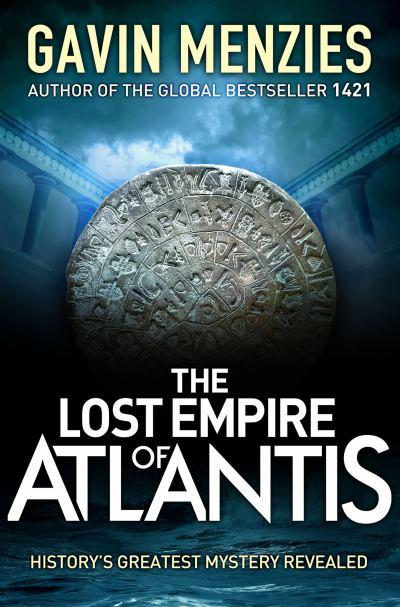
Ex-submariner Gavin Menzies attracted global attention with his eye-catching farragos “1421” and “1434”, books laying out how he imagined 15th century Chinese fleets sailed through a dried-up Egyptian canal to reach Renaissance Europe and beyond. And now he’s moved onwards and backwards to the Minoans, an ancient Mediterranean civilization he proposes were in fact the sea-faring glue holding European Bronze Age trade together. Yes, and he thinks that it was the volcanic eruption on Thera / Santorini that destroyed the Minoans (though via a tsunami), and that this is what Plato was talking about when he talked about “Atlantis”. Hence Menzies’ book is entitled “The Lost Empire of Atlantis“.
So far, so nondescript – nothing that isn’t already in a thousand books (and disputed or disproved by ten thousand more). However, Menzies’ particular new shine on all that rusty metal is that he has a vastly grander vision of the Minoans’ geographic sprawl. For one, he thinks not only that it was they who were the first Europeans to discover North America, but also that they mined and shipped out millions of tons of extraordinarily high-purity copper from beside Lake Superior. Oh, and that the Egyptian Pharaohs basically outsourced sea-trading to the Minoans, and that you can (if you squint at all the evidence) see evidence of the Minoans on the Red Sea and even in India, too. [Though not Australia and New Zealand yet, but perhaps Menzies is holding those back for a sequel, wouldn’t be the first time, eh?]
I think the main things just about any reader would notice are the book’s relentless stylistic tics and its metronomic structure. In pretty much every chapter, Menzies jumps on a plane or boat with his wife Marcella to some vaguely-connected place, looks out of a hotel window while musing to himself on how much it had all changed since he had last visited it while still in the Royal Navy, and then trolls round a local museum or historical site, where he is suddenly struck by the ineffable kindness of the ancients to have left him yet another glaringly obvious clue to add to his list – another cookie crumb in his global trail.
This struck me most strongly in Menzies’ mercifully brief Chapter 21, where he is transfixed in the Prado by the similarities between a 19th century AD drawing of bullfighting by Goya (Sketch No.90) and another image of bullfighting he had previously seen at Knossos. “What I’d been witnessing – had I stopped to think about it – was a calling card. It had been sitting out the centuries, but it was there, written in the colourful script of the Minoans.” Yes, in this book Menzies does indeed raise his pursuit of historical bull to an epic new level.
In many key ways, all he’s really doing is trying to fit into the idiot wet dream vision of ur-historians that TV producers have talked up over the last decade: genially talkative late-middle-age buffoons buffers who (conveniently for the constraints of the medium) practise history just by striding around, all the while making dramatic & striking connections to camera. But of course that’s simply a nonsensical fiction: to a very great degree, history is driven more by detailed textual study and a curiously rigorous kind of critical empathy than a series of ever-longer intuitive leaps towards an eerily uncanny mega-Truth That Lies Beneath.
For me, I think Menzies sees the great swathe of historical textures not with an historian’s eye but more as an abstract artist might see a series of impressive colours: as things demanding to be used, appropriated and joyfully displayed. Enjoy the scenery as a whole sequence of contested Bronze Age artefacts – the Nebra Disk, Stonehenge, the Amesbury Archer, the Uluburun wreck, the Antikythera device, Orkney voles, the Nabta stones, Cornish tin mines, the Great Orme copper mine, and countless others including (yes, finally) the Phaistos Disk – drift pleasantly past your eyes.
Of course, for a cipher mystery reader, YABOA (“yet another book on Atlantis”) ain’t no big thang at all: but sporting the Phaistos Disk on the front, spine & back of Menzies’ book is surely intended as some kind of provocation, right? But given that he clearly does not have the historical apparatus for decrypting the Disk’s mysterious spiral messages, why does his book sport it so jauntily?
The answer is that Menzies happened to meet Dr Minas Tsikritis, who has long been studying all the extant Cretan hieroglyphs, including the Phaistos Disk, the Arkalochori Axe, seal fragment HM 992 [which contains the Phaistos Disk’s distinctive “double-comb” symbol #21], together with all the known Linear A inscriptions… and who believes that he is now able to account for a large proportion of them. So, what’s the Phaistos Disk, then? Well, according to Tsikritis (p.320), “at least one side is a [Tragoudi]”… basically, a sea-shanty. Well, pickle my timbers and sell my soul to Captain Teague: who’d have thunk it, eh?
Buy Gavin Menzies’ book if you like: but please bear in mind that his ongoing Voyages of the Damned proceed despite capital-aitch ‘istory, not because of it. Despite a sensitive nose for what’s wrong with big picture accounts, his syncretistic urge to jam all his pieces together serves only to weaken his overall case, not to strengthen it. The reader departs with the impression of having met a kid trying to build a Lego wall without knowing how to make brick bonds: for as a discipline, history is far less about simply accreting evidence than about examining the nature and limits of the bonds binding those pieces of evidence together.
To me, Menzies’ Lego walls really don’t stand up to close scrutiny: though they’re formed of all the right sort of brightly coloured bricks, their bonds – those connections that move us along the continuum from coincidence to correlation to causality – are simply absent. So, even though what his approach yields is a series of vividly-coloured, imaginative accounts of how things might have been, these ultimately are little more than modern-day sea-shanties. What shall we do with him? Shave his belly with a rusty razor!
Histerical fiction is a genre of its own and now one with quite a venerable history, beginning with a French chap who let his imagination rip on the subject of Carthage. And I rather think a work like this interests more yung’uns in archaeology and historical studies than all with ones with proper footnotes. I won’t read it, though; apoplexy is so unwomanly.
Diane: there may well be other books that should be higher up your reading list. 🙂
I think I would rather buy your book, Nick! Thanks for the review; my brother told me about 1421 and I asked him if they’d been assisted by the Nephilim or our Lizardoid Overlords…he said no, but I can’t help but catch a whiff of von Daniken here.
Slow day in “cipher world”, Nick? I think I’m going to learn Braille, combine it with shorthand I was forced to learn in high school, use some of ASL signs, stick an occasional heiroglyphic here and there, and maybe an atomic number or two as a finishing touch — and write my autobiography! (I’m half-blind,three-quarters deaf, speak with a lithsp, and can read comfortably at approximately 750 words a minute. (I was reading at the 4th-grade level before I “graduated” from kindergarten).
Ennyway — Cheers!
Bye!
I enjoy reading these reviews but find one common theme. Always a blasting of Menzies but not one historical basis for refuting any part of his book. What gives?
Gregg: I suspect the common theme you’re reaching towards is that there is no historical basis for supporting any part of his book. I secretly like Menzies’ schtick, and I think he’s got the chutzpah & balls to ask the right kind of question… but he plainly hasn’t got the historical machinery to answer them. Ultimately, history when done properly is very rarely about grand questions (let alone grand answers): this, rather than any ‘establishment’-style conspiracy to do him down, is why he gets short shrift from historian reviewers. Just so you know!
To be fair: Menzies isnt the first person to consider that the bull-trial is so unusual a ritual, and Crete is so close to Spain..closer than Carthage to Tyre, or Alexandria to Rome, that its occurrence in both places is probably not coincidental. ‘Skeptical’ science has created almost as many errors as semi-credulous science, as it happens, as you can see by reading the number of times that the word ‘preposterous’ has been used by the losing side of any long-term argument.
Cheers.
..As, in the present case, nothing in my own research offers support for the views of Rich Santacoloma, but at the same time, I am perfectly prepared for the possibility that time will prove his views correct. History is not the study of any logical chain of events, but of the chaotic and impenetrable motives and actions of human beings within their environment.
Much more is possible than is admitted by mere logic. Fortunately we are also endowed with reason.
I found the book to be an entertaining read. That seems to be it’s point: entertaining, which it does well.
`Be willing to suspend your disbelief ‘ere you open it’s covers!’
Any iconoclast – and Menzies is a good one – is bound to be rubbished by the established “bien pensants.” Anything that disturbs conventional wisdom is bound to be dismissed. Look at the evidence, idiots, but try to keep your minds open!
George Stebbing-Allen: iconoclasm yields no Royal Road to the truth. Menzies is – in my own iconoclastic opinion – a prime example of an iconoclast who is just plain wrong, sorry if that’s inconvenient. And yes, I looked at his evidence, and it was rubbish. 🙁
Nick,
Since you introduced me to Menzies’ books, I’ve read the ‘Atlantis’ story and tried to struggle through the “Chinese junks in the Mediterranean’ saga, and I can see why they fascinate so many people. He isn’t the first person – and I mean the first ‘serious’ person – to have hypothesised that the evident evacuation of Santorini before the blast must imply an intention to re-settle somewhere well away from the volcano, and then to have wondered about the fairly unexpected co-incidence of bull-dancing and -killing in Iberia.
Similarly, there have been some fairly persuasive arguments from archaeology about the design of an ancient port discovered on the southern coast of Ibera..
Altogether, though, I get the impression of a very bright kid with very short attention span: he gets the first idea but his attention drifts when you get to the “on the other hand..” sort of stuff.
It’s a fun read, and the sort of people who read it do so for their idea of fun, even if it’s to feel righteously irritated. 🙂
Nick Pelling seems to know everything about everything. This doesn’t necessarily mean that he’s right about everything – or anything. Long live the Establishment, eh?
George Stebbing-Allen: no Establishment minions round here, sorry. But you don’t have to be part of the Establishment to think that Gavin Menzies got numerous big things wrong.
He didn’t just get them wrong, Nick, he is/was a liar. Gavin Menzies’ work 1421 is the only book of his I have read and I stopped reading it on page 43 when I realized he is shamelessly dishonest. He used ‘evidence’ from ‘The Portuguese Discovery of Australia’ which I knew from personal investigation to be unexamined, or fraudulent, or, in any case, wrong. The author of that book had only three pieces of hard evidence to support his theory that ‘the mahoganey ship’, a reportedly very old wreck lost in dunes near Warrnambool during the 1870s, was a Portuguese ship that had wintered at Bittangabee Bay, south of Eden, New South Wales. Ruins at the site he claimed were Portuguese, as was a vase discovered at the site. The vase was in the museum in Eden. At the time I lived not far from there. Intrigued, I went for a jaunt with my kids to have a look. The site on the beach was humble and non-descript. After going there I went on to Eden to see a local engineer about something he was making for me and mentioned this site and claim. As it happened the engineer, Rene Davidson, was president of the local historical society and he said the ruins were well known as the remains of early settlers the Imlay brothers. Half an hour later we were walking up the street and I met a fisherman I knew, and another fisherman I didn’t know, and we chatted and I mentioned that we were going to the museum to see the vase etc etc and the fisherman I didn’t know poohed poohed it all and said the vase had been found 40 km off the coast and was of unknown origin. He knew this because he had winched up the net in which it was found. Menzies took this silly confection and scratched out ‘Portuguese’ and wrote ‘Chinese’.
Later is emerged that Menzies, pushed by his publishers, concocted a fraudulent book (1421) for commercial gain. They falsified the dismissive remarks of reputable historians to make them supportive and pasted them on the front cover. This was all bruited in a televised documentary, Nick, so you may publish it with impunity.
George, get serious.
‘A little learning is a dangerous thing./ Drink deep or taste not the Pierian spring:/ There shallow draughts intoxicate the brain/ And drinking largely sobers us again.’
As you have so often aptly put it, Nick *Sigh!*.
Photo of said “vase” – believed a Portuguese wine jar according to an article In Eden’s “Magnet” (11 Mar 2015):
http://www.edenmagnet.com.au/story/2938325/pots-hold-vital-clues-archaeologists-focus-on-eden-in-bid-to-unlock-australias-early-history/
It gives one fisherman’s name as Alan McCamish. Last year the Portuguese theory was still just a theory:
“The ceramics may provide critical evidence in support of the theory that Australia was mapped by the Portuguese or Spanish as early as the 16th century”.
The Portuguese theory has some merit, unlike the two books mentioned. This is a different vase. The events I was referring too took place in 1987. This vase is new to me! Thanks, Diane.
Robert –
my pleasure.
d
What, then, in regards to this book in particular, can he be called correct upon? The proposition that the Minoans sailed the Atlantic seems far fetched until one recalls Lief Erikson did the same only a millennia ago, using quite similar ships as the Minoans likely used.