
As I mentioned here recently, I’ve been trying to grasp the structure of the humanist community of astronomers / mathematicians orbiting around Nicholas of Cusa and Cardinal Bessarion in Rome… but so far haven’t found any definitively useful books on the subject. Thony Christie has a nice article here, and there’s a book on 15th century Viennese astronomy here (for Regiomontanus and Peurbach), but sadly not a great deal else that rises far above Wikipediaesque factoids.
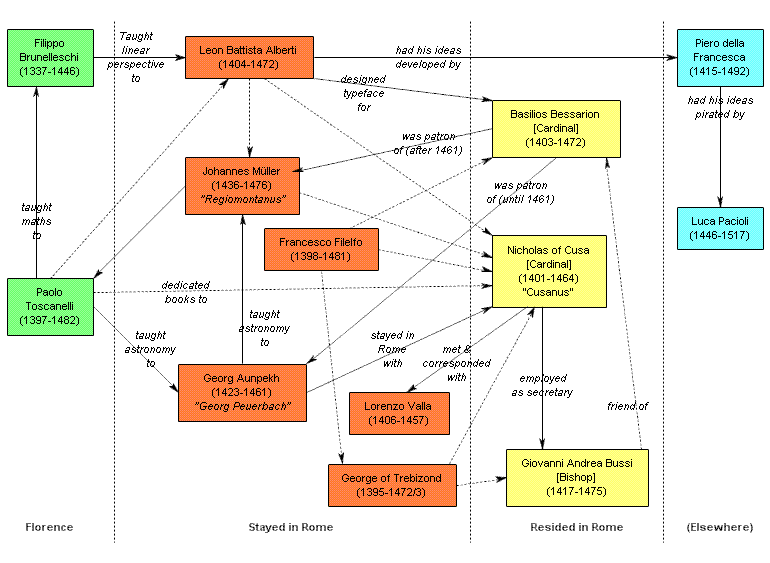
All the same, here’s the connection map I’ve put together: it’s far from complete, but it’s probably a decent enough starting point. Doubtless you’ll note plenty of familiar names!
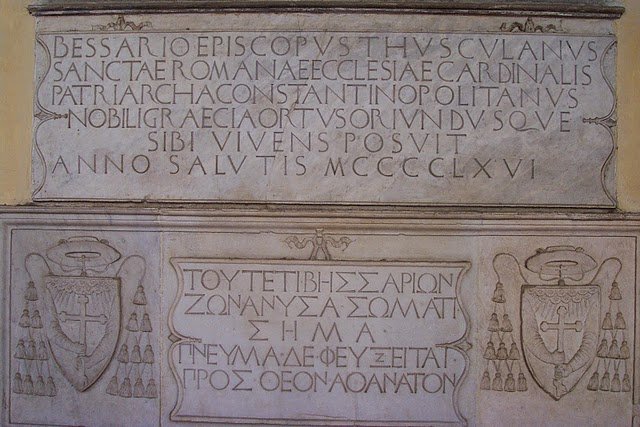
Also, I found a nice blog post containing pictures of Bessarion: mirroring his life-long interest in astronomy, the Greek epitaph on his tomb (below) says “I, Bessarion, raised this tomb to hide my bones; my soul will seek the stars whence once it came.” Not particularly religious for a Cardinal, perhaps, but I like it all the same!
Thanks for the link. Nice map. There’s a lot of Austrian and German literature on Regiomontanus, Peuerbach and The First Viennese School of Mathematics. When I have more time in summer I put together a bibliography, something I have intended to do for a long time. I also have some literature on the early history of printing around Regiomontanus that I will include.
A couple of points. The Medici circle and that of the ‘neo-Roman’ academy in Rome were ideologically opposed, even if the individuals remained civil at the professional and political level.
Secondly, I think Bessarion is talking in terms of what one might call a moralised astronomy that had come from older eastern Christianity, most of which was now heretical in Rome’s eyes, and of whose influence among these ‘reborns’ it was frightened.
Congratulations for the design of the diagram as well as the contents. Some of the arrows are explained (e.g. “designed typeface for”) but others are not. Is there a common feature that goes with dashed and continuous unlabelled arrows?
Axel: when I started building the diagram, my plan was to use continuous lines for solid evidence, and dotted lines for less-then-solid evidence. However, once it became clear that it would take a PhD dissertation-style amount of work to assess the reliability of most of the claimed connections, I ended up leaving this particular aspect of the scheme by the wayside – it’s only work-in-progress, after all. 🙂
Axel: I also intended that each connection should be hyperlinked to a note detailing the source document [letter, book, etc] where it is attested, but these are proving surprisingly hard to track down (and many of the connections may well turn out to be hopeful historical interpolations). Still, I’ve had some good books and papers recommended to me off-line, so there’s plenty of pragmatic work to be done yet…
Cusanus is high on my list of people to research. His lifespan nicely overlaps the carbon dating and he was a German from the Rhineland who divided his career between Germany and Italy. Furthermore he was a diplomat who would have understood the principles of encipherment, he held unorthodox views about astronomy, and he had a network of friends with whom he might well have wanted to share ideas which were not for general consumption. Very much the kind of man who one could imagine writing the manuscript.
Giovanni Bianchini should probably be in there somewhere.
This page might be useful:
http://www.trin.cam.ac.uk/sk111/diagrams#_Regiomontanus
Note the book by Zinner.
Great chart, Nick.
And in there somewhere is Gaza, though he didn’t translate “de Plantis” till 1483 – in Treviso.
I found this included as a quote in an old, unfinished, paper of mine. I haven’t noted its source, sadly.
“It is worthy of mention that, at a time when the gifted Christopher Columbus was still ridiculed as a dreamer by the learned, the Florentine astronomer and physician, Toscanelli, and the house-physician of the Franciscan monastery of Santa Maria de Rabida, Garcia Fernandes, both heartily encouraged him and gave him material aid.” the Franciscan perhaps read Greek astronomy too?
Diane: thanks for that, though I’ll be revisiting the (much-disputed) correspondence between Toscanelli and Columbus at a later date as there’s quite a nice story to be had there… 🙂
Actually de la rabida..
Without comment…
“The word ‘rábida’ is actually an arabic word meaning fortress and therefore it is no surprise to discover that the monastery was built on the site of a former moorish monastery…on the site of a Moorish stronghold; ‘rábida’ is a Arabic word meaning fortress.
Pingback: The Giant’s Shoulders #25: 2nd Anniversary Edition! « The Dispersal of Darwin