
For the most part, constructing plausible explanations for the drawings in the Voynich Manuscript is a fairly straightforward exercise. Even its apparently-weird botany could well be subtly rational (for example, if plants on opposite pages swapped their roots over in the original binding, in a kind of visual anagram), as could the astronomy, the astrology, and the water / balneology quires (if all perhaps somewhat obfuscated). Yet this house of oh-so-sensible cards gets blown away by the hurricane of oddness that is the Voynich Manuscript’s nine-rosette page.
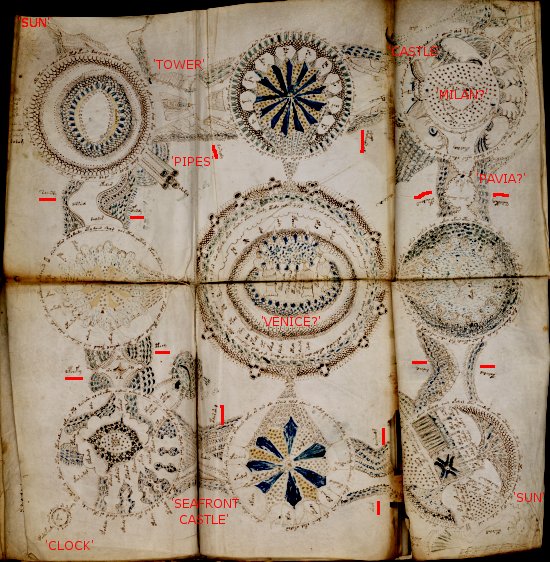
If you’re not intrigued by this, you really do have a heart of granite, because of all the VMs’ pages, this is arguably the most outright alien & Codex Seraphinianus-like. Given the strange rotating designs (machines?), truncated pipes, islands, and odd causeways, it’s hard to see (at first, second and third glances) how this could be anything but irrational. Yet even so, those who (like me) are convinced that the VMs is a ‘hyperrational’ artefact are forced to wonder what method there could be to this jumbled visual madness. So: what’s the deal with this page? How should we even begin to try to ‘read’ it?
People have pondered these questions for years: for example, Robert Brumbaugh thought that the shape in the bottom left was a “clock” with “a short hour and long minute hand”. However, now that we have proper reproductions to work with, his claim seems somewhat spurious, for the simple reason that the two “hands” are almost exactly the same length. Mary D’Imperio (1977) also thought the resemblance “superficial”, noting instead that “an exactly similar triangular symbol with three balls strung on it occurs frequently amongst the star spells of Picatrix, and was used by alchemists to mean arsenic, orpiment, or potash (Gessman 1922, Tables IV, XXXIII, XXXXV)” (3.3.6, p.21).
Back in 2008, Joel Stevens suggested that the rosettes might represent a map, with the top-left and bottom-right rosettes (which have ‘sun’ images attached to them) representing East and West respectively, and with Brumbaugh’s “clock” at the bottom-left cunningly representing a compass in the form of the point of an arrow pointing towards Magnetic North. You know, I actually rather like Joel’s idea, because it at least explains why the two “hands” are the same length: and given that I suspect that there’s a hidden arrow on the “bee” page and that many of the water nymphs may be embellished diagrammatic arrows, one more hidden arrow would fit in pretty well with the author’s apparent construction style.
This same idea (but without Joel’s ‘hidden compass’ nuance) was proposed by John Grove on the VMs mailing list back in 2002. He also noted that many of “the words appear to be written as though the reader is walking clockwise around the map. The words inside the roadway (when there are some) also appear to be written this way (except the northeast rosette by the castle).” I’ve underlined many of the ’causeway labels’ in red above, because I think that John’s “clockwise-ness” is a non-obvious piece of evidence which any theory about this page would probably need to explain. And yes, there are indeed plenty of theories about this page!
In 2006, I proposed that the top-right castle (with its Ghibelline swallowtail merlons, ravellins, accentuated front gate, spirally text, circular canals, etc) was Milan; that the three towers just below it represented Pavia (specifically, the Carthusian Monastery there); and that the central rosette represented Venice (specifically, an obfuscated version of St Mark’s Basilica as seen from the top of the Campanile). Of course, even though this is (I think) remarkably specific, it still falls well short of a “smoking gun” scientific proof: so, it’s just an art history suggestion, to be safely ignored as you wish.
In 2009, Patrick Lockerby proposed that the central rosette might well be depicting Baghdad (which, along with Milan and Jerusalem, was one of the few medieval cities consistently depicted as being circular). Alternatively, one of his commenters also suggested that it might be Masijd Al-Haram in Mecca (but that’s another story).
Also in 2009, P. Han proposed a link between this page and Tycho Brahe’s “work and observatories”, with the interesting suggestion that the castle in the top-right rosette represents Kronborg Slot (which you may not know was the one appropriated by Shakespeare for Hamlet), with the centre of that rosette’s text spiral representing the island of Hven where Brahe famously had his ‘Uraniborg’ observatory. Kronborg Slot was extensively remodelled in 1585, burnt down in 1629 and then rebuilt: but I wonder whether it had swallowtail merlons when it was built in the 1420s? Han also suggests that other features on the page represent Hven in different ways (for example, the three towers marked ‘PAVIA?’ above); that the pipes and tall structures in the bottom-right rosette represent Tycho’s ‘sighting tubes’ (a kind of non-optical precursor to telescopes); that one or more of the mill-like spoked structures represent(s) Hven’s papermill’s waterwheel; and that the central rosette represents the buildings of Uraniborg (for which we have good visual reference material). Han’s central hypothesis (on which more another day!) is that the VMs visually encodes information about various supernovae: the suggestion here is that the ‘hands’ of Brumbaugh’s clock are in fact part of the ‘W-shape’ of Cassiopeia, which sits close in the sky to SN 1572. Admittedly, Han’s portolan-like ‘Markers’ section at the end of the page goes way past my idea of being accessible, but there’s no shortage of interesting ideas here.
Intriguingly, Han also points out the strong visual similarity between the central rosette’s ‘towers’ and the pharma section’s ‘jars’: D’Imperio also thought these resembled “six pharmaceutical ‘jars'”. I’d agree that the resemblance seems far too strong to be merely a coincidence, but what can it possibly mean?
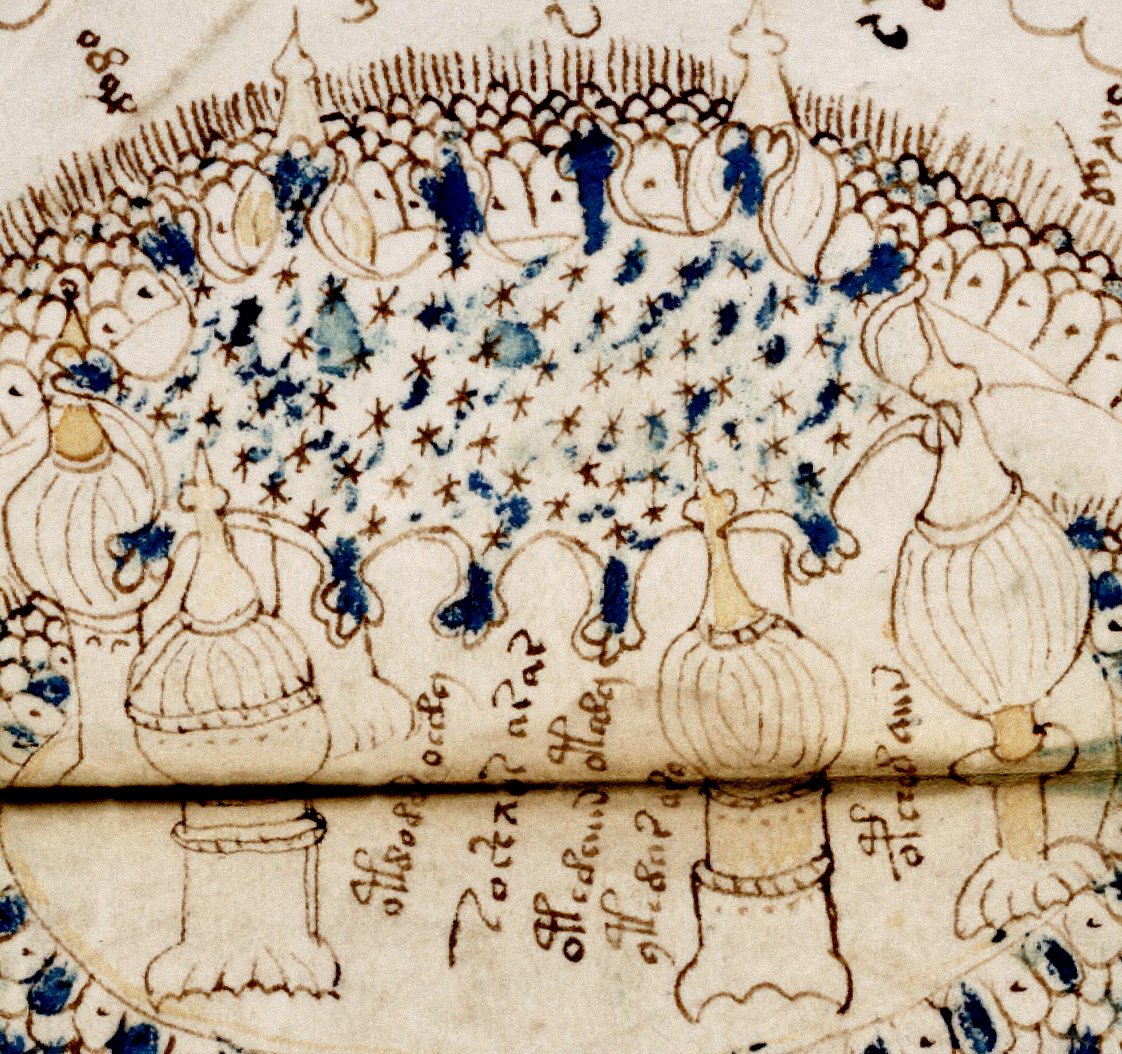
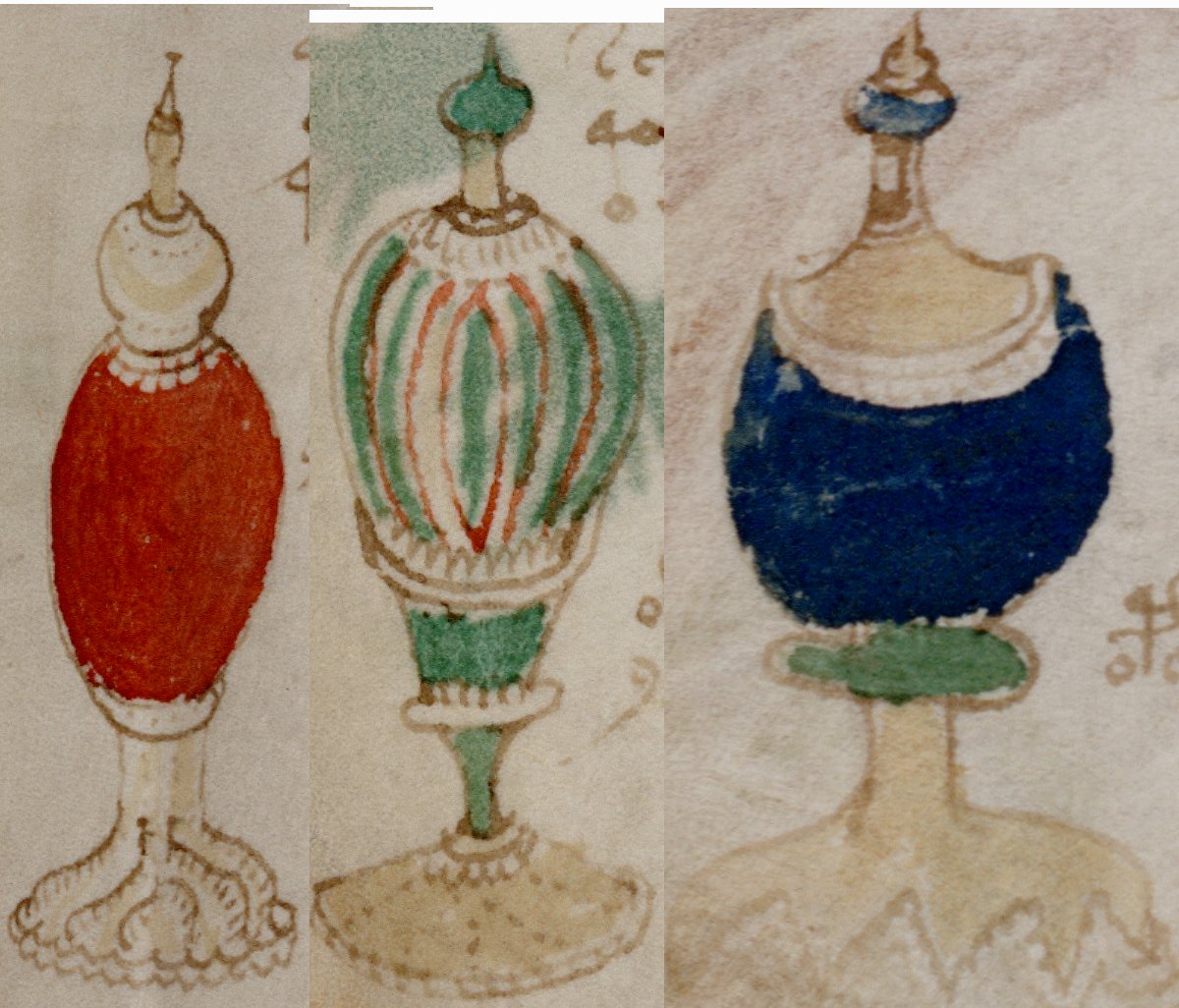
Finally, (and also in 2009) Rich SantaColoma put together a speculative 3d tour of the nine-rosette page (including a 3d flythrough in YouTube), based on his opinion the VMs’ originator “was clearly representing 3D terrain and structures”. All very visually arresting: however, the main problem is that the nine-rosette page seems to incorporate information on a number of quite different levels (symbolic, structural, physical, abstract, notional, planned, referential, diagrammatic, etc), and reducing them all to 3d runs the risk of overlooking what may be a single straightforward clue that will help unlock the page’s mysteries.
All in all, I suspect that the nine-rosette page will continue to stimulate theories and debate for some time yet! Enjoy! 🙂
Nick – I’m going to credit Han and re-post my own observations on this point of towers as ‘jars’ – actually here, burners. Apologies to Nick for my ignorance of his priority.
Diane: actually, Mary D’Imperio pointed it out in 1977 (I’ve amended the page to reflect this), and it may already have been a Voynichian commonplace by then, it’s hard to be sure. As an aside, I started out just trying to cover a couple of theories, but the page just grew and grew… oh, well. =:-o
yes, well.. maybe I should credit her. The habit’s pretty well known, historically. Just not sure how long it has been known in Voynich studies.
What are the rune-like Hebrewy characters in the middle-top and middle-middle images? Can we have a much closer look please?
Paul: it’s all Voynichese, I’m afraid, just at funny angles. Nothing to get excited about! 🙁
A good collection of theories… and thanks for the mention of the 3D Rosettes. Related, I do have this post:
http://proto57.wordpress.com/2009/06/15/theres-no-place-like-utopia/
As you know (you commented there)… but since it fits with the theme of identity, I add it here. On that page I show and compare other Utopias and how they were illustrated… IMHO, very similarly to how the Rosettes is laid out, in many ways. For a speculative identity of the specific areas, from “that old theory of mine” (pre-Carbon): http://www.santa-coloma.net/voynich_drebbel/new_atlantis/rosettes_labels.jpg That map compares the parts of the Rosettes to places mentioned in The New Atlantis. Rich.
Nick – Stretching this out to it’s original square shape (quite a bit seems to have disappeared in the folds) – it looks to me as if it was constructed by drawing a diagonal from corner to corner then taking a 12 inch ruler across the 2 diagonals to mark of 6 inch centres for all the circles – would a European have used a metric ruler in the 15th century?
Can I add a general comment, Nick? Do delete if you think it irrelevant.
A lot of the comments seem to me to be attempting to guess what an individual meant to express by the drawing. I think that this is perhaps not the angle of approach for a drawing set down in the early 15thC.
If you think of the drawings less as a means of personal expression, and more as an alternative, and formal, system of communication, then the stylistic features are as telling of their period and context as a variant form of handwriting is. I rather think that the person who first put the bits together to form the anthology had absolutely no conception of the idea of meaningless art: that is, art without meaning apart from its maker.
Diane: it’s certainly true that 90% of Voynich theories give a strong impression of back-projecting modern experiences of art and writing in regard to some key element of the argument, so placing it in entirely modern categories such as asemic writing would almost certainly be inappropriate. What is perhaps more relevant is Marc Bloch’s distinction between historical documents intended for general consumption and historical documents intended for a single person’s eyes only: as with the VMs, the latter category can yield a very distorted set of meanings if (wrongly) interpreted as if it were the former category. That is, I think the VMs has primarily private meaning, not public meaning: though it is, of course, hard to prove this definitively. =:-o
If no-one else has made the observation: the layout of the map is similar to formal maps of the world in the east which place Mount Meru at the centre of the world.
Hang on, I’ll look one up on the web..
ok Here’s a korean example
http://www.saudiaramcoworld.com/issue/200504/the.leek-green.sea.htm
Not exactly the same appearance, but similar scheme. A lot of Buddhist maps and diagrams take the same form.
PS This Mt Meru is an island, not the Kenyan mountain
Hi,
Just to clarify what has been described as a “portolan” chart at the end of my rosettes section. A number of years ago I came across this impression of the markers of the circles on the rosettes folio, which though similar to those on other folios, due to the large number of examples and the spread of the rosette circles had the feel and impression of a mariners map with its many straight criss-crossing lines representing compass directions from various given points. However, although the rest of the rosettes folio I have interpreted in the “light of this particular theory” as described in relation to the life and work of Tycho actual places relevant to this the “portolan” chart is interpreted in relation to a star chart and not a mariners chart. As a star chart locating the position of SN 1572 it is in keeping with the type of work carried out by Tycho concerning the triangulation of the positions of various stars and also along the lines of the work of “Stephenson, F. R. & Clark, D. H” and not out of keeping with the subject matter suggested or the methodology, which if one accepts the possibility of the manuscript being a later creation using old materials is within the realms of possibility. The down side of the manuscript however is that it is as hard to prove a theory wrong as it is right, but it would be more useful to have evidence for something being wrong rather than opinion that it is “too out there”. I would welcome evidence that it could not be as suggested.
http://adsabs.harvard.edu/full/1977QJRAS..18..340S
P. Han
P. Han: the problem with trying to review such a substantive (yet, dare I say it, somehow sprawling) theory as yours is that I end up needing to post substantive lemmas on individual aspects first, or else the review would end up 10000 words long. I’ll get there, though, please bear with me…
I’ve put up a note on the battlements of the tower in Taormina, with a link to yr blog, Nick.
As far as charts go – the same grid applies to astronomical and terrestrial positions. The ancient techniques of sidereal surveying remained part of the surveyor’s curriculum well into the 20th century.
Mmmmnnn. merlons.
http://www.vrmalta.com/malta-tour/source/malta-red-fort1-r.html
Purely an historical note: I’ve found the origins for the swallow-tail merlon, I think. They appear atop a building on a coin made for the first Selecid satrap in Persis.
We need a ‘Voynich trivia’ website!!
Wow this sure reminds me of the manuscript
http://www.saudiaramcoworld.com/issue/200504/leek-green.popup7.html
So P. Han, the book you link to by Tycho Brahe, relates to his prophecy about the golden age that he seems to think it would arrive after supernova explosion, it IS totally consistent with your theory… he links it to the bible and other prophecies
Amazing to see, Nick, how in 2010 you had enough energy to notice and report as little as a one-sentence observation by not one but several other researchers, all in a single post.
Congrats.
Diane: everyone has their own unique blogging muse – and mine hasn’t been particularly inspired by Voynich research since 2010, I’m sorry to say. There’ll be another cycle soon, though…
Not to worry – the weird and wonderful world of historical ciphers is much more interesting. Voynich studies is soooo 2008.
😀
more pirates?
Diane: you can never have enough pirate ciphers, right? 🙂
.They are fun – but only if one assumes the treasure already found. Don’t want local residents woken by the hum of foreigners dressed in shorts, sandals and metal detectors.
Diane: yes, some of those shorts can really hum. 🙂
Re-reading this, and tony’s acute observation about use of a 12″ rule, I thought it might be a good time to emphasise that comparing Vms pictures with other pictures is likely more productive that the assumptions underlying efforts to match Vms pictures to objects. Pictures are not failed photographs.
English 13thC ms with lots of buildings in it, but not exactly in Vms style, is
An Itinerary to Jerusalem attibuted to Matthew Paris (Brit Lib. Royal 14 C VII)
f. 5 shows the coast, and includes a keep/castle with flanking towers, which is nice. But of more interest, I think, is the use of the same blue letter, in different forms, before the name of each.
See:
http://www.bl.uk/catalogues/illuminatedmanuscripts/ILLUMINBig.ASP?size=big&IllID=45873
for:
… is more likely productive that the …
read
… is more likely to prove productive than adopting the..
Dear Nick,
after reading your book my wife and I were particularly hooked by the Rosette folio… My wife and I put together a few thoughts in a manuscript (link underneath, open repository) on what we think the entire folio is about: In a nutshell it is a map (as others already hinted at) but also a map of the four classical elements and we show the links between the continents (Europe, Africa, Asia and the forth continent) with the elements with climate and cardinal points.
Here the doi: 10.6084/m9.figshare.903756
[i.e. http://figshare.com/articles/VM408_folio86v_The_Rosette_Map_Elements_of_a_mappa_mundi_and_a_map_of_the_Elements/903756 ]
Juergen
So nice to find someone else who has reached such a conclusion. My full exposition of the map on folio 86v was more than a ‘hint’ though. Must warn you that while I explained it as a world map, identified the cardinal markers, related them to astronomical marks and set conventions *outside* Europe, then identified historical strata, concluding the imagery based in the early Hellenistic period but overlaid with additions from what I judge the century 1150-1250 ad, and other indications of late links to the western portolan tradition then arising…. the whole of my work was ignored.
Better luck yourself.
my exegesis is in a series of posts at my later blog voynichimagery dot wordpress dot com – just in case reading it might save you a little needless duplication.
Diane
Thanks for your feedback and further information.
However, we think our conclusions differ significantly, e.g. different cardinal points(via the element discs), landmarks (paradise, pharos, Nile) and cities (Alexandria) etc. We believe parts of f86v to represent map-style features and conclude these characteristics to be part of a joint map, with the Classical Elements forming a climate diagram with characteristics which are not described or mentioned in your blog. For example a search on the (Aristotelian) Elements reveals no result in your blog in connection with f86v. We couldn’t find a conclusion or uniform picture on all discs in combined form as they occur in the Rosette Map in your research.
The title of our paper already is the clue that our conclusion is that there is more than a world map in f86v.
druids
just found yesterday another manuscript (16th century, MS83, Special Collection, University Library Madison, WI) with a climate diagram (folio 23) and the classical elements in deciperable writing (and their influence on the climate in between). All goes back to a commentary (unknown author) on Sacrobosco’s Tractatus de Sphaera. I am sure Sacrobosco was discussed before (not so sure if in this context?); I saw this version only yesterday and fits with what I suggested for the Rosette map. If interested, a one page visual (with bibliography on where to get the manuscript /images/diagram from) is here:
http://dx.doi.org/10.6084/m9.figshare.1282401
Juergen: Sacrobosco’s Tractatus De Sphaera was hardly a secret book, so your suggestion that some of these notes might derive from a commentary on Sacrobosco rather than on Sacrobosco’s book itself seems worthy of further consideration. It was the late Glen Claston who proposed that there could well be a connection between the Voynich Manuscript and De Sphaera, but I would need to go back through a lot of old notes to reconstruct exactly what it was he was reaching towards there.
There’s an interesting book by Lynn Thorndike (whose books occupy a disproportionately large amount of shelf space in my study) on commentaries on Sacrobosco that might well be a good starting point here: http://babel.hathitrust.org/cgi/pt?id=mdp.39015025028716;view=1up;seq=14
Nick: Thanks for the link to the free edition. I read a comment that Thorndike’s book may be misleading for later commentaries for Sacrobosco’s ‘Tractatus de Sphaera’ (late 15th century onwards) but fits nicely in the time frame of interest here. Excellent starting point indeed.
Juergen,
You are quite right about there being no reference in my work to your idea of the map’s depicting the elements in its four corners. No such interpretation occurred to me.
However, I did identify and discuss at length the structure I believe is the (or ‘a’) Pharos, comparing it to representations in Hellenistic, early and later medieval works. I did not identify it with the great ‘mound’, but with a neat drawing in the north roundel.
Not sure, but as a matter of fact I think I was the first to refer to the ‘paraidisi’ in relation to fol. 86v, this being the emblem used in the map’s north. (East and West are indicated by rising and setting sun).
However, I don’t think anyone could mistake my analysis and conclusions for your own ideas. My point was simply that no-one before I offered a detailed analysis of that folio had regarded it as a world map. Indeed, the response to that explanation of it, as I recall, was generally indifferent and I’m not surprised no more reached you than a vague mention that it was supposed a map.
Nick and Diane,
Yes, ‘Tractatus de sphaera’ itself was not secret at all (Nick’s comment above and Diane’s comment on the block paradigm part 3 comment section), however some commentary seem to have been more secret than others (Lynn Thorndike link above) leading to ‘extremes’ such as Cecco d’Ascoli’s ‘Necromantic Commentary on the Sphere of Sacrobosco’ (14th C).
Juergen: Cecco d’Ascoli’s commentary is indeed what I was thinking of. 😉
PS,
cute bull in Cecco’s zodiac. I’ve found another with such unusual horns in a manuscript made several centuries earlier, too. None, so far, in imagery not consciously antique-d.
Here a more technical comment to the Rosette Map… I had a look (again) at the Rosette Map and tried to figure out how the scaffold had been constructed. What I found, basically, are two easy ways of geometric construction with compass and straightedge – a ‘circle’- and a ‘square’-based one – both not perfect due to the scan not being 100% flat or unfolded. The interesting bit is that the golden ratio is all you need to construct the bare minimum of the scaffold of f86v.
Not only is the inner circle to the eight outer circles in golden ratio, but also can the radius of the inner circle be deducted from the overall dimension of the folio f86r. The location and position of the smaller outer circles also is rather easily found ( again, not a perfect match due to what I believe scan and minor human error issues).
For those interested further, I discuss if the use of the golden ratio is deliberate or a just consequence of the construction process. I put together a manuscript with the ‘circle-’ and ‘square-based construction in the annex or separate files (in the bibliography).
http://dx.doi.org/10.6084/m9.figshare.1368746
I found that trying to re-‘create’/draw the Rosette map as a free-hand drawing with results far more off than the ‘scan’ issue I mention above. I have a few more thoughts on that – to be revisited at a later time…
Juergen,
I think you’ve done an excellent backwards projection.
Some of the folios in MS Beinecke 408 show marks of some sort of pricker or compass (Rich Santacoloma noticed that there was more than one ‘centre’ on f.57v, and found a puncture mark.
Question is: have you seen any sign at all of puncture marks from compass or divider on f.86v?
I might also suggest that the beautiful intricacies of Celtic interlace would give you a lot to write about, too.
For example, this page from the book of Kells seems to have lots of interesting geometrical arrangement:
32minutes.files.wordpress.com/2012/05/book-of-kells-man-lion-bull-eagle.jpg
Juergen:
Haven’t yet read your new article, but anyways great that you develop this map issue further.
Just to let you know that I occasionally found an example of a T-O map where Africa and Europe are strangely swapped: http://www.e-codices.unifr.ch/en/zbs/SI-0167/55v
Maybe that is of interest for your research.
Diane,
thanks for your comment and the link.
Yes, I did check for the marks you mention in my preparation of my manuscript.
However, the results were inconclusive (for me): The scans (even the new HD ones) bear marks and signs that I can’t distinguish from other marks (material based) so I cannot be sure about these. My best guess is that only the live visual inspection of the folio would reveal any signs at all (puncture marks).
Is there a breakthrough yet? I simply cannot read everything.
But I write it down what little things I have observed. There is a thick starry something, a cloud or magic carpet, on the central disc, apparently floating in the air in the height of the onion domed towers or herbal jars, whatever they are.
This thing has exactly thirteen fringed corners around its edge. Now, the top middle disc has a large starry star that is also thirteen pointed. Could this number, thirteen, be an intentional design, or simply coincidence by chance?
Another thought of mine is that maybe these discs are vertical sections or layers of what this rosette drawing is supposed to depict. Considering this, I imagined viewing the top middle disc as it was showing the relevant layer from below and the middle disc as it was showing its layer from above.
In that supposed system, the cloud or carpet, observable from above as such things, would take up the starry star shape when observed from below.
I just thought of this engineering view system where side views, frontal views, top views of the same object are placed systematically around each other on the diagram, together with its meaningful sections necessary to show.
To support this viewing fom above and below concept, here I mention the “tower in the hole” feature. Opposite the fold, an upside down earth mound is discernible for me, as I see it.
This earth mound has a hole in it, where the tip of the tower could go when we fold the page. In turn, the earth mound will precisely fit and fill the hole around the tower’s bottom half.
Then, if this perception of mine is of any import to consider, could it be that what is being shown deliberately to the viewer, is that the tower has significantly deep underground foundation, or maybe underground part that contain room?
I have some impressions about the nine rosettes image. Starting from the top left circle, it looks like a view of the land from above. To the right of it, the top central circle looks like a view of the heavens from below.
I perceive an indication of the change of the projection in the tower-in–the-hole detail and opposite to it the seemingly underside view of a possible earth mound taken out from the hole, thus creating a kind of sectional depiction.
Furthermore, I perceive most of the land views from above incorporating hairy lines at the foot of stone walls or what could be termed as stone walls, which look fish-scale like. These circular stone walls, when supposedly observed from below, do not have this hairy line feature.
I sense this upward looking view from the illusion of seeing the stone circle from inside as if looking upwards from a large stone walled well. The top centre circle looks like such, with the addition of spouts that seem to issue something symbolically.
Here again my sectional depiction concept is to be tested. It appears to me that the circle of stone wall from which I look up to the skies, is a horizontal section of the same wall on the corresponding, downward looking view.
I also suspect that the blue/white or the alternatively dotted rows of stones may indicate which wall fits which other one when imagining turning the two halves together.
So far I have no full success in this, but my strong impression remains, that somehow on this Escher-like, twisted diagram, the corner rosettes are mainly views looking downward and showing mostly land, while clockwise next to each of them are the corresponding upward looking rosettes, showing mainly the heavens, possibly above these lands.
The skyward looking circles seem to have some starry spangled star shaped canopies or umbrellas or who knows what. These seem to be depicted in some symbolic projection mode, where four differently textured set of rays open them out. These rays come out from the central rosette’s stone spouts.
The central circle must be special and also remains a mystery just as the rest. My observations may be wrong or bearing no significance, I do not know, I just have this feeling of sectional depiction. For example, at the left bottom rosette, I think I see another sectional view, just as on an engineering drawing where the material is broken out to show a hole or cavity.
At that corner, a curious hollow protuberance seem to be cut out like that, showing the inner mouth of the hole through which some smoke or substance is emitted towards the large central rosette.
Just had a half baked Idea about the Rosettes, Not even a theory at this level.
Perhaps what we are seeing is the central circle is the world as a whole and each of the surrounding circles is a “blow up” of some generalized aspect of the world. For example the upper right circle a generalized representation of the oceans, the lower left are perhaps caves or some such.
I am not saying this is the answer because it probably is not but I thought it interesting.
I just hope that I have not stepped on any others ideas.
Donald V: certainly could be, who knows? The big problems with the rosette page are (of course) that (a) there’s only one of it, and (b) it doesn’t fit into any obvious representative tradition or literature: as such, we have no clear fixed points of reference to work with, to keep us on the (historical) ‘straight and narrow’. Oh well! 😐
I don’t think the idea would stand up to even the slightest of breezes, but it seemed novel to me. The rosette certainly doesn’t fit any known precedent, though recently I found some interesting similarities to a certain bit of historical imagery. I won’t present anything until I can build a case.
My theory for what it is worth:
Top Left Rosette represents the Council of Basel of 1431.
Top Centre Rosette represents Pfafers Abbey.
Top Right Rosette represents Milan as per Nick Pelling’s theory
Centre Left Rosette represents Geneva
Bottom Left Rosette represents Lucerne and its many surrounding lakes
Central Rosette does not represent a location, but rather the pope or the power of the papacy if you prefer(note it is the only rosette not connected to the others.)
Causeway between Top Right Rosette and Top Centre Rosette represents the land between Lake Maggiore and Lake Como
Causeway between Top Centre Rosette and Top Left Rosette represents the land between Lake Zurich and Lake Constance
Causeway between Top Left Rosette and Centre Left Rosette represents the land between Lake Geneva and Lake Neuchatel
Causeway between Centre Left Rosette and Bottom Left Rosette represents Interlaken
Causeway between Bottom Left Rosette and Bottom Centre Rosette represents Bellinzona (as per Rene Zandbergen’s thought mentioned once on this website, but never pursued any further.)
Causeway between Centre Right Rosette and Top Right Rosette represents Pavia (as suggested by Nick Pelling)
It should be noted that this leaves 3 Rosettes and 2 Causeways unexplained. The nature of these has become so important to my theory that I would prefer not to give locations for these. I will just say that I believe the Centre Right Rosette to represent the crown of Milan from above with the edges of the crown turned in so they are visible (one should observe the faint lines connecting the centre portion to edges of the crown). This fits the description I have found as to how the crown looked when worn, but I cannot, as yet, find a painting or the like of the crown on the head of the Duke.
These statements are presented here simplified with very few details and no justifications, although I have conducted a very detailed analysis with clear justifications of each statement. However for the time being I am happy to leave it at this for others if they have any interest, at all, to speculate as to why I have come to these conclusions.
As far as to what the map represents, I believe it describes a journey to and from the Council of Basel of 1431.
Sorry for being cryptic, but given we are talking about ciphers it seems appropriate. I am sure I will elaborate in the future. Anyway to understand it there would really be a lot to convey and images are essential.
For clarity, I suppose I should mention that I have interpreted the central rosette as a crown surrounded by chalices. What some have described as “pipes” I believe represent cannons. The cannons pointed back from the top left rosette illustrate the tension/conflict between the Council of Basel and the Pope.
I should further say that my analysis of the map has been done largely without reference to the rest of the manuscript; an approach which I appreciate has its drawbacks. However it has allowed me to focus intently just on the map.
I thought I would write a little about my Council of Basel identification. Determining what the top left rosette, on the Voynich map, represents is to say at least somewhat difficult as there is relatively little detail in the drawing. The chief detail that I can see is in the central oval. This I have long believed shows crescent moons, also in a oval shape, arranged around the centre of the main oval. For some time the question has been, for me, what does the crescent moon here represent.? At first I thought it must represent the Islamic symbol. However subsequently I observed that the crescent moon was used in the Christian world in many different scenarios. The next question being is why are there many crescent moons arranged an oval? Another important fact I think to notice is that there are “pipes” or cannons in my identification pointing back at the central rosette; the only rosette for which that is the case.
So why did I identify this as the Council of Basel? There are a few reasons:
1) I had already identified the central rosette as the pope for the reasons I stated before and I had long been inclined to view the “pipes” as cannons(for reasons I could go into), This would imply an opposition/conflict between the top left rosette and the pope/papacy, which fit given the opposition of the Council of Basel to the Pope.
2) The location of Basel fit neatly given the nearby identifications I made on the map.(I could go into the precise details.)
3) The arrangement around an oval was consistent with the layout of a council and the symbol of antipope Benedict the XIII was the crescent moon fitting with the widespread allegiance to the antipope..
4) My research into the authorship of the manuscript first of all led me towards the council as being a significant event to the author.
I have listed below some of my specific identifications on the Voynich map:
Buildings->
Abbey of St Gall (Under construction) in the valley of St. Gallen
Laufen Castle in the Schaffhausen valley
Reichenau Abbey
Church of St Johann in Rapperswil
Church of San Biaggio in Bellinzona
Fontenella Abbey
San Lorenzo in Milan
and many more …………………………………
Rivers->
Ticino
Po
Sesia
and more……………..
I have researched my identifications carefully. However given the total number of identifications I have made, including those above, I would be surprised if no identifications will be subject to revision.
I should say I am not aware of anyone who has provided a similar analysis of the map at all except Nick Pelling’s identifications of Milan and Pavia. If someone has come up with anything similar I would love to hear about it; I am sure that would be very interesting to me.
My Perception of other “map” theories: (excluding Nick’s)
For me, internal consistency and detail(i.e. lack a vagueness) are vital in a Voynich map theory. A complete analysis which fits together I feel is also important, though a local analysis of the map is not necessarily wrong.
A first impression: the way a lot of other analyses seem to differ from mine is obviously first of all that I envisage a much smaller scale for the map whereas the other theories appear to view the map as a “Mappa Mundi”. Secondly a lot of the other theories focus much less on very specific detailed identifications of the map and much more on generalities, if I am not mistaken. I have tried to identify everything on the map down to the very smallest detail. I would love someone to provide a critique of my map. I firmly believe theories can only benefit from specific criticism.
I notice my identifications relate far more to recognisable details of specific buildings or geographical features. Maybe I am missing something, but I think this is much less the case with other analyses.
Also my map is much more down to earth than the Mappa Mundi, not that that makes it true, but I tend to prefer the more prosaic than the grandiose theory which seem to predominate(you know Incas in South America with Christopher Columbus kind of theories).
Also core to my analysis is that as it has progressed I have tried to make testable predictions about other details of the map.
A few more details as to my identifications:
The rosette I have identified as Geneva. Illustrates the rose window of Geneva cathedral.
The rosette I have identified as Pfafers Abbey shows the tower of the abbey in the centre with its bulb shaped roof. I believe that around the edge we can see the pillars holding up the elegant ceiling of the church(this is much better illustrated using an image rather than a description).
The explosion of water emerging from the bottom left rosette towards the centre to me most likely represents flooding. This areas of Lucerne Canton often experienced floods. This may represent a specific flood or flooding in general. Determining which floods occurred in this area in the early 15th is hard and I must admit in this regard I haven’t invested much time.
The two drawings often described as “volcanoes”, and coming from the top right rosette towards the centre of the map and the bottom right rosette towards the centre of the map, I believe represent the Alps. The white round circles and blue wavy lines I believe represent the snowy slopes; note the same illustration comes from the Pfafers Abbey rosette towards the central rosette (Pfafers Abbey being in the mountains). From the top of the “volcanoes” I believe water emerges illustrating that the Alps are the source for the many major lakes and rivers of Europe.
The Famous Long Walls of Bellinzona
As I have previously identified I believe the causeway running from the bottom left rosette to the bottom centre rosette to show the walls of Bellinzona. The walls are shown adjoining the Ticino River and on the other side of the causeway further away we have Lake Lugano and behind it Lake Como.
Another detail:
I believe the bottom centre rosette shows a vaulted ceiling and flamboyant tracery. The central drawing represents an aerial view of a hill/mountain with a path ascending the mountain; note the path does not go to the top which is only accessible up a slope . The squiggly line emerging from the centre I interpret as a stream coming from a water source near the top of the hill/mountain. These details are all consistent with the identification of a specific location.
Bearings:
I, along, I believe, with some other people, interpret the following representations on the map:
In the top left hand corner of the map we have the sun rising in the East. Similarly in the bottom right hand corner we see the sun setting in the West.
In the bottom left hand corner we see a compass pointing North.
This provides us with our bearings: North, East and West. Logically we can infer that South is in the direction towards the Top Right of the map.
I can say these bearings fit neatly with the general bearings consistent with my identifications on the map; obviously for a map of this kind one cannot expect bearings to be 100% precise, but rather to reflect the general layout of the map.
Nick: I am sorry if I am clogging up your blog with my analysis. Unfortunately, or maybe fortunately, it is long and very detailed. However I feel I have covered very many of the core details(excluding those relating to authorship) and can leave it there if you wish. I don’t want to misuse your blog in a way it was not intended to be used.
Mark: no, your comments are relevant and interesting, but I think they’ve probably now gone past the point where they need to have a post of their own. Perhaps I should add that first? *sigh*
To be honest, though, even determining something as (apparently) simple as when the walls at Bellinzona gained swallow-tail merlons is something that could very easily warrant a blog post all of its own. (Hint: I looked at this before and again yesterday, and I don’t know – as with Milan, this needs some solid sources.) Rene Zandbergen is correct that the Murata could form an excellent candidate for the long swallow-tail merloned wall on the nine-rosette page, but the swallowtails could very easily have been added by Francesco Sforza. That’s something that really should be possible to test.
Mark Knowles: there must surely be dated drawings of the Murata in the Museo di Castelgrande, right? Here’s a link to a short video on some old painted wall panels (if I understand correctly) that were reclaimed and are held at the museo, including a brief cameo from none other than art historian Vera Segre herself:
https://www.youtube.com/watch?v=n0OpwH1PR2E
Nick: Thanks for your assistance! I have tried to be a thorough as possible in my research. However I do admit given the sheer quantity of identifications I have done rechecking details is certainly of value. I must state that my identification of Bellinzona occurred prior to my reading Rene;s suggestion. I found his comment as I was searching online to see if anyone had made similar identifications to my own as far as I could find nobody had made any suggestions such as mine bar obviously your identifications of Milan and Pavia and Rene’s suggestion of Bellinzona. I believe some other people may have made similar suggestions with regard to bearings; however just for the record I was not aware of these until after I had made my own analysis of this kind.
As well as the Murata there are 3 castles in Bellinzona and some(all?) have swallow-tailed battlements.
Yes, if its not too much effort creating a page just for my analysis would be great. I can also provide relevant images if you like.
Rivers:
Looking at the causeway connecting the bottom centre to the bottom right and the causeway connecting the bottom right to the centre right and the causeway connecting the centre right to the top right; these causeways have what I will describe as squiggly lines on either side. The squiggly lines I believe represent meandering rivers. I associate these lines with the water bounding the causeways.
Unfarmable land:
Towards the top of the causeway running from bottom centre to bottom right and towards the left of the causeway running from bottom right to centre right there are many circles with dots in the centre I believe these to represent rough, rocky and unfarmable land. There are reasons why I have come to this conclusion.
River Delta’s and Open Sea:
In the top right of the map and also in the bottom right of the map I believe there are illustrations showing river deltas leading to the big waves of the open sea. This is best illustrated visually.
With regard to unfarmable land I do not believe this land is unfarmable now as significant efforts were made to improve the quality of land; some of them in the 15th century.
Mark Knowles: the first part of Sasso Corbaro castle was built in 1478, so I think we would only likely have the two other Bellinzona castles to consider. 🙂
Mark Knowles: the two reasons I’m particularly interested in Bellinzona are (a) that the long swallowtail merlon castle wall is a fairly distinctive feature of the nine rosette page, and (b) that if swallowtail merlons were added to the Murata at a particular date, we could get a terminus a quo on the date of the Voynich (contingent on the identification of the Murata being correct).
Nick: Absolutely I completely understood your logic vis a vis Bellinzona. I know some sections of the wall do not have swallow tailed merlons now. I will look into it in more detail though I don’t know how difficult it will be to determine. I should probably email you with a visual identification of the bottom right rosette; not only has this rosette become very important, but I find the visual details of this identification particularly persuasive. I say this, because if there are other identifications on the map you find very persuasive they could also be helpful in dating.
Mark Knowles: it may well be that a friendly historian at (or associated with) the Museo di Castelgrande might be able to tell us exactly when the Murata gained swallowtail merlons – it’s certainly an historical question that really ought to have a high chance of being answerable. 🙂
A single well-placed email ought to do the trick – do you want to write or shall I?
Nick: Do you know Italian? I don’t. Funnily enough I spent a certain time in Italy when I was very young and my parents speak Italian, but until now there has been little reason for me to learn.
If you know Italian it makes sense for you to write an email otherwise I would be happy to. If you write it, do copy the email to me and let me know who you have chosen to email and what their credentials are.
Very Many Thanks!
As an aside since I started looking at the Voynich for fun I have often wondered what we know about swallow-tailed battlements. When did this technology emerge and where? What are the earliest examples we have and where? Were they originally associated with a specific state or military power? How fast did they spread? (I imagine they must have been some kind of military architecture fashion. You know keeping up with the Jones “his castle has swallow tailed battlements, so I’ve got to have them”.)
Obviously whilst they are very striking it also seems to me that unlike building a new wall or new tower adding them or modifying existing battlements to incorporate them is not so much work.
Mark Knowles: my understanding is that they were less a technology than a symbol of political alliance, i.e. Guelph or Ghibelline.
Mark: I read Italian tolerably well but speak it like a tourist. I’ll compose something suitable and see where it lands (cc-ing you, of course). 🙂
Great thanks for that! I have also sent you an email about bottom right rosette specific identification details.
When traveling through Northern Italy, one inevitably encounters buildings with swallowtail (Ghibelline) merlons. Long walls with these merlons are indeed found in Bellinzona (I only saw these in pictures) but there are many other examples.
Verona has long stretches at the ‘Ponte del Castelvecchio’ with the connecting castle.
So does the Fenis castle in Valle d’Aosta.
The most striking example I ever saw was the ‘arsenale’ in Venice.
Why 9 foldout page is a map
I have written this in reply to Rene Zandbergen’s request that I justify why this page represents a map.
First of all in one sense I agree with you that we cannot say for certain that it is a map as we can’t say very much for certain about the manuscript.
To start with, I don’t believe the manuscript is a hoax(I can leave this argument for a separate discussion), so I see purpose in what the author is doing. I am inclined towards the view that the author was an intelligent serious person.(Again this is a separate discussion).
I don’t believe it is a fantasy document. I think it was intended as a practical document. It took a lot of work, so I feel there must be a meaning to what is written.
Rene mentioned John Bunyan’s “Pilgrim’s progress” and the similarity of a drawing in it to the top right rosette. However this of course is a work of fiction intended for an audience. I do not think the Voynich represents a work of fiction, though I am open to persuasion. In so far as the Voynich is not a work of fiction I think the parallel between the two does not really exist.
When I first saw the map I thought it looked like a map from Lord of the Rings, although I don’t think the Voynich is an early fantasy novel written in a made up language like elvish. Especially as one would assume the author would then produce multiple copies.
Similarly the foldout page could be a board game for a child, but I don’t think the author was so frivolous; though this is something that I cannot disprove.
First of all I must say I was convinced it was a map from the start. This was because of the very specific detail on the map. In particular there are numerous different looking carefully drawn detailed buildings on different parts of the map. I thought and continue to think that these drawings correspond to real buildings in the real world at that the time of writing rather than made up buildings, otherwise why the attention to such specific detail which would presumably have been unnecessary if they were ficticious.
I believe the author had intent in the details he drew in the manuscript and so he drew each building in its own specific detailed way for a reason rather than just making up buildings for no reason at all. Drawing a detailed building just for the sake of it seems somehow too frivolous for the author. You would expect at the very least the building drawings would be influenced by real buildings.
If they do indeed correspond to real buildings what is the significance of their relative locations on the “map”? My sense is that the relative locations of buildings on the map have some association to their relative locations in the real world. If so, we can say that we have a map as that fits the definition of a map, though it could be topological in nature like the London Underground map.
I would certainly welcome an argument as to why it’s not a map.
If it is not a map I welcome someone to provide very specific identifications of the drawings of buildings on the “map” and what they represent.
Rene: Yes, I am sure, in fact I know, there many walls it Italy and I daresay other places with swallow tail battlements. For me, as someone who believes this page represents a map, it is important also that the location fits in a logically consistent way with other locations in the map. So my identification of Bellinzona comes not only from its appearance, but from its position relative to my other identifications on the map.
Verona. Fenis castle and Venice just would make any sense in the context of my framework. Now my framework could be wrong, but that is why I have identified Bellinzona and it fits neatly and logically with my map.
Having said that I appreciate you making me aware of that information. It would be wonderful if someone could produce a precise history of the swallow-tail battlement, as far as that is possible, when it was first used and how its usage spread; I think that would be of real value. Am I right in thinking it was first used in the 13th century as wikipedia seems to suggest? If they were a symbol of political allegiance can we trace their usage on that basis. I think being able to predict who would have more likely had swallow tail battlements and when could be really useful.
This text belongs in a cipher related page though I don’t know which!!
My Ideas for how the cipher may be solved:(What I say may have been said somewhere else, in which case I apologise)
I think even attempting to solve the cipher comes at the end of a potentially long process. Far too many people just seem to dive in prematurely before having a solid foundation from which to work.
I think first of all one really needs to know the text; one doesn’t need to be able to read the text of the manuscript in order to know it very well, I think to start with one needs to be familiar with the “landscape” of the text. I think understanding the features of the text(maybe even broadly speaking the patterns within the text) should form the basis for going forward.
I have questions I would like to ask the text. So for example I would distinguish between “isolated” words, i.e. labels, and words that are part of a sentence. So for example I might ask the manuscript to list short low frequency isolated words and their corresponding pages and locations with the manuscript. Certainly whilst specific labels corresponding, for example, to known plants could be useful to work with one, might become aware of a word in the manuscript which occurs twice and on the basis of commonalities between those pages it which it occurs determine what it means. There may be words which occur more on some pages than others. There maybe a series of distinct words, such as for example a sentence, which occur in more than one place in the manuscript. These are all just features of the manuscript and may not lead to a solution, but these kind of features are, it seems to me, part of the “knowing the manuscript” process.
My wild speculation about the manuscript is that a small number of specific examples, which will probably be stumbled upon when exploring the text’s landscape, will unlock the cipher and the only way to bump into these examples is by knowing the text of the manuscript really well without being able yet to read it. Probably building a long list of observed possible features of the manuscript would be a good way the begin.
I am sure some, although I hope not all, of what I have said here has been said elsewhere, but with luck this is a little food for thought.
What scares me about the Voynich cipher
(It should be noted that I know very little about ciphers except for the modern “Number Theory” kind.)
The vague impression I get is that this cipher should not be viewed through the frame of reference of the formal modern idea of a cipher. By that I mean one where there are a very clear define set of rules to get from the original text to the enciphered text and similarly a definite set of rules to get from the enciphered text to the original text. Rather I wonder if rules are applied on an ad hoc basis and the process of reading back the text, knowing the set of rules used in the cipher, is more like solving an anagram by working out which rules have been applied.
This, I believe, represents a personal cipher.The purpose of most ciphers is for the secure conveying of information between two individuals. However this cipher I believe is intended for 1 individual or maybe small group of individuals to record information which he/they can subsequently read back as and when they need to. With this kind of cipher I would think the writer brings a certain amount of insider information which is not necessarily contained within the rules of the cipher and which makes it easier for them to work out what they originally intended to encipher.
I sincerely hope that most of this speculation is untrue as if a lot of it is true it could make the cipher fiendishly difficult to crack.
A question for Nick
I searched your site for a page about the different available data structures which have been generated to store the manuscript; I daresay there is such a page but I didn’t happen upon it. I note there is a page on Rene Zandbergen’s website listing something of the kind, although quite a few of the links are broken. Realistically in order to ask the manuscript the questions I want am I going to need to generate my own data structures/SQL database?
Are there tools you would recommend using to work on the manuscript text?
Don’t worry posts will dry up soon!
Nick: I think Filippo Maria Visconti was a Ghibelline as he led a Ghibelline revolt. Is it reasonable to infer on that basis that his castle has Ghibelline battlements?
I would think if these battlements were a reflection of political allegiance rather than for some military reason they could be changed without huge difficulty as and when that political allegiance changed. This could be like changing a flag, although somewhat more work.
Mark: allegiances to the papacy or Holy Roman Empire were rapidly shifting sands at that time – and for something like the Murata at Bellinzona caught between multiple expansionist empires, even more so.
Nick: I actually mentioned it in the case of the Porta Giova Castle as previously we were discussing whether it had swallow tail battlements. I am inclined to agree that the Bellinzona case is likely to be more complicated. I still wonder how much work there really would have been in changing one’s battlements from one to the other.
“This, I believe, represents a personal cipher.The purpose of most ciphers is for the secure conveying of information between two individuals. However this cipher I believe is intended for 1 individual or maybe small group of individuals to record information which he/they can subsequently read back as and when they need to. With this kind of cipher I would think the writer brings a certain amount of insider information which is not necessarily contained within the rules of the cipher and which makes it easier for them to work out what they originally intended to encipher.”
Mark Knowles: I couldn’t have said it better.
Voynich Documentaries
I have only found 2 bona fide Voynich documentaries on YouTube. One which is a BBC Four documentary and another American possibly History Channel documentary. Are there others available online now?
Voynich Prize
I feel a prize ought to be set up for the person or persons who produce a universally accepted (by academic and non-academic experts*) decryption of the manuscript. I don’t know if this could be done by crowdfunding it or some similar way. I feel such an important puzzle should have some reward for its solution. This could create a real incentive leading to its solution as well as publicity for the Voynich.
*there will always be a tiny minority who will object to whatever theory is presented that is not their own
mark Knowles ,
you want to know about the map ? just look for aziz azbo on youtube and watch the videos . you will know what land is that .
Mark Knowles: there are plenty of interlinear transcriptions out there, but this topic would be a 4000-word post on its own.
The rosette is a map of the Golden horn (Constantinopole) Istanbul today. it shows the Topkapi palace (castle) on right , Galata tower on left Hagia Sofia betwen and one mosque with domes. The map matches with old maps and nowadays maps. The naked women in VM are Odalesques living in the sarayi bathing . most of them are princesses with crowns ( Sultanates). to know more ask aziz azbo .
Nick: These guys are unreal. Claiming to have discovered lost pages of the Voynich manuscript. Are they joking? Are they charlatans?
http://www.youtube.com/watch?v=3bpe4ftj-6c
There are really a lot of odd YouTube pages on the Voynich manuscript as I am sure you know well.
By the way, Happy Easter to you Nick and all visitors of this website!!!
Nick: I was wondering about making my map analysis, or the part I am happy to provide, available online. It benefits hugely from the use of images(including quite a lot of small photos) which I have obviously been unable to include here. I could put it all in a pdf. To be honest just one image the original Voynich map page with my annotations and photos included would be a big start. Naturally these files are large. I have a website of my own, but I use this exclusively for business purposes. Is there somewhere on the web you suggest uploading it to? I know there are a few other websites devoted to the Voynich some which have downloadable papers from them,
Mark: I’d be happy to put it here as a guest post, either as a PDF or as HTML.
Mark: they’re not for real in any useful sense of the phrase, but that hardly counts as any kind of handicap on YouTube, right?
There are hundreds of castles with these peaks in northern Italy. Whether in the direction of France, Switzerland or Tyrol. Sure for me is that they are at the edge of the Alps. Possibly, she has guarded an access to a valley. Or it was a church or monastery fortress. However, many of them are no longer in use today, they can only be seen as ruins or have simply been rebuilt. Since I have concentrated on the plants in the VM, and these actually occur and have not sprung from a fantasy. These also tell me that Milano is too low, since certain plants occur only in height.
For me, the city gate is also important. Middle section with 2 round towers and a bridge in front.
How big must a city be around 1400-1450 for such a city gate?
Peter: May I ask, whereabouts do you live? Do you live in Switzerland or Northern Italy?
Peter: few researchers currently claim that the majority of plants in the Voynich are definitely real, this isn’t something that has been widely accepted at all.
Peter: You say “These also tell me that Milano is too low, since certain plants occur only in height.” What makes you think some are Alpine plants?
Nick: Most plants are even pretty much drawn. In my opinion no one really took the trouble to look for the plants.
Mark: Some of them are pure alpine plants and rarely occur in the plains. ( No rule without exception )
Yes, I come from Switzerland.
I do not like advertising on my own, but here again the link for the plants. The similarities are, in part, astounding.
https://www.youtube.com/watch?v=Tri2OW1WqXg
Peter: Whilst I know nothing about plants your identifications sound plausible. As you should know if you have had the chance to read my comments my map analysis leads me to believe much of it refers to Switzerland. May I ask more precisely whereabouts in Switzerland you live? You might be able to provide some insight into my theory.
Peter: You seem to have been quite thorough in your identifications. I hesitate to comment on whether they are right or wrong as I have simply no idea, but they certainly appear to be plausible. Also the identification of Milan on the map does not mean that Milan is the place of origin of the plants. How far do you live from the Canton of Lucerne?
Peter: Of course there were very many castles with that style of battlement in northern Italy and many are ruined. In my opinion identifying an individual castle is part of a broader identification of other locations into a tight consistent system. You wouldn’t identify a plant just by looking at its flowers without looking at its leaves or roots. I believe Milan fits within a tight consistent system of identification of many locations on the map; this doesn’t contradict the idea of alpine plants appearing in the Voynich. Have you ever climbed Mount Pilatus?
Peter: I don’t know if someone has produced a candidate shortlist for each plant in the Voynich. Then I would think the key criteria to membership of the list obviously has to be visual identification though my understanding is that in medieval times plants were not always represented completely accurately. Clearly the extent that a plant identification fits within the general framework of the other plants broad geographical area and other geographical location pointers from the manuscript will of course affect its suitability for the list. For example a plant only found on Easter Island or one only found in Alaska are likely to be incorrect even if there appear to have a strong resemblance though the plant could come from a related plant species.
Even if one cannot identify a specific plant, but the group or family of plants it belongs to then that is progress.
It seems the primary use for plant identification has been for the purpose of text identification. Although again plant identification could assist in geographic identification.
I have no idea what the level of consensus in plant identification has been. I am pretty certain plant identification is very unlikely to be something I try. Whilst it is far from my core mission if there are consensus identifications in the manuscript outside of the map it would probably be a good idea for me to make myself aware of them should my focus at some stage turn to text identification.
Mark: All plants are found in Central Europe. The basis were the native plants of Switzerland. Since the area has different climates and differences in altitude, the variety of planting is appropriate. I am currently investigating the flora of Italy. Most plants are even classic examples of early healing.
I’m sure you got it in Milano as well, but it’s also certain that they do not all grow in front of the front door.
I also wonder what makes the crown of Albrecht II or Frederick the III in the VM? Did the Habsburgs have an influence in Lombardy at this time? This makes me suspect the route to Tyrol.
Yes, I was already on the Pilatus about 25 years ago.
Peter: My advice to you is to focus on 1 thing, plant identification, as you seem to have some facility for this. The Voynich is a big enough puzzle, so to attempt to understand everything in one go is very likely to lead to miserable failure,
Look at other people’s suggested identifications of plants and where you disagree with them; you should try to provide a good justification behind your difference of opinion. You need to be very open to the idea that one or more of your plant identifications is wrong and someone else has got it right; far too many people stick stubbornly to their own theories even when the evidence might point in another direction.
So in short don’t worry now about Albrecht II or Frederick the III, Hapsburgs and Tyrol; just focus on the plants.
Also, by the way, whereabouts in Switzerland do you live?
Here is a link where I show a part of the work. It is written in German, but much is also in pictures.
Much is only an example to look at and should only bring people to new ideas but the facts not from the eyes.
Maybe it will bring you new ideas.
PS: Near Zürich
https://www.facebook.com/groups/voynich.yahoogroups/
Peter: My focus is purely on the map page and inferences I have made, to the best of my ability, from it.
I know nothing about plants, but would certainly welcome a widely accepted set of consistent plant identifications. Have you compared your identifications to those of many others?
My in depth analysis of the map leads me to believe the map covers parts of Northern Italy(north and west of Milan) and much of Switzerland. For more details read the many comments I have already made on this page.
Where exactly do you live near Zurich? I ask as you might possibly be of some help with my identifications.
@Nick
I suppose you saw the plants in the video. What is your opinion on this? Is it possible that it is really only fantasy plants?
The details speak for me a different language.
And indeed, many of them target women’s problems in medicine.
Nick: The Voynich “map” and the Travelling Salesman Problem.
In the past in my professional life I implemented many algorithms for solving Vehicle Routing Problems. In case you don’t know the Vehicle Routing Problems are extension of the famous travelling salesman problem.
Surprisingly it only occurred recently to me that I am trying to solve something vaguely akin to an extremely informal variant of travelling salesman problem. Whilst a glaring difference is that I am not trying to minimise travel time from my perspective I am endeavouring to solve a loosely related optimisation problem.
In my situation there are two important assumptions which others may not agree with: One that this page represents a “map” and moreover it illustrates a “journey”. I even believe the “map” was written during the journey not at the end of it.
Anyway although unlike the Travelling Salesman Problem this problem cannot obviously be formalised, for me it could serve as a useful analogy. There is a parallel to the idea of an objective function satisfying closeness of fit I.e. localised similarity meaning specific things looking like they do in real life and the overall fitting together of parts of the solution. This fits neatly with your notion of plasticity and the goal to minimise plasticity. It is true one can point to the notion of local optima versus the global optimum, but by exploring the whole solution space one can seek to avoid that. Actually in general regarding the Voynich I think methodologically the goal of people trying to come up with the most “plausible” explanation for certain features of the manuscript is a perfectly reasonable one. Methodologically I think the idea of providing formal proofs of theories is the wrong paradigm rather the goal of providing the most probable solution is actually a better way I think of approaching many though not all aspects of the manuscript.
I apologise for the delay in replying to your email; I think you misunderstood the nature of my challenge.
It seems to me that the best way to approach the question of the identification
of the Central Rosette is from two angles “A critique of your identification” and “A look at my argument for my identification”. I will start with the first:
1) A critique of your identification
You identify the central rosette with St. Marks in Venice. I am challenging whether that can really be a valid identification. There are the 5 domes of St. Marks versus 6 domed objects in the drawing, 4 front domed objects and 2 rear domed objects. What in your model does the central area around which the domes are encircling correspond to? Why are the domed objects not connected in the way the domes of St. Marks; in the shape of a +. Why are the bases of the domed objects as they are? What does the rest of the rosette represent with the different tiers and the “pipes”? It seems hard to reconcile the drawing with your interpretation and the fact that you attempt to explain little else does not help. You describe it as a scrambled view of St. Marks, but it almost feels like it has been put through a blender to get to that identification.
It feels like your core argument is that there are drawings of objects in the central rosette the tops of which could resemble domes and St. Marks in Venice has domes with a few possible slight extra similarities to the drawings therefore the overall drawing represents St. Marks. This feels like a big leap especially given the inconsistent number of domes.
I feel you ought to be able to justify your identification to some extent independently of other ideas of yours. This is not necessarily to be viewed as a challenge to the Venetian connection, though I must admit I doubt there is one, but merely a challenge to the central rosette identification.
My understanding is that you deduce Averlino is the author in part on the basis that the Central Rosette represents Venice not that you deduce the Central Rosette represents Venice not the basis that the author is Averlino.
Even if one believes there is a Venetian connection to the manuscript it still seems very hard to justify your identification of St.Marks as it seems fundamentally incompatible.
As far as the pages of the manuscript you link to are you suggesting the objects on these pages represent St. Marks as well as or have some connection to it? To me they look like containers for preparing recipes.
2) A look at my argument for my identification
I identify the Central Rosette as showing in the centre a crown surrounded by 6 ciboria(A ciborium is a chalice with a lid). The series of tiers of the Central Rosette(Like the tiers of a wedding cake) I identify with the tiers of the Pope’s tiara(This is the special crown warn by the Pope. This crown is actually composed of 3 crowns each above the other.)
At the edge of the final tier there is drawing which I identify as the rim of a crown. Prior to looking at this I previously identified a very similar drawing around the Centre Right Rosette, which I identify with the crown of the Duke of Milan. The way the rims of the crowns are drawn in both cases is very very similar. (It may be of note that I had identified the Centre Left rosette and the Central rosette before I spotted this rim on the Central rosette.)
It is worth noting that this explanation covers all or almost all features of the drawings except for the difference of appearance of some of the ciboria from each other. This I can only speculate about: it could be they represent different cardinals or different regions or different chalices belonging to the owner, it could be that they are merely a reflection of the author’s artistic choices rather than anything real.
The objects, termed by some as “pipes”, I identify as cannons indicating the power of the Papacy militarily, politically and religiously.
It may also be of interest in noting the author made what looks like an error in the drawing as behind the front left “ciborium” is what looks like a partially drawn ciborium.
I would contend that however one analyzes the drawing the central part of the rosette, it looks very much like a crown encircled by chalices. I initially came to the conclusion this rosette corresponds to the Pope given the representation of the church(chalices) and also the king of a state(crown). However other people may interpret the meaning of the crown encircled by chalices differently.
Paradoxically this is the one part of the “map” I don’t think is a map as it does not constitute part of the author’s “journey”.
(As an aside, if the St. Marks identification was correct chalices would be the most obvious representations of the domes of a religious institution.)
More to come….
Mark: I started from Averlino’s own description of his various books of secrets – something which I suspect is extremely rare, if not unique – and worked my way out, exploring the implications of the Art History hypothesis that he was essentially describing the Voynich Manuscript.
Nick: I guess the only precise concerns I have at this time which relate to the Averlino hypothesis are:
1) Dating
(a) By symbol 4o
I think one reason you date the manuscript to around the 1450s is in part because of the non-occurrence of the 4o symbol in ciphers before 1440. However the absence of this symbol before 1440 seems to be largely explained by the absence of records of ciphers in the early 15th century, especially in Milan where all records were destroyed.
(b) By Swallow-Tail battlements
Which you have covered
2) Central Rosette – Venice Identification
Which I have explained
Mark: you’re projecting your own proof structure onto a different kind of claim. Averlino wrote in cipher, had his own herbal, describes Greek tachygraphy, was close friends with the head of Milan’s Chancellery, and describes writing a number of small books of secrets. This is a mainstream kind of Art History narrative, not a proof by iconography.
Nick, what did you mean when you wrote “that many of the water nymphs may be embellished diagrammatic arrows”? Was this someone’s theory?
Koen: that was my suggestion in the “The Naked Lady Code” chapter (Chapter 8) of “The Curse of the Voynich” (2006).
Nick: As regards the “pharmaceutical jars” illustrated above I think it is very possible they also represent chalices. At least one of them has the same circular band around the “neck”(narrow park). I guess this circular band is there to make it easier to hold in the hand. To me the presence of this band would suggest a drinking vessel and hence a cup of some kind and therefore a ciborium. However they do differ from one another in appearance and so they may not all represent the same kind of object. The one on the far right looks most like a ciborium chalice and the one on the far left least like one. However Ciboria from that period could vary in appearance quite a lot from one another, so it is hard to be certain.
Nick: In addition I wonder if some ciboria were used purely for religious purposes and some for non-religious purposes. Even if that is the case it makes far more sense for those in central rosette to represent religious objects. To me the one in the far right looks like a religious object whilst the other two much less so, in fact they may not be ciboria at all.
A bit of research on Wikipedia, no less. A chalice is a “footed” cup. In Western Christianity they normally have a “pommel” on the stem, the pommel being the large wide band around the stem possibly to assist in the holding of the chalice in the hand.
The front far right object really fits all the criteria to be a ciborium: it is “footed”, it has a “pommel”. It seems most likely to me that the other objects are ciboria probably drawn with some artistic license.
Mark: be careful of linking the word “research” to the word “Wikipedia” 🙂
Nick: I thoroughly agree with you, but in this case I would think it is trustworthy as this is a fairly simple idea “footed” cup with “pommel”.
Nick: Another thing I have spotted is that some of the other objects referred to as “pharmaceutical jars” may be thuribles. Thuribles are incense burners and the more ornate variety bear a striking similarity to some of those objects. I imagine thuribles could be used for burning things other than incense.
I would argue that the tops of the “domed” objects, which I regard as ciboria, must be crosses. Now to look at them they don’t instantly strike one as being crosses as they have distinctly pointed tops and somewhat bulbulous sides; crosses normally have rectangular tops and sides. So how do I explain my claim: well I have a few thoughts
1) This is an easier and quicker way to draw a cross as the author had many to draw and so probably opted or fell into the habit of drawing them this way as one does with one’s signature.
2) Many crosses are not in the standard rectangular form. It is not unusual, especially in this period, for crosses to have very curved and pointed ends.
I appreciate this could be seen as quite controversial, but this is what seems most likely to me.
Mark, I would not call this controversial. It is a fairly clear example of ‘making the data fit the theory’.
(Don’t take this personal. I see this being done all the time).
This is something that can be done at the end, when the theory isn’t really a theory anymore, but considered to be a reliable explanation.
It cannot be done at the beginning, when it is still speculation.
Rene: Have you followed my full argument as to why they represent ciboria. If you merely look at points in isolation then you won’t understand the full argument. I think the case that they are chalices with lids i.e. ciboria is strong given the fact that they are “footed” cups and the far right one has an unmistakeable “pommel”. Then given the other aspects of my anaĺysis of the Central Rosette this fits.
I think you mistake the difference between “the facts fitting the theory” and “drawing an inference from a theory”. I am not saying that, because they are crosses my theory is true. I am saying that my theory makes be conclude that they most likely represent crosses.
My theory is not based on them being crosses rather this seems to be a very likely consequence of my theory. I hope you can see the difference.
Rene: Read my detailed argument for my identification of the Central Rosette further up in these comments “2) A look at my argument for my identification”. You may find my comments regarding “Thuribles” also interesting.
Rene: Let me simplify the argument for you. I don’t mean to be patronising when I say this.
A: I am in Texas.
B: I see a man on a horse herding cattle.
C: The man is wearing a hat.
D: The man is a cowboy.
E: The man is wearing a cowboy hat.
Ok there are two different arguments:
1) A & B -> D
C & D -> E
2) A & B & E -> D
1 is my argument. I think you think my argument is 2 (Imagine the cowboy hat is the cross)
Mark: an implication of a speculation is a speculative implication.
The only real question is whether it strengthens the initial speculation or merely adorns it.
Nick: Of course it is an implication of a speculation. How can I be sure I am in Texas and have not strayed across the border? How I can I be sure I see a man herding cattle? It could be a mirage or it could be a machine not a man and a mechanical horse with mechanical cattle not real cattle as in Westworld. How do I know he is wearing a hat? He could have a frisbee glued to the top of his head. How can I justify the inference that he is a cowboy merely on the basis of being in Texas and the man riding a horse and herding cattle? He could be a tourist playing cowboy. How can I justify the inference that he is wearing a cowboy hat from the fact that he is a cowboy and wear a hat? He could be a cowboy who actually prefers to wear bowler hats.
So in conclusion these are all inferences based on speculations. The same applies to my Voynich arguments. So of course this is a speculative implication. It is not intended to strengthened the initial speculation. In fact it could even be said to challenge it. On the whole I think it probably neither strengthens it nor weakens it. However if they are crosses then it could lead me to other avenues I might wish to explore.
Adding more speculative elements to a theory may appear to make it stronger but there is a great chance that it makes the whole construction weaker.
Two items of speculation may be consistent with each other, but that does not mean that they confirm or support each other.
You need some other kind of confirmation.
As regards the cowboy parallel, it is more like this:
1. I think that I am in Texas (cf. I think that the drawing is a map)
2. I see a creature moving. I think it is a man on a horse. (cf. I think I see ciboria)
3. I see a big fluff of hair on top of the creature. I think it’s not hair but at hat, because this fits with Texas and the man on the horse…….
Rene: I am not saying that the tops of the domes objects which I say are ciboria, are crosses, makes the theory stronger. I am saying that given that normally on the tops of ciboria are crosses if these are ciboria the tops are most likely crosses. There are examples where the tops are birds, with a religious significance, but these are much rarer. The crosses on top of ciboria do vary significantly in appearance whilst maintaining the standard features of a cross. However this poses a challenge as the tops aren’t obviously crosses.
So I am not adding this to the theory to make it stronger rather I am inferring what I see as a likely consequence of the theory. It could be seen by some to make it weaker, but I am trying to stick to my principles of not conveniently ignoring features which some think might make the theory weaker. Personally I think it makes the theory neither weaker nor stronger, but more interesting.
I am not saying that they confirm or support each other in the way you mean.
More to come…
Nick: As an aside have you looked into the progress of the construction of the Certosa di Pavia during the 15th century and how it looked at various times and how they fit with the drawing the identification of which we agree on. For example it would be interesting to establish how it looked in 1431 and how it looked in 1456.
Nick: I believe the 4th foundation stone of the Certoss di Pavia was laid by a prominent member of a Novara family.
Mark: I’ll check the official history this evening (which I bought rather than a T-shirt when I visited the Certosa).
Nick: I know construction began in 1396 and continued throughout the 15th century.
Nick: One thing I have been thinking about generally is what level of accuracy can we expect from the author’s drawings? Obviously this is a very general question. I say this as for example there are ways in which certainly there are differences in the Certosa di Pavia drawing from the way it looks now. It is possible it looked different in the past or it is possible that it just not a very accurate drawing, maybe a function of memory rather than drawn on site. I was persuaded by your identification by the presence of a porch at the front of the Certosa which is very hard to find amongst Italian basilicas. It also fits neatly with the rest of my “map”.
Obviously themes and symbolism also impact on drawings.
This question touches many identifications I have made. How many drawings are there in the manuscript which we can identify with certainty, so that we can make some assessment of the level of accuracy we can expect from the author?
I know this is a rather big and open ended question, but it is something I have been wondering about and it obviously really impacts on everything such as my “crosses”.
Rene and Nick: I wonder if we are talking the same language when in comes to argumentation and methodology.
Yes. This is all about probabilistic speculation rather than formal logical proof. Nick’s Averlino theory obviously is based on different speculations, which is perfectly fine by me in principle.
So when you talk about confirmation, what kind of confirmation would be sufficient in your mind, Rene? Certainly my identification and analysis of the Central Rosette fits and implies things. Most noticeably the tiara hypothesis fits well with a subsequent observation. However none of that is or can be rock solid confirmation.
Speculation is of course a normally part of the process of developing theories even in subjects like physics people speculate and then look to find evidence which will either support or contract the theory. Even in the process of developing a “Mathematical” theory speculation is often employed. So we should not treat building theories on the basis of speculation as problematic. Clearly one aims in the long run to move away from speculation to certainty.
In fact as I have explained before the Central Rosette is the one part of the map I don’t think is a map.
If the objects don’t represent ciboria can you find a more plausible explanation? You may say that it is not your job to find a more plausible explanation, but I think it is fair to ask what is the most likely candidate for that drawing. Also the ciborium hypothesis fits neatly with the rest of my analysis of the Central Rosette.
I would say that I constantly challenge my ideas that is why I have spent a lot of time going over details.
Rene you are in the safe position of not having a theory to justify. Howevet I feel one needs to stick one’s neck out and try and construct theories to make progress. I continue to have plenty to do to follow up my lines of enquiry and challenge and test my ideas.
The Case of this Page being a map:
I thought it worth presenting an argument as to why this page represents a map and exploring counterargument.
I thought I would start with what I hope can be universally agreed on; if not then let me know and I can explore this.
Assumptions:
A) There are drawings of buildings on this page.
B) Many of the drawings of buildings are distinctly and recognizably different.
C) These buildings are drawn at separate locations on the page.
Now possibly more conversial statements:
D) The buildings are crudely drawn.
E) There are other geographical features drawn on the map such as cliffs and expanses of water (This could represent rivers, lakes or seas)
F) Fantasy maps from this period either do not exist or are very rare. By fantasy map I mean a map of a deliberately completely made up land like “Middle Earth” or “Narnia”. ( It should be noted that many medieval maps have the Garden of Eden marked at the edge of the map, but this in the context of a map with many real locations in it)
G) There are no or very few examples from this period of architect’s plans containing very crudely drawn, often very small and lacking in detail buildings as we see on this page.
More To Come…
H) All or almost all documents containing drawings of distinctly and recognizably different buildings drawn at separate locations in this way at this time period are maps.
An interesting issue raised by Rene is that maybe the page is not a map in its entirety, but maybe a small part is a map. The obviously candidate for this theory is the Top Right rosette.
On the basis of the presence of buildings one might argue that the following are maps:
Top Right Rosette
Causeway from Top Right Rosette to Top Centre Rosette
Causeway from Top Centre Rosette to Top Left Rosette
add possibly
Causeway from Top Right Rosette to Centre Right Rosette
Causeway from Bottom Left Rosette to Bottom Centre Rosette.
More To Come…
It seems to me that it is hard to argue that the Top Right Rosette and the Causeway between the Top Right Rosette and the Top Centre Rosette are distinct and separate maps as they very much flow into each other. I think the same could be said to apply to the Causeway between the Top Right Rosette and the Centre Right Rosette.
Following on from this one can make the case that all or most if the page is likely to be a map. In my case I can argue why this is not the case for the Central Rosette.
Some rosettes certainly raise question about being part of a map such as:
Top Left, Top Centre, Bottom Centre, Centre Left, Centre Right and Central
I think it worth stating that no maps or non-maps of the period resemble the overall design of this page. Yet it must be a map or a non-map. I argue that it much more closely resembles a map of that period than any non-map of the period.
Nick: Just a quick update on the Bell Tower. The curves under the roof I referred to are described I believe as “arcades cornices”. My research seems to indicate that the use of them in Bell Tower architecture does not occur in southern italy. In fact in Italy it looks like this precise design of Flat-Roofed bell tower was most common in Lombardy or around Rome. Though I do believe this design is also found in the very South Eastern part of France.
I am beginning to wonder if this could serve as a much more useful geographical marker than swallow tailed battlements.
I intend to do more research to be able to precisely isolate exactly where towers of this type are to be found.
I have my own map analysis which is unchanged, but I am still exploring these broader questions.
@Mark
Actually, I was not interested in the rosette before. Only now by your descriptions, I’ve looked at it to me times more accurate and so my thoughts. And this also compared with the whole book.
1. If you look at the links up and down, left and right, you could really talk about a kind of road rough way.
But the middle has no real connection which I would call as such.
Compared to the rest of the book, we have a fundamental problem.
1. The plant part, not perfectly drawn, but somehow scientific.
2. Sternzeichen, also somehow scientific.
3. Stars cards, also Scientific.
4. Processing Description (Bathing Women), Scientific
5. Recipe, or at least looks like this, Scientific
The rosette, however, is not scientific at all. And already garnnicht as a map to use.
The author was certainly not a gifted artist, but he had a hang on reality. It makes all sense, only the rosette does not.
But there is a historical reference. Although the church has separated from this vision, it is still represented in some peoples today.
I myself am anything but religious, but have the guess that it could have something to do with it.
What happens after death.
Resurrection, sojourn, rebirth. etc.
Stations that a soul must go through to their …. (whatever).
eg. Egypt. Check your heart on the scale with a spring to test the purity of the affected person.
In this way I can imagine the importance of Rossete.
(To be regarded as an example)
Peter: As I think I have written before I don’t believe the Middle is part of the map. I sometimes wonder if I should call it a “map” or whether a better name would be a “journey”.
Peter: If it is a “map”/”journey” then I think there is a strong argument that it is the most important part of the manuscript for practical purposes. This is, because if one can identify the geographic region it covers then this can tell us a lot of important information about the manuscript.
Peter: Also since I first looked at this page I believed it was highly likely that the precise location that the author came from was drawn on the map. I also wondered if one could determine who the author was on the basis of the precise location they came from.
Obviously determining the author whilst not the same as translating the manuscript is a very important achievement.
@Mark
The term “card” is certainly wrong and confusing.
In your case would be more likely “The history of a journey” or in this way.
For me it is certainly no map, and it will never be one.
Peter: Without getting bogged down in semantics I think it could be called a “map of a journey”. I believe there are broadly speaking general bearings defined which are features of a “map”, so obviously the word we use is not important, but what our interpretation is important. However I think the word “map” does capture the general description of my interpretation even though I don’t believe the Central Rosette is part of the “map”.
Fantasy Maps:
I can say that if the Voynich was dated to for example the 21st Century I would say it is almost certainly a fantasy map. Why? Because it doesn’t look like a 21st Century map and the creating of fantasy maps of fantasy lands is a normal thing in modern fantasy fiction such as Lord of the Rings, Narnia and Game of Thrones.
However as the Voynich is dated to the 15th Century I think it is almost certainly a real map. Why? Because it much more closely resembles a map of the 15th Century and the creating of fantasy maps appears to be from my research something which wasn’t done at that time though there were sometimes elements to these map which were fantastical though the author’s believed them to be real.
Rene Zandbergen mentions Pilgrim’s Progress published in 1678. However this dates from a much later period than the Voynich. And at that time the idea of fantasy lands and fantasy fiction was emerging. For example Gulliver’s Travels was published in 1726 think one can argue was an early fantasy novel.
Other Geographic Markers:
I have already mentioned Swallow-Tailed battlements and the Bell Tower with arcaded cornices, but are there other geographic regional identifiers?
Well looking at the causeway between the Top Centre rosette and the Top Left rosette one thing that strikes be is what appears to be a Germanic style city gate, the building with the blue smudge on it. This needs to be investigated as to whether there is any case for using it as a geographical marker.
Another conceivable geographical marker on this causeway is the tower with the very steep and tall steeple. These seem to be a Germanic feature, but whether this drawing is specific enough to be of any use as a marker is questionable.
As far as the building on the causeway between Centre Right Rosette and the Top Right Rosette one might think this would be useful as a marker, however this kind of design appears to be very widespread. Despite this, even if it is quite a broad one we might be able to narrow down the area in which this design is found or at least determine areas where it is not found.
Exploring these design geographical identifiers is potentially an arduous task nevertheless it has the possibility of being of great value.
Whilst my analysis concurs with that of Nick’s in identifying the Top Right rosette as Milan, systematically looking at Northern Italian towns and cities and comparing their design with that of the Rosette would be a useful exercise.
Another contentious, but I think reasonable question is the extent to which the Bottom Left Rosette is a geographic identifier. The way water is drawn on the page appears to be by using blue and white wavy lines whether this represents rivers, lakes or sea is to be determined. Land appears to presented as areas which are not illustrated. In this rosette there are areas bounded by land, but containing water. These areas I would have thought can only be identified as representing enclosed seas, like the Caspian sea, or lakes.
Having reviewed the buildings I fear to my disappointment that the city gate is not sufficiently detailed to act as geographical marker, part of the problem being the extent of the blue smudge.
I still think that the Bell Tower can serve as a reasonable geographic marker.
If I had one complaint it would be that the author would have been much more helpful if he had drawn some of the buildings in more detail. However I don’t think he had in mind the concerns of someone 600 years hence.
Concerns with my Voynich analysis->
I would suspect that the differences between reality and the drawings in the Voynich can be explained due to author inaccuracy, artistic decisions and also how the locations looked at the time compared with now.
Certosa di Pavia: – Causeway between Top Right and Centre Right Rosette
There are ways in which the drawing does not represent the current building; these being that the side towers are much narrower than in the drawing and the Central tower does not look the same. In fact there are multiple side towers.
Milan Castle: – Top Right Rosette
Whether you identify this as Portia Giova as I do or Sforza Castle as Nick Pelling does there remains the question of how one explains what appear to be steep cliffs either side of the Castle leading to the adjacent causeway. Whilst the Castle may have had steep sides leading to a moat these hardly justify what we see in the drawing.
Geneva: – Centre Left Rosette
The rose window in Geneva cathedral has significantly fewer panes than in the drawing.
The Lakes:- Bottom Left Rosette
There are many questions about my identifications of specific lakes and how they appear in the drawing; to use Nick Pelling’s term they have to be somewhat “scrambled” to get those identifications. (This does not necessarily mean they are wrong merely that there is not a very neat fit.)
The Pope – Central Rosette
Some of what I identify as ciboria have wider necks than what would normally expect from ciboria. The Pope’s tiara is composed of 3 crowns, but by my analysis there are only 2 drawn.
More To Come…
Nick: Don’t worry if you don’t have time to answer this, but I wanted to mention it.
If this page represents architect’s plans one has to ask what all parts of it represent as much of it does not represent buildings. For example, how does the bottom left rosette illustrate architect’s plans unless this is somekind of landscape gardening? Whilst some of that page could theoretically fit within that framework much of the page seems to be pretty inconsistent with it.
@Mark
Sometimes you just have to look closely.
http://www.suedtirolerland.it/images/cms/D-Margerethenweg-Promenade-Terlan-Maultasch-P1130836.JPG
Mark: what I speculated in 2006 was that the page was an encrypted (or at least obfuscated) record of Averlino’s architectural works. I don’t believe every detail on the nine-rosette page is meaningful, because there is clear evidence of at least two phases of construction.
Nick: I am intrigued when you say “two phases of construction”, can you elaborate?
Mark: the 2+ phases of construction in the nine-rosette page is something I’ve talked about for years, but I don’t recall blogging about it. I’ll try to put that right before long…
Nick: Clearly the overall design was decided at the start. That being 9 circles with the outer circles connected by sections which herefore I will use the term “causeway” to denote. Clearly a distinction was decided upon between the 4 side circles and the 4 corner circles in their design representation which I assume was made at the start.
Within my framework I would argue that it seems most likely that the centre circle was completed first. Also I believe the 2 suns and the “compass” were added at the start.
In almost all cases the “causeways” are bounded by water; I interpret the wavy lines as representing water. It should be noted that part of the Causeway between the Top Left and Top Centre Rosette is not bounded by water on the Upper side. I am unsure whether the author anticipated that design in advance.
It is my interpretation that the details of the page were filled in over a period of time starting in the Bottom Right circle and moving in a Counter-Clockwise fashion over time from Circles to Causeways and Causeways to Circles.
I believe the author had some very rough idea in advance as to what the completed page would look like before he started filling in the details.
However I would really love to read your thoughts on the “construction”, if I have understood what you are referring to.
Nick: I would expect that having rays emanating from the 4 side circles to the centre circle or vice versa was decided in advance, but drawn as the details were completed as the Top Centre circle has a different illustration of rays.
I think it worth noting that the 4 side circles follow an overall spiral design, but the Centre Right circle does not. I would argue this design style choice came about after the completion of the Centre Right circle. Having a drawing in the middle of each spiral side circle was a similar design choice.
In terms of the key, how different aspects are illustrated like water or cliffs, I would think it was probably again decided upon as the details were filled in, though I am sure the author had a good idea in advance as to how he would illustrate the different features.
Nick: With my “map of a journey” interpretation I anticipate that the author had decided the destination would be illustrated by the Top Left circle at the beginning and that the start of the journey would be the Bottom Right circle.
I would expect this page to have been completed over a period of months, which is roughly how long I imagine the journey would have taken.
Nick: It is worth noting that I was unhappy in the past with the identification of Pavia as the bearings relative to Milan didn’t fit well with the overall bearings of the map. Now I believe Milan is off bearings not Pavia.
The initial part of the map from the Bottom Right circle to the Top Left circle seems to be quite organised and detailed. The final part seems less detailed and somewhat disorganized relative to the bearings and the overall layout of my idea of the route in question. I think this is, because at the end the author was stuck with fitting the route to the design not producing a design to fit a route. I think also the author may have been somewhat less motivated than prior.
Nick: I interpret the 4 corner circles and all the causeways as more directly illustrating the features of the map. The 4 side circles I interpret as having drawings associated with a specific location on the “map” rather than being directly part of the map or maps in their own right.
Nick: Though I should add that I believe the Top Centre and Bottom Centre and probably Centre Left rosette all have a specific buildings/geographical feature drawn in their centre.
Nick: As far as I am concerned it seems hard to determine how much of the design of this page was decided upon at the start and how much of the design immerged as the page was filled in i.e. how much planning and how much improvisation there was. Clearly if it was “a map of a journey” then the author would certainly have had at least a rough idea of the route the journey would take.
Nick:
I have some questions for you:
I assume the author would have used some kind of “pair of compasses” to draw the circles and given that there are circles within circles there must have been quite a few to draw. Do you think that is correct?
I guess now someone would use a pencil to draw the initial outlines before reaching for the paints. Did the author do something similar in this case?
I haven’t checked how accurately everything is laid out, but this should give one an idea of how much it was planned out in advance.
Looking forward to reading your thoughts.
Nick: Another question:
Would the author have used a tool like a ruler to ensure some lines are straight and to measure distances?
Having looked at the Sforza-Visconti Tarot cards to see if I could identify similarities between the drawings of people in the Voynich in terms of their clothing style I spotted some drawings of chalices. I thought them interesting as they have the same wide bodies with a narrow drinking opening in the top that one sees in the “ciboria” in the Central Rosette.
I would say that some of the drawings on the Astronomical pages show naked men as well as naked women.
Identifying a localised geographical area based on the clothing of many of the individuals looks as if it would be quite hard.
Nick: Is there somewhere in your comments or elsewhere I should look for your writing about “the 2+ phases of construction in the nine-rosette page”?
I would love to hear your thoughts.
Mark: I’m writing a post on this at the moment, but the scope is a bit wider than I at first thought. :-/
Nick: Wonderful thanks Nick! I just received an email on the subject from Diane, your sparring partner, but I imagine you have a different perspective.
@Mark
Yes, there are also men in the star sign. Naked and in clothes.
This is one of the reasons why I think this is about plants.
Another reason is that it only starts in March.
The months January and February are missing. In the plant world this is rather the quiet months. Snow, less sun, cold.
About page 74 I’m therefore not sure. It is said that this page is missing.
From the view of the plants it is not necessary (dead month).
In January and February, the binding technology of the book leaves no side.
@ Rene
You have been impressed with the binding of the book. Is the page 74 only cut or missing?
In my opinion there have been no grounds for page 74.
Nick: Did you make any progress on “the 2+ phases of construction in the nine-rosette page”?
Don’t worry if your work is not complete, any work you have done would be of interest. I have my own ideas about the process of construction of this page, but I would welcome a challenge to them.
I think it important to begin to address the non-map hypotheses that purport to explain this page.
Two ideas that I am aware of are the “planets” interpretation and the “elements” interpretation.
I am sure I will analyse these in more detail in the future, but for now my impression of these ideas is that they provide superficial overall explanations of the page without providing any detailed explanations. So if they represent planets which planet does each circle represent and what aspects of the drawing explain the association with a given planet? What do the connecting “causeways” represent and what are the explanation the specifics of each “causeways”? What is the interpretation of the aspects of the drawings outside of the circles and causeways? All the details on the page are very specific, so is it reasonable to assert that they are just fanciful with no meaningful interpretation?
I believe that it is easy to develop of superficial theory that explains this, or I daresay any, page. However when it comes to explaining the specifics is where I think “the rubber meets the road”.
Rene Zandbergen suggests that the Central Rosette represents the sky full of stars held up by 6 towers. One important thing to mention is that the “*” which I assume Rene believes represent stars are not only found in the central rosette, but in many places on the page such as in the top right and bottom right rosettes. So why are there stars in all of these other places?
He comments that the top right rosette represents the earth and that most of the buildings are on or near this rosette. However if the other non-central rosettes represent planets why are there buildings drawn between the top centre and top left rosettes?
I feel this “planets” explanation creates many more open questions than it answers.
Many of the “map” theories, even those that I completely disagree with, seem to provide a more detailed explanation of the page than, as far as I am aware, the existing “planets” theory does.
I suppose one way in which my perspective differs from the “planets” theory is that I don’t believe in many that the circles are important, rather a chosen framework for representation, and that the contents/details of the page are what are important. I think the author could in theory have chosen squares or triangles instead of circles, though I think they would have looked uglier.
One more thing, the author chose to represent the features of the page using a 3×3 arrangement of circles, however I think the author could have chosen a 2×2 or 4×4 arrangements of circles; though I am not arguing that they would necessarily be better for this “map” than a 3×3 arrangement. My point again is that I believe the 3×3 arrangement of circles was a design decision rather than a reflection of an underlying property of the contents of the page.
Mark: generally speaking, I try to avoid criticizing theories on the grounds of perceived inelegance, because that’s a gun that’s just as good at shooting my own foot. 😉
Mark, related to your comment about looking at towns with similar characteristics, I’ve been doing that since early in 2008. I’ve explored every major town (and many minor ones) in Europe, many parts of Russia, the Middle East, Pakistan, the west coast of India, and northern Africa.
Despite a years-long obsessive hunt, I’ve only found three or maybe four that are similar enough to the touchpoints in the “map” that they seem like plausible options.
A further possibility is that it’s a plan for something, one that may not have been carried out.
Another possibility is that the details with a landmark-like feel to them may no longer exist. Many towers, castles, and whole villages were torched and torn down, or built over. It’s also difficult to determine which Ghibelline merlons are original and which were added later when they became popular. I had to rely on drawings and they probably don’t show half of what was out there and many are not early enough to be sure.
But there’s also the metaphysical possibility. If the almond shape in the top-left is a hell-mouth, it opens up a different line of possibilities, like apocalyptic visions, or vision of the “new Jerusalem” or Dante-esque scenarios. I don’t specifically mean those, but they illustrate that many medieval drawings were imaginary rather than real.
JPK: I would love to know more about your towns. What are the 4 you decided upon?
Can you email me at [email protected] as there are images I would like to email you?
We both seem to have a shared pre-occupation with geography and the geographical isolation of the origins of the Voynich. I think geography is crucial, but many others put their focus elsewhere.
I have a very detailed and very specific geographical theory.
JPK: On your website you mention the Gardens of Este, but I have very different interpretation.
My idea that the central rosette shows the starry sky held up by six towers is speculative. It would be of interest if there was actually somewhere, sometime in the past, a myth or a tradition that he sky is held up by six towers. That would be a promising lead to follow. However, I did not yet hear that anyone found such a story. I don’t put more importance in it than that.
All discussions about the interpretation of the rosettes image are speculation against speculation. Which version one prefers remains to a large extent subjective.
There are different types of drawings of connected circles to be found in medieval (both early and late) manuscripts. I have never seen any one that is (as a whole) a map. Of course, that doesn’t mean that this one *could not* be a map. This could be the first one found. However, from this point of view I don’t see a reason why the ‘map’ explanation should be preferable.
Here’s just an arbitrary example (sorry for the Pinterest link):
https://www.pinterest.co.uk/pin/517139969703554198/
Mark – it’s worth taking a bit of time, when you read what is expressed as a fact or as an ‘idea’, to find out whether the person saying it is repeating the gist of someone else’s work, or whether they’re just repeating things that have been around so long no-one knows where the notion came from… or whether it is really a new thought. It can be a bit of a shock to learn that what comes across as a new revelation is no more than the re-presentation of something written as much as ninety years ago, whether the remark is the repetition of what someone speculated about the ms as much as a century ago.
Checking sources for assertions can be a real pain, but I find it usually saves wasting even more – because so much of the old information isn’t really information. Luckily, Nick always cites his sources accurately, for which he deserves much credit and thanks from all of us, I think.
Rene: Thanks for referring me to those drawings they are really very interesting.
My first observation I would make is that those drawings seem to lack any of the kind of detail one finds on the Rosettes page. They are on the whole relatively simple loosely connected circles.
I think we have to agree that the page certainly appears, so far, to be somewhat unique and have no exact parallel in any other document we know of. I guess it shouldn’t be surprising as uniqueness and the Voynich go hand in hand.
I think the detail is what really marks the page out as a map. Whereas I view the 3×3 layout as a interesting and personal design choice of the author as a way of representing locations or geographic areas on a journey, each circle, except the centre circle, corresponding to a specific location on a route and the connecting causeways as the map of the journey between locations. I should of course point out that I view the corner circles as representing maps in their own right, though the top left I think is on a very limited scale. I think the side centre circles illustrate features or drawings associated with a specific location, though not maps in their own right they sometimes have geographical features as part of their drawing. The central circle I associate with an individual/subject of universal relevance to the journey, author and theme of the “map of a journey”. (I have outlined the very specific details of my identification elsewhere.)
So what are the specific features which I believe uniquely mark it out as being a map?
1) Distributed cruely drawn buildings, a feature only found in maps of that period.
2) Additional geographical features such as cliffs and expanses of water; I think the blue and white wavy lines must correspond to waves whether seas, lakes or rivers. There are 2 drawings which look like mountains or volcanoes extending from 2 corner circles.
3) The top right circle clearly has features consistent with a map as do its connecting causeways and the bottom right circle certainly has map-like qualities.
Whilst the overall design layout choice is distinctive I think the details closely fit a map analysis. The alternative non-map theories purport to explain the layout, but almost none of the details. As the saying goes in this case I think “the devil is in the detail”.
Diane:
I would love to hear about the existing theories that argue that the centre left rosette shows the Rose Window of Geneva Cathedral and the bottom left rosette illustrates the many lakes around the canton of Lucerne and so on (Read my many previous statements for more details)
If someone has come up with an identical theory or even one that is a quarter as detailed as my own that would indeed be interesting.
—–
Legal Notice:- Everything I state in this comment, unless it can be proven that it has been previously stated by another party, is my own intellectual property and could be liable to litigation should someone else without reasonable evidence (especially Diane) claim this idea is their own original idea.
Zandbergen and Ants. Everyone sees it, that is is heaven and stars. 🙂
But you have to read what is written there. You also have to find out what it means.
Drawing has two meanings. One concerns Eliška. The other concerns the code.
Nick: It is certainly a fair point that one should be just as aware that one’s own theory could potentially be open to a blistering critique. And I am somewhat unfair in not having provided a detailed writeup of my theory yet, though not for lack of inclination, but rather due my perception as to my current research priorites.
I would say my main criticism of the “planets” theory was not really one of inelegance, but rather one of a lack of explanation for almost all of the details on the page.
I do think actually, as unpleasant as it is, research benefits from others’ critical analysis of one’s own work. So, in so far as inelegance is of any bearing in determining the quality of a theory, then all theories should be subject to criticism on those grounds.
I think we have to try to define more precisely what we mean by a more elegant theory if we are to decide on the significance of this criteria.
Of course to the extent that inelegance should be viewed as reasonable or useful or valid grounds for criticism of a theory may be difficult to determine. However I suppose I would associate elegance with “Occam’s Razor”, so on that basis I would think elegance is a valid measure. (I didn’t intentionally mean to upset you by mentioning Occam’s Razor.) It seems that a simpler neat theory could be said to be more elegant if it explains all the details.
I certainly do not draw pleasure from the idea that my own theory that I have worked hard on and have some degree of confidence in should receive such harsh criticism, however I have to recognise that it is part of the process and that it will result in the rejection of a false theory or lead to the strengthening of the existing theory.
Having one’s theory criticised in the this way is like having teeth pulled, a highly unpleasant experience.
Remaining objective is hard, on the one hand one should stick by one’s guns if one believes one’s theory is correct, but one should avoid being obstinate in not rejecting a demonstrably flawed theory.
As scientists we have to resist ego, which I agree is extremely difficult. Ultimately if my theory is completely wrong I should welcome its destruction. If it is partially wrong, in an important way, I should aim to improve it.
The difficulty is that we live in a grey area of uncertainty which makes evaluating the merits and weaknesses of a Voynich theory difficult and therefore arriving at a consensus much harder.
So I should not avoid criticising other theories on the basis that this could lead to criticism of my own theory. If all theories equally receive crltical analysis this will help us move towards a smaller set of persuasive theories.
There is the saying “those in greenhouses shouldn’t throw stones”, metaphorically in this context I think they should, as all greenhouses, if they really are greenhouses, should be destroyed whether one’s own greenhouse or that of others i.e. weak theories need to be shown to be so.
It seems to me that competing theories can sometimes face a struggle fighting for supremacy and war is horrible, but without it in this context there will be no survival of the fittest theory and unfortunately we have to favour stronger theories over weaker ones. And we have to recognise that if one’s theory is to to any extent mistaken then the person who demonstrates that successfully is doing one a favour even if it doesn’t feel like it.
Mark: let’s just say Occam’s Razor is not on my Christmas list, however it may be packaged this year. :-/
Nick: Sorry for the mention, I understand it pains you.
Geographical markers are very valuable as a way of supporting or undermining my own theory, this explains part of my preoccupation with them.
In addition to the castle with swallow-tail battlements, which is a standard though not universally accepted marker, I also suggested that the tower on the causeway between the top right circle and top centre circle is a campinale with arcaded cornices from my research towers of this kind can only be found in Northern Italy and South Eastern France and so this suggests to me that it is another possible geographical marker.
However as I have mentioned before I think it valuable to compile a list of all geographical identifiers that one can think of.
Of course my map of a journey theory implies that the author was in a variety of locations in Switzerland and south Germany as well as Northern Italy, which if my theory is correctly could account for some variation in geographical markers. It should be noted that my theory was in no way based or influenced by this observation, however that is clearly a consequence of my theory. Elaborating on this idea, if correct, It is very probable the author picked up ideas on his journey visiting monasteries or other places on route and seeing astronomical manuscripts or the like which he may have copied from or influenced his own designs. The Abbey of St. Gall is an example on my “map of a journey” that the author could have visited and with a well-known library. This is of course speculation, bit I think it is not implausible.
I would appreciate details of other geographical markers as creating a list of each of the specific markers would be a time consuming process for me alone, it also seems this would be a very valuable exercise for the benefit of everybody.
If anyone wants to look into which herbal manuscripts have roots of plants represented by animals and the geographical and other distribution of these manuscripts would be interesting.
@Mark
You write something about “Legal Information and Intellectual Property”. You seem to have forgotten the meaning of the world wide web.
Many bring facts together and make them available to everyone. What do you think how far you come when someone says that is on my side, you must not need.
I only work with facts, but here’s a rosette theory.
At the top right we see something like a city.
Below a field and a cultural garden. (But no monastery garden, these do not run over the diagonal)
Left side … no idea. But it looks like heaven and hell.
In the middle some vessels.
Summary: The secular on the right and the clerical on the left, but medicine is the center of attention
If you want a center, without a round arrangement around the center, 3×3 circles is the logical choice. The next one would be 5×5.
Mark asked: I would love to know more about your towns. What are the 4 you decided upon?
Mark, I’ve devoted wayyyy too many years to this to just give it away in a heartbeat. When I have the time to write it up properly, with illustrations, I will do so.
Mark Wrote: “On your website you mention the Gardens of Este, but I have very different interpretation.”
Mark, I never said I thought it was the gardens of d’Este. I said I explored that possibility (along with a number of others) and also mentioned that what I was really looking for was the predecessors to water gardens like the d’Este estate. But it’s only ONE of many possible scenarios (one of my earliest ones). There’s no rule that says I can have only one interpretation. 🙂
Peter: My comment about “Legal Information and Intellectual Property” was intended as a joke in response to Diane’s comment and her tendency to always bring up the question of priority.
JKP: If you don’t want to divulge the names of the towns I fully respect that; I was not aware that that was your position.
Of course you are welcome to have as many interpretations of anything as you want, I never said otherwise, and in fact that is often a good idea, though I think one should informally try to rank interpretations by plausibility which will allow one to over time narrow down the number of interpretations. My comment was only on the one interpretation of yours that I am aware of.
JKP: I should add that in my comment on your website I made ìt clear that I was aware that you did not mean to say the drawing explicitly represented the Garden of Este.
@Mark
On the topic map with circles, so etas similar I already saw from this time. It consists of a large Keis, and inside several circles.
In each of these circles a special building is marked. The circles are known places. What I do not know, whether it is possessions or important buildings.
For me, only a headgear is interesting, as this is very distinctive and also occurs in the VM. For me something like a regional fingerprint. (Costume).
But first I have to get a confirmation.
Example: Ask yourself what is a Jew’s hat? In the VM, I found none, but this is very noticeable in many old books. Therefore, Jewish participation in the VM is rather non-indicative.
Nick. publish it, what I wrote about the walls. And do not play the scientist.
castle with swallow ??? 🙂
Ants. Do you think there was no castle in Bobemia witch such walls ?
Take a look at, for example, Prague Castle. On the walls that had been made by Vladislav Jagellonsky. Czech king.
Letter V , here is the name Vladislav. Of course Eliška know him. She was a mother of the Polish royal family.
cs wikipedia org wiki Benedikt Rejt. ( 1 ).
cs wikipedia …..Pražský hrad. Mihulka. ( 2 ).
castle with swallow ??? 🙂
Ants. Do you think there was no castle in Bohemia witch such walls ?
Take a look at, for example, Prague Castle. On the walls that had been made by Vladislav Jagellonsky. Czech king.
Letter V , here is the name Vladislav. Of course Eliška know him. She was a mother of the Polish royal family.
cs wikipedia org wiki Benedikt Rejt. ( 1 ).
cs wikipedia …..Pražský hrad. Mihulka. ( 2 ).
No castle with such tin before 1500 north of the Alps.
Prague castle reconstruction to the Renaissance after 1560.
First Pinnacle (known) 1502 in Bavaria
Positioning of the two main tower structures of Klivokat castle in central Bohemia seem to have about the same proportions and complimentary aspects. Forget about various add ons brought about by five hundred years of theme changing renovations and disappearance of battlement surrounds; even the landscape is within a quite acceptable margin for error, bearing in mind that the image would have been painted from memory without any real effort at precise replication.
Ants. Křivoklát Castle is not.
Words in a big circle : Hor. Ros. Castl. = castle Rosenberg.
( Hor = Hora = mountain.)
( Ros = Rose.)
( Castl = Castle ).
Maybe Vladislav got the VM from his mother when she came from Vienna to Prague.
That’s why it’s not Czech yet and Eliska did not write it either. 🙂
And who is an ant here? 🙂
https://en.wikipedia.org/wiki/Elizabeth_of_Austria_(1436%E2%80%931505)
Ants. You can not read ?? The circle is written : I live here. In this castle Rosenberg ( Rožmberk ). Rožmberk is the name of the castle, and of course the name of the family.
Otherwise about the castle. Many and many wars, fires, wars….etc. There was only a tower from the castle, her name Jacobinka. 🙂
Maybe it was the Swiss Baldassare Maggi who brought the VM from Ticino. He was also the architect where the castle was rebuilt in 1570 the Castle Rožmberk, As a gift for the new library.
https://cs.wikipedia.org/wiki/Baldassare_Maggi
Nick and Ants. ( III ). 🙂
With Germany, Italy and Switzerland, the manuscript has nothing to do with it.
Otherwise the builder and architect Benedikt Rejt, he made the walls in 1485. !
Not 1560.
With Germany, Italy and Switzerland you could be right, I think more of Austria.
You speak of 2 different castles. Benedict Rejt, who was the architect of the Prague Castle, has nothing in common with the work in the Renaissance. I’m talking about castle Rosenberg, which was around 1560.
Anyone who orders an architect from Italy or Ticino must expect that he will get dovetails. 😉
Only if that architect were a supporter of the Holy Roman Empire.
If the architect were a staunch supporter of the pope, he would certainly not want to include dovetails unless ordered to do so at spearpoint.
Peter and J.K.P
Peter coment . December 15.2017 at 9:06 pm. said :
Prague castle reconstruction to the Renaissance after 1560.
I wrote . 14 :42 said ::
Otherwise the builder and architect Benedikt Rejt, he made the walls in 1485.
I wrote to you as a reaction. On your continual writing that such walls are only in Italy, Germany and Switzerland.
You know at least. That the same walls are in Prague. So you’re smarter.
————————————————-
Otherwise, the family of lords of Rosenberg had many castles. He was the richest man in Bohemia. The family of lords was always the first king. Of course he also had property in Austria.
A fisch is drawn in the upper left rosette. That’s Eliška. In the manuscript he writes that he is a golden fish. You know at least what the fisch symbol means ? The fisch waves on your hand. And he holds a monkey in one hand. A monkey is a symbol.
Find out what a fish symbol means. And also find out what the monkey symbol means. 🙂
At this time it was already difficult, and dangerous to opt for the right Pope. Which one would you have taken? (Constance Concil).
What I mean, I can solve any puzzle somehow, I just need a hammer.
What I do not understand is how to lead a theory without having any facts, or to follow a certain logic.
The fish was a secret symbol of the first Christians at the time of Petrus in Rome.
And the three monkeys ….. not …. not …. not ….., and do not believe any nonsense where they tell you. 🙂
Peter: what the books don’t tell you is that each of the three wise monkeys had its own cipher theory. Hear no evil, see no evil, speak no evil… but believe any old rubbish. 😉
My first thought to the symbol monkey, was actually Giraltar. It is said, as long as there are monkeys on the rock, Gibraltar remains with England.
But it seems that some have already escaped to the North due to global warming. 😉
If you do not know the meaning of the symbols. So you do not have the chance to decode and decipher the handwriting. You do not know anything.
Apart from knowing nothing, I have to be blind, too. I really can not find a fish, monkey, dress, Jewish 8-bit code and a face from Eliska in the top left of the Rossette.
What ever, I wish all of you a nice weekend
The crown of the Dukes of Milan is studded with precious stones crossed by two twisted branches of palm and olive. If anyone is interested I can email them an image showing what I mean.
It is my opinion that the centre right rosette represents the crown of the Dukes of Milan drawn from above with the rim of the crown drawn flayed inwards so as to be visible.
I believe the drawing of the crown is intended to represent a specific geographical location.
Note in the drawing of the rosette there are slightly faint lines connecting the central portion to the rim of the crown. When I first looked at it it took a while for me to spot the faint lines, though when you look closely they are obvious as I am sure anyone would agree.
The top branch I take to represent the palm branch and the bottom branch to represent the olive.
Nick: Without wishing to digress too much I should say that there are strong probabilistic arguments for Occam’s razor. Karl Popper amongst many other philosophers valued Occam’s razor. So I think whilst some might argue against its value it should not be dismissed lightly.
Mark: even though Karl Popper put forward many good ideas, I would not include his arguments for Occam’s Razor in that list. If Popper had found himself running a cipher mysteries website, I am sure he would have recanted at great speed! 🙂
Nick: I can imagine that running the cipher mysteries you have encountered many examples of poorly constructed arguments using Occam’s razor; my suspicion is that in these instances Occam’s razor was being applied incorrectly or as part of an otherwise flawed argument. I think the principle is sound, but like many logical tools easily open to misuse.
Mark: a sawn-off shotgun is a sawn-off shotgun, it doesn’t matter who’s shooting it. :-/
I had mentioned previously that I believe the bottom centre circle to represent a vaulted ceiling surrounded by flamboyant tracery. (What I believe the very centre of the circle represents I am sure I will state at some stage.) Therefore I wonder to what extent flamboyant tracery can serve to some extent as a geographical marker. I believe flamboyant tracery was first used in France around 1350, but subsequently became a common feature in many European churches and other buildings. However I am sure it had to some degree a limited geographical usage in the early 15th century.
Regarding the left centre circle, I have said I believe it shows a drawing of the rose window of Geneva cathedral which fits with where I expected that circle to represent on the “map”. I have looked at photos of a variety of rose windows and I have not seen one which more closely resembles the drawing though possibly one or two of the numerous rose windows found in European churches which may look as similar. If someone is bothered, which I doubt, they could make list of any rose windows that also resemble the drawing.
Nick: Well then I will carefully avoid shooting a sawn-off shotgun anywhere near you. Which is probably very wise anyway as I would think my aim is at best poor.
I should also say, if I haven’t mentioned it elsewhere, that I believe the top centre circle also represents a vaulted ceiling. The bulbous tower in the centre I believe represents the tower of Pfafers Abbey, though I must admit this not one of the identifications that I am most confident in.
I think it is worth mentioning, if I haven’t stated it elsewhere, that I also believe the circle divided in half and into 2 quarters in the Top Right corner of the page is a T/O map as those advancing a non-map theory have suggested. I believe the circle is divided into Asia, Africa and Europe as can be seen in some T/O maps. I think this T/O map is there to indicate the Rest of the World not illustrated on the rest of the map. The connecting lines are there, I believe, to indicate that the Rest of the World is in the distance. In fact I think part of that very Top Right corner of the page is there to indicate land and sea flowing in the distant across the Mediterranean. I believe what looks like a series a feet next to each other represent the undulating Southern Italian coastline, unlikely and unrecognizably as it may appear. Similarly I believe the Top part of the city wall is not illustrated as the purpose is to use the Top part of the circle to indicate land running into the distance across Italy to the Adriatic and not at close proximity as the other wall would be.
My best guess as to what the 3 “streams” emerging from the Top side of the Castle represent is that they are used to represent the canals of Milan. However, as I say, that is very much a guess.
In the very Top Left corner of the page I argue that we see a mountain range and rivers extending into the East.
In the very Bottom Right corner we again see mountains, the open sea and also I think a meandering river.
Mark,
It is difficult to share your impressions and ideas and then meet no response, but since 2011 a lot of time and speculation, and even some solid research, has been devoted to the folio. A number of writers have noticed, as you do, that the emblem in question has its centre divided into three parts, of which one part is the size of the other two combined. From this others (including Don Hoffmann) concluded not only that it had one point in common with T-O diagrams but that it was one. I cannot agree with that idea but I think some other Voynich writers do.
Diane,
My analysis of the page is one where I don’t view any detail in isolation, but rather as part of a whole, within my overall analysis the T/O Asia, Europe and Africa makes most sense. I hope each identification fits together with the others as part of a jigsaw or map of course. When you ask me about “sources” I have relied mostly, though not exclusively, on modern maps and photos; the T/O is slightly unusual in that it originates from a historic documentary source. Other sources I have used come from reading about historical events such as the Council of Basel amongst others. So, in short, I largely haven’t relied on the kind of sources when looking at this specific page that you might, though I can see their value when looking at other pages.
Here I still have the comparison of the 4th headgear. The link is from my Facebook page because I could not place with Bax anymore. If this compares, it probably says something more accurate about the region of the VM.
Although I write in German, but it’s about the picture. Statements are welcome, maybe someone knows more about it.
https://www.facebook.com/photo.php?fbid=1977529169136394&set=gm.1436364283140035&type=3&theater&ifg=1
Peter: That looks interesting!
The beret was also quite popular in France and can even be found in 15th-century Hebrew bibles from Spain (e.g., Kennicott Bible, Bodleian Library, in which the beret shows up several times):
https://www.ziereisfacsimiles.com/fileadmin/facsimile/images/003450_03-89c2ffb746.jpg
http://bav.bodleian.ox.ac.uk/sites/default/files/field/image/305r.jpg
Here is another from an earlier manuscript (BL Add MS 35166):
http://sarahjbiggs.typepad.com/.a/6a013488b5399e970c01b7c7aa74b3970b-pi
Manuscripts often illustrate prior fashion rather than current fashion, especially when they are copied from other sources, so it’s possible this style was around in the early or mid-1400s.
One disconcerting problem that I have noted before is that the Castle appears to guard a causeway bounded on each side by steep cliffs as though it were something from Indiana Jones. This appears to have little in common with what we see in Milan; the castle might have had steep sides leading to moat, but nothing like what we see in the drawing. I have said that I believe the castle is represented that way for effect rather than as an exact represention of reality. Clearly one would be pushed to find any place in reality that looks like that; this could be said to support the non-map hypothesis, but my opinion is that for thiis kind of map we can’t expect the kind of accuracy that we see in modern maps.
In this vein I have another identification that I propose where I also believe slopes have been exaggerated. This is what looks like a candle on the causeway between the top left circle and the top centre circle. This “candle” or “tower” has been suggested by someone to be the lighthouse at Alexandria in Egypt; this is very different from my more prosaic identification. I believe this drawing represents a hill with a spiral path leading to the top where there is a tower. I believe around it drawn a valley in which the hill sits. I think the steep sides of the hill in the drawing are for effect and for emphasis. My best guess is that it represents Laufen Castle in the Schaffhausen valley. I note that there is a prominent tower that one sees on entrance to the castle by a path which winds around the hill and the castle is in a striking spot with the river Rhine rushing past in. There is an element of guesswork as that location could be in a fairly wide area from my map analysis and the level of detail in the drawing is not ideal.
Another slightly awkward identification due to the lack of detail is what has been termed the “hole” that is drawn again on the causeway between the top left circle and the top centre circle. I do not interpret it as being a hole. My interpretation is that it represents a building/place at the bottom of a valley. We have what looks like a cylinder coming out of a large hole. I believe this represents the Abbey of St. Gall in the valley of St. Gallen. I make this identification in all honesty as I think the author must have drawn the Abbey of Gall on his map as this would have been very much on his route and not the sort of place I think he would want to miss. In addition the location in the drawing and the location in the real world relatively to the other identifications fits very neatly.
I have made identifications of the smaller buildings drawn on the “map” and I will discuss them in the future.
I should add that the Abbey of St. Gall had been through a period of conflict and so it is not clear what state of disrepair it would have been in that time.
@ J.K. Petersen
What you show in the link is probably a Fez and Kippa, but both have no bullet.
With a link, I think that it is a Jew’s hat, conically pointed.
The French Berett is not as old as you think, it is something before the time Napolen. But also has no ball.
Therefore, your examples probably have nothing in common with the VM.
I have said that I believe the centre of the causeway between the centre left and bottom left rosette represents Interlaken. If you look at a map you may be able to understand why I think that given the neighbouring lakes and also rivers. One thing I would like to mention is the drawing of what looks a little like a cross; this I believe shows a sign marking the directions “North”,”East”, “South” and “West”. At first glance this doesn’t seem to make any sense as we already have bearings on the page and they are quite different from those. I believe these bearings are there precisely to indicate that in that particilar drawing the bearings are different from the rest of the drawing and are as stated. If correct then this presents a probably very value crib as we then have 4 short Voynichese words which correspond the words “North”, “South”, “East” and “West”. I think what lends to the plausibility of this is that they precisely are all very short words. Having said this I very much doubt that a 4 short word crib is sufficient to crack open the cipher.
In addition as I mentioned in the very top right corner of the page there is a T/O map showing Asia, Europe and Africa. If correct these words could also contribute to a crib.
There is a short word in the bottom left rosette that I think possibly corresponds to the word “alps” though this is more speculative than the others.
There are certainly other words on this page which could form part of a crib, however they tend to be longer and on the whole more speculative
Another thing I have found very intriguing and shocking at first sight is that there is a word at the top of the causeway between the bottom centre rosette and the bottom right rosette that I think is very likely the same word as the word at the left of the causeway connecting the bottom right rosette and the centre right rosette. I identify both of these words with, most likely, the river “Ticino”. It should be noted that the spelling appears a bit similar, but not the same. One very persuasive thing for me was that when I first noticed this I was shocked that it looked like the author had used two different characters to represent the same letter. This shocked me as it meant there was not a unique 1 to 1 correspondence between the spelling in Voynichese and the word itself. This generally is a property I thought all ciphers should conform to. Subsequently I was very surprised to discover that from reading about Cicco Simonetta paper on this website that this was at the time a standard encipherment procedure. Now this may be all coincidental, nevertheless it is still intriguing to me.
I think that pretty much concludes all I can say regarding a crib for this page. If there is any truth to this crib it could augment a crib obtained from other parts of the Voynich manuscript. Unfortunately I get the impression that there is virtually no consensus on a crib for the rest of the manuscript.
I was thinking about what I would do if I had a large square piece of parchment and I wanted to illustrate a circular route for a journey I intended to take. In my modern mindset I would certainly follow the overwhelming consus of our times that a map should be precisely accurate in terms of coordinates and so of course angles and distances. However we know from Medieval maps that these constraints were taken very much more loosely. In fact topological maps like the London underground map were far more acceptable.
On this basis I thought I would want to use the whole of the expensive piece of parchment and illustrate the most significant parts of the journey. It seems therefore logical to draw a square route following the edges of the parchment so as to make best use of the space. This course however leaves a blank space in the centre. It would seem that the natural thing to put in this space as it could not constitute part of the journey would have been something of relevance to the whole; this could have quite a few things such as in my analysis a significant religious or political person.
So how do we get to the circles? Well it seems not unreasonable to want to highlight locations of particular importance. It would make sense to put them in circles not to confuse them with the scale of and exact connection to the neighbouring causeways. So this would justify to me the corner circles. I find it harder for practical purposes to justify the side centre circle representations as I think that space could have been used more usefully to illustrate geographical locations, so I conclude that the primary motivation for that form of representation was artistic or stylistic to add interest to the overall drawing.
So in short I think this representation makes perfect sense. I think the problem many people have with a map interpretation is that they are familar wirh Mappa Mundi of the time and nothing else and this is a map of a shorter journey which is something quote different.
@Mark
I put the card in my pocket for you. Unless it’s a card. East and West can be recognized by the sun and moon. It is also interesting that the upper part is written in German and the lower part in Latin. Not the Latin as we know it today, but Latin like.
Take a look, it may be interesting for you.
And search for you once pictures of ( Kloster Rüti )
And all of you have a nice Christmas and a happy new year
Peter: Thanks for the map image, it is interesting.
Kloster Rüti was certainly somewhere I was aware of.
So thanks for your Christmas present.
Merry Christmas and A Happy New Year!
My identifications in the bottom left circle and extending from it towards the central rosette are:
Lake Lucerne
Lake Brienzersee
River Reuss
River Lorze
Lake Sarnersee
Lake Rotsee
Bern Flood around 1332
Lake Zug
Mount Pilatus
Lake Sempachersee
Lake Hallwilersee
Lake Baldeggersee
Lake Agerisee
Lake Zurichsee
Lake Sihlsee
Lake Wagitalersee
And some peaks that I will list later.
Do I believe all of these identifications are correct? No
Do I believe that the author had precise identifications in his mind for all the details of the bottom left rosette? Probably not.
However I have done my best to find the most plausible identification for each part of the drawing for the sake of thoroughness and completeness as always.
@Mark
The lakes Lake Sihlsee and Lake Wagitalersee are not historically possible. I know both very well, we go xxx times fishing every year.
Peter: Do you know of a historical map of the lakes of that area around the beginning of the 15th century? That would be really useful.
I have tried to make the best identifications that I can from a modern map, but with a historical map to work from I could probably make better identifications.
Again even with a historical map it would probably be quite difficult, especially as I think the author skewed the circle in such a way that its orientation would be correct where it meets Bellinzona and also where it meets Interlaken.
I don’t know to what extent the author was familiar with the precise lakes in that area and therefore what his accuracy would have been.
However I have made an effort to produce the best identification that I can of every detail on the 9 rosette foldout page for which I believe such an identification could reasonably make sense. I think it better to try to identify everything, but knowing inevitably there will be some that are wrong than limit oneself to those one is nearly certain of.
So if you can help make better identifications that would be very much appreciated.
In the drawing of the Bottom Left Rosette I have identified the flower as being on Mount Pilatus which is drawn around it. This is because the mountain is known for its wild flowers and there is at least one myth associating it with a flower, that I have read. An alternative would be Mount Rigi which whilst less famous would fit more neatly with the drawing.
Below is a list of the peaks I identify in the Bottom Left rosette.
Mount Chopfenberg
Mount Brunnelstock
Mount Etzel
Mount Aubrig
Mount Wildspitz
Mount Zugerberg
Again these are the best identifications I could come up with. They correspond to small circles which think correspond to peaks.
To best appreciate these identifications and others in different parts of the “map” you would need to look at the image(s) that I have produced. If you ask me I can email it to you.
@Mark
The lakes were usually larger than today, as many swamp areas were drained.
For example, Lake Lugano went as far as Bellinzona.
Most maps are regional. Otherwise, the maps are in something to what concerns the lakes. Beware of reservoirs on today’s maps 🙂
I have a map from 1520, Gotthard to Lombardy with old names. Interestingly, she is upside down, so is Milan in the north and Gotthard in the south.
I’ll put it in for you.
I have already written about the 4 headboard. The cap seems to me more important today than the 3 crowns.
So far, I have looked at 1300 paintings, but have not found anything comparable. Except for a drawing in a book.
That does not matter, I still have 8,000 paintings in front of me. 🙁
If my guess is correct, and the cap is only known regional, well then ….
Every ant. He should see the picture. Rosette left down. Image of a woman. !!
And do not see the lakes. 🙂
Who can not see women in the picture. He’s blind.
In the text Eliška writes. She has 6 sisters. He also writes about the fetus of a woman, and an egg. ( text – Ofo = Ovo ). 🙂
What I don’t really understand are the rays going from the central rosette to the centre side rosettes. It is not very easy to see the precise details of the rays to the left and right as they are significantly obscured by the page folds. It is worth noting that each of the 4 different rays have a different style drawn on them such as “///” or “>>>” or “|||” or “ooo”. There appears in somecases to be a ring or circle where they meet such as around the left and bottom rays, the right rays are too obscured to tell. The top rays do not have a ring around them.
It is worth restating that I believe the top rays have the same style as the large snowy mountains(sometimes termed “volcanos”) which fits with my identification of the top centre rosette as being in the mountains.(See previous explanation.)
My interpretation of the rays is that they are there purely for artistic/stylistic reasons(except the feature I have explained with the top rays.) and there is no particular significance to the rings or ray styles that I have mentioned. It is conceivable that in the future I may arrive at an explanation, however for the time being I am fairly content with this one.
If the central rosette had something specifically in common with the centre side rosettes then the rays could make sense, however given my identifications, which I am happy with, of each of the rosettes I cannot see a reason why those centre side rosettes are better associated with the central rosette than a couple of the corner rosettes; in fact I cannot see a strong association at all.
I have stated that I believe the curly lines that we see on either sides of the causeways from the centre bottom rosette to the bottom right rosette, from the bottom right rosette to the centre right rosette and from the centre right rosette to the top right rosette all represent meandering rivers. As an example on the causeways between the centre right rosette and the top right rosette we see the curly lines coming from the top right rosette meet at the building with 3 towers identified with the Certosa di Pavia; this is consistent with the meeting of the river Ticino and the river Po at Pavia. Again an annotated image of the 9 rosette foldout makes this much clearer.
Ant has to work more. You mst also use your brain. Then he will certainly read.
1. down – vv, vv, vv, = W.
2. Up – o,o,o,o, = O
3. left – lll,lll,lll, = 3 = C ( substitution 3 = C,G,S,L ).
That’s = Woco .
The meaning = Woco Rosenberg.
And it was the founder of the Rosenberg family. Eliška writes that he is from the Woc ( Wok ) family.
( Wikipedia = Woko Rosenberg ). ( Woco Rosenberg ).
Well wako-the-diddle-o both to you and all your ants J.Z. ej Prof. Seems we‘re almost there; alas we must bide until next year for the solution. Have a happy 2018 one and all.
John Sanders: Yes, there is tenuous and there is tenuous. This argument appears to be amongst the flimsiest of the flimsiest. Still I have my own: We have 9 circles, “i” is the 9th letter of the alphabet, a circle represents the letter “o”. There are 6 foldout pages, “f” is the 6th letter of the alphabet. On many of the edges of circles we see the “u” shape drawn repeatedly. Putting these letters together we get->
“I UFO”, this shows that the Voynich manuscript is extraterrestrial in origin.
Mark – I agree that those details you call ‘rays’ are interesting.
Thanks to Ellie Velinska who posted an image from
BolognaFlorence Pal. Lat (f.25) – though she later took it down. The language is Occitan and (unnoticed by Velinska) the image contains a clue to the ‘wreath ring’ from the Vms.[Here’s the manuscript’s link. No point in linking to Velinska’s blog since the image and sound were removed).
That illustration from f.25 shows a two headed creature creating a powerful wind, something indicated by setting a sort of ‘wreath-ring’ around it.
Discussion of this detail was published by the present writer in 2013, in a post called ‘A Missing Link’, (12.02.2013).
The manuscript I thought the wind probably meant for the Mistral – a word from “the Languedoc dialect of Occitan” – and so akin to the dialect of the month-names in the calendar.
In the illustration that was formerly posted by Ellie, that wind is given the same wreath-ring as we see on one ‘ray’ within the map, where it descends to or rises from the rose set between south-and-west.
It would be easy to protest that the Mistral rises from north, or north-east, but while landsmen tended to define winds by point of origin, seamen thought more often in terms of the direction towards which it would take you.
And the direction a wind is felt to come from is affected by topography. Thus, the Mistral: ” refers to a violent, cold, north or northwest wind that accelerates when it passes through the valleys of the Rhône and the Durance Rivers to the coast of the Mediterranean around the Camargue region. It affects the northeast of the plain of Languedoc and Provence to the east of Toulon, where it is felt as a strong west wind. (wiki ‘Mistral’)
But then again, I could be mistaken about the ‘Mistral’ bit, so here are the Provencal words associated with a wind emerging from south-to-west – according to a fairly late-carved windwheel.
* Labe – *Vent de Damo – Pounentau – Rousauand,
I’ve already transcribed the names around that wheel:
https://voynichimagery.com/2016/02/28/brief-note-re-wind-wheels-and-roses-the-32-winds-of-provence/
The image removed from her blogpost by Ellie Velinska can be seen as f.25 here
http://www.bncf.firenze.sbn.it/Bib_digitale/Manoscritti/Palat586/main.htm
Also the stone wind-wheel is here, but treat with care.
http://www.petit-patrimoine.com/photos_pp/photo_pp_final/thumbs/sem_2012_1/04128_1_photo3_g.jpg
Sorry this is so long.
Re: Diane’s observation about Palatino 586 f25…
It’s always difficult to make out details in Palatino 586, so I can’t be sure what I’m seeing in f25 upper right. This might be a picture of wind with some kind of wreath encircling it, as Diane has stated, but it seems to me there are other possibilities. Perhaps this is a flute and the knob is one of those common to wind instruments? Musical instruments are very common in medieval illustrations, especially in marginal drawings.
It has the correct shape… the first part is slightly tapered, then there’s a knob of some sort (it looks like it might be hard material), then a broadening hornlike bell shape. The lines on the part that broadens might be shading or texture and don’t necessarily represent wind.
I don’t know the answer, but it seems to me a larger image is needed in order to get a better idea of what it might be.
Diane wrote: ‘The language is Occitan and (unnoticed by Velinska) the image contains a clue to the ‘wreath ring’ from the Vms.”
One cannot categorically say this is Occitan. There is a significant proportion of Latin and places were Catalan was written rather than Occitan.
For example, In folio f25v the beginning and end are all abbreviated Latin, which I transliterate (with the Latin expanded) and translate as follows:
Ciclamen id est “panis porcinis” est calidum et siccum ad quarto grado. (Cyclamen, it is “pig bread” [and] is hot and dry in the fourth degree.) In the sentence following where it describes swollen hemorrhoids and promoting/provoking menstruation, they chose the Catalan words for inflamed and provoke and then switched back to Latin.
There’s quite a bit of overlap between Occitan and Catalan, which is understandable given the geography, but enfladas would not typically be used in medieval Occitan, as far as I’m aware. It is more closely related to old Catalan and to Spanish/Portuguese inflamadas.
-JKP-
Thank you for introducing the idea that the language could be Catalan.
I envy you your training in medieval Occitan and Catalan and I’ve been waiting for almost a decade to find someone who is competent in both, and whose translation I can quote as cite, as a second opinion on Artur Sixto’s analysis of the month-names. His conclusion was that they are formed closer to the style of Judeo-Catalan than Occitan. Would you agree?
-JKP- I take it you read that image not as the bird’s being held back by a powerful headwind than as its being halted by the instrument’s loud noise or being frozen by the music? Doesn’t look to me a type of bird who can hover, though. I’d be interested to know what you make of the pair on the right: antecedents and intended significance and so on, but this is not the right place for it.
As originally posted by Ellie, the picture was far less badly bleached-out than the library’s scan, so here’s that, too, from another of my posts
https://voynichimagery.files.wordpress.com/2015/04/wind-motifs-occitan-ms-florence-ms-pal-586-f-25-and-detail-from-voynich-f-86v.jpg
Mark
Just a note on your comment above that you “have written this in reply to Rene Zandbergen’s request that I justify why this page represents a map”.
I don’t really think that you need think in such defensive terms; our task is to explain what is on the page, and to provide intelligent (and hopefully accurate) commentary, with reference to the range of wider reading and so on which informs our opinions.
As far as the map goes, I think Rene’s comment has been misintepreted, since when I performed the first full analysis of this folio and published it, with details, historical context, academic and online references etc.etc. over a period of more than two years, Rene’s response was to inform me that the work was not original and that there had earlier been a number of people with the ‘idea’ that it ‘might be’ a map. Might-be cheese makes no feast, of course, but the assertion that the folio is a non-Latin style of map now has enough supporting commentary and documentation from me, alone, to make a nice little book by itself. About 45,000 words all up.
So consider the ‘idea’ at least to be already well ‘justified’. When someone equally well qualified is able to offer me an informed commentary and debate on my findings, argument, comparative examples, historical references and so forth… then there’ll be time enough to start talking about ‘justifications’ for debate about this detail or that.
The persons concerned will, of course, begin by orienting the map correctly, and then moving around the map explaining not only what one detail or another means and how it lies in relation to the rest, but how everything does.
Not an easy exercise but I found it a fascinating challenge and hope you’re enjoying the process too.
It is perhaps not quantity that will convince….
Diane:
Well, yes, obviously the idea that the page represents a map is not original; clearly what the specifics of the map analysis are become very important as it being a map is such a general notion and probably the most common idea. There seem to be pretty varied interpretations of the page as a map; I know my interpretation is distinct in many ways in addition obviously to the specifics.
Diane wrote: “Thank you for introducing the idea that the language could be Catalan.
I envy you your training in medieval Occitan and Catalan and I’ve been waiting for almost a decade to find someone who is competent in both, and whose translation I can quote as cite, as a second opinion on Artur Sixto’s analysis of the month-names. His conclusion was that they are formed closer to the style of Judeo-Catalan than Occitan. Would you agree?”
There’s no need to be snide, Diane. I said there was a significant proportion of Latin and pointed out some specific Catalan words on the folio you cited that were sandwiched between the chunks of Latin. I have never claimed to be “competent” in both Occitan and Catalan, and you know that.
.
Learning a language is a lifelong endeavor. I am still learning English, my native tongue, on a daily basis. The same is true for music—even the world’s top musicians practice every day to maintain and improve their skills.
I know some Latin, German, French, Scandinavian, Korean, Japanese, and Middle English, and a smattering of words in Russian, Greek, Hebrew, Spanish, and Dutch, but I do not claim fluency in any of them. I do seek to improve my skills daily.
I have worked my way very slowly through a number of medieval manuscripts in Occitan and Catalan dialects. You don’t have to be fluent in Swedish and Danish, for example, to be able to distinguish that there are certain specific words that differ between them. The same is true of Occitan and Catalan. You need to know enough to be able to use available resources, dictionaries, and etymologies, and also to have seen the words in actual use in various historic manuscripts, and then sometimes it’s possible to distinguish whether certain specific words lean more toward one or the other. The folio you referenced had words I recognized.
Provençe is a multicultural region historically inhabited by Ligurians, Celts, Greeks, Romans, Merovingians, Burgundians, Visigoths, Catalans, and French. The Catalans dominated the area in the 12th and 13th centuries. As far as dialects go, it is still linguistically very diverse.
I studied Palatino 586, a number of years ago when I was cataloguing herbs, and I didn’t just look at the pictures, I read the text. It is in a blend of languages, with Latin dominating the portions that describe the Galenic properties of plants.
With respect to Florence MS Pat. 586, the language of the MS has been the topic of several scholarly publications.
These have been summarised in one of the more recent publications, namely:
Matteo Milani (2004): “Aloes es caut e sec”: edizione di un erbario occitano, (Firenze, Biblioteca Nazionale Centrale, Palatino 586), La parola del testo, 2, VIII, p.369-391.
Despite the title of the article, the language is not positively identified as Occitan. In fact, different parts appear to be in different varieties of French provencal, including Occitan, and there are Latin elements too.
It is ascribed to the ‘larger area of the Provence’, with a suggestion to the bordering area of the langue d’oc and langue d’öil (Auvergne – Limousin).
Some French (non-provencal) influences are identified by the author.
Nick: Some things I wanted to mention is:
I think it true that if you had not identified the city as Milan then I may not have ever done so myself given the sheer number of possible cities to consider and my focus on seas rather than lakes. Also if I didn’t know the carbon dating I may not have worked out where I believe the author was from as the date would imply that we are not talking about botanical gardens which came later.
However if I had worked out where the author was from without knowing about the carbon dating I don’t think I would have trouble identifying the author amongst the various options for that location and different time periods. Similarly I think it very likely I would have identified the council of Basel as the top left rosette and therefore been able to identify about the time the manuscript was written which would have been in the period which the manuscript has been dated to. Whilst I take the carbon dating very seriously it is not the whole reason why I date the manuscript to during some of that time period. My dating of the drawing of the 9 rosette page is actually much narrower than the carbon dating as it must correspond to some time at the Council of Basel was active; somewhere between 1430 and 1438. Obviously my dating of the rest of the manuscript would depend on how soon the other pages were written to the date the 9 rosette page was.
Addressing the question of whether the 9 rosette foldout is a map: I have noted that the way water is represented on the Voynich “map” is very similiar to the way water is represented on many maps of the period further bolstering the case that the blue and white wavy lines do indeed represent either rivers, lakes or the sea.
Obviously the way buildings are represented on the Voynich “map” is wholly consistent with the way they are represented on other maps of the time. Likewise I believe one wiould find that slopes and cliffs are also represented on some other maps the way they are on the Voynich “map” page
Again if all the features discussed drawn on the 9 rosette foldout resemble features only found on maps of the period it reinforces the strong case that it is far more likely to be a “map” than anything else.
I thought I ought to address the references to Joel Stevens and John Grove that Nick mentions in his post above.
As is clear from some of my comments I concur with Joel Stevens’ suggestion that the rosettes might represent a map, with the top-left and bottom-right rosettes (which have ‘sun’ images attached to them) representing East and West respectively, and with a compass represented in the bottom-left hand corner in the form of the point of an arrow pointing towards Magnetic North. Indeed it is very likely that this idea originally came into my own head having read this post.
I believe that John Grove’s observation that many of the words appear to be written as though the reader is walking clockwise around the map is explained by the text having been written in an “anti-clockwise” not “clockwise” direction. My explanation of this, as again I have written, is that the page represents a “map of journey” and that the page was filled in as the journey progressed one rosette followed by one causeway at a time; the central rosette having been drawn at the beginning or end of the process as it is not part of the journey. The fact that the page was completed in an “anti-clockwise” manner merely reflects the sequence in which the steps in the journey took place.
I should say it looks much more plausible that the causeway from the top right rosette to the top centre rosette was filled in prior to the top centre rosette itself; this is due to the way the causeway extends into the rosette.
I think from my analysis the term “causeway” could be replaced with the term “strip” as that is consistent with the notion of a “strip map” which I believe has significant parallels.
For anyone who is interested I now believe that, whilst the author knew what the general route he/she would be taking at the start, a change was made to the route to visit Geneva. This change in journey I believe was for the purpose of being part of a group paying a diplomatic visit to Amadeus Duke of Savoy, who later became an Antipope. I believe this was because he was the key figure in the debate as to who was the true Pope and this debate was the key one that the Council of Basel was involved in. Amadeus was based very near Geneva.
As stated in this post there is a strong visual similarity between the central rosette’s ‘towers’ and the pharma section’s ‘jars’. I would not dispute this.
Now as I have stated I believe the objects in the central rosette to be ciboria (Chalices with lids as one might see in a church.)
So how does that tie in with what have been described as the “pharmaceutical jars”?
Well, first of all, I can’t comment on what these objects in the pharma section represent. It seems to me that they may represent different kinds of containers. Looking at the image of the 3 containers above, the far right one looks like a ciborium with its distinctive pommel, whilst the other two look much much less like ciboria. (A pommel is the bulge in the neck of a cup for the purpose of assisting in its holding.)
As I have stated, amongst the objects in the central rosette the one at the front and far right looks most like a ciborium with an obvious pommel. The others admittedly look somewhat less so as they do not have the narrow necks that one would expect. However my suspicion is that the author chose to represent those ciboria differently maybe for symbolic reasons, though what the symbolism is I can’t say.
As part of the process of formulating my writeup and for the possible interest of others I thought I would present a skeleton of the sequence of my reasoning:
1) Most probable, though not certain bearings, with North being in the direction of the bottom left corner of the page.
2) Top Right Rosette = Milan
3) Top Right to Top Centre Causeway = Land between Lake Maggiore and Lake Como
4) Top Centre to Top Left Causeway = Land between Lake Zurich and Lake Constance
5) Bottom Left Rosette = Lakes around Lucerne
6) Probable Bottom Left to Bottom Centre Causeway = Bellinzona
7) Probable Centre Right to Top Right = Certosa di Pavia
8) Bottom Right = Location of Author (Unspecified here)
9) Probable Top Centre = Pfafers Abbey
10) Author journey to the Council of Basel in Basel, so Top Left Rosette = Council of Basel
11) Top Left to Centre Left Causeway = Land Between Lake Geneva and Lake Neuchatel
12) Centre Left Rosette = Geneva
13) Centre Left to Bottom Left causeway = Interlaken
14) Centre Right Rosette = Crown of Duchy of Milan
15) Central Rosette = the Pope
16) Far Top Right Corner = T/O Map – Asia, Africa and Europe
17) Unspecified candidate(s) here for Bottom Centre Rosette
18) Other more minor identifications such as buildings, other geographical features and more.
Obviously these points are justified in much more detail in my full argument to come.
One simple, but useful point I think for interpretating the page is that if we have the following:
1) Rough bearings such as towards the bottom left corner of the page is North.
2) A reference point such as the top right rosette representing Milan
3) A rough scale such as the causeway from the top right rosette to the top centre rosette representing the land between Lake Maggiore and Lake Como.
Then we have a basis for very roughly guessing where an individual rosette or causeway may represent i.e. we will then know very roughly which area the map covers.
Likewise the more identifications one makes the more accurate one’s guesses as to where each causeway or rosette represents becomes.
One has to recognise the very rough nature of the bearings and distances of the “map”, so it would be absurd to expect it to represent a precisely square area with perfectly accurate angles between each location.
I think my map analysis even is significant for those who disagree with it in that it seeks to explain a very large number of specific, distinct and clearly identifiable details of the page hitherto undescribed or for which there has been no attempt to explain then. This then challenges others to provide an alternative explanation of them for those that do believe the author was rational and not just randonly doodling on the page. I believe there was a logic to why the author drew almost everything he drew in the way he drew it on this page. I believe I could quite easily reconstruct the entire page from memory though my drawing is not good, excluding most of the text, so I have carefully observed the unique details and therefore my work could open other people’s eyes to the specifics of the page.
Mark: actually, in the context of an historical mystery such as the Voynich Manuscript, the point of constructing hypotheses is not to “[challenge] others to provide an alternative explanation” but to draw out (possibly unexpected) predictions about the object that can be tested independently. Explanations are only stepping stones en route to unravelling the whole of the mystery – and in the case of the nine-rosette page, we have 200+ other pages (and en entire writing system) to work with and understand, not just a single page (albeit a large fold-out one 😉 ).
Nick: This is where methodologically I disagree with you. If a hypothesis is one which concerns known and already examined features then I agree. However the point I made is that where it concerns hitherto not specifically observed or examined features then I disagree. The purpose that you describe is closer certainly to the core purpose and most important purpose though I would say “ultimately tested independently”, but not the only purpose I think. Observing aspects in the manuscript that others have not considered or observed has value I think in pushing research forward; anything that provides impetus or inspiration to others is of value. I am not saying I think my research is incorrect of course, though anyone who says that there is not a possibility as with most Voynich theories is foolish.
This is slightly related to why I have dwelt on the question of methodology.
Nick: As I think you know I see unravelling the 9 rosette foldout as crucial to unravelling the Voynich mystery. If it is a map as I obviously have argued then I think it really assumes a special significance. I am of the opinion that only a relatively small part of the manuscript will be fundamental to its decipherment. This actually fits with your block paradigm model in the sense that one “rosette stone” page could lead to the decipherment. I just don’t see much potential mileage for example in exploring the plant pages as I can’t see how they will be the important stepping stones to a solution, though obviously textual data has value.
It seems customary for Voynich researchers to have a theory for every page of the manuscript; I have deliberately not adopted that approach favouring a much more narrow focus which largely, at this stage, ignores most of the manuscript focusing largely on the characters and their relationship to diplomatic cipher alphabets, the 9 rosette foldout and the implications for authorship of my theory.
Nick: I obviously failed to correctly post a previous additional comment and I am not sure if I can be bothered to reproduce it.
Suffice it to say I don’t agree with you when you say:
“actually, in the context of an historical mystery such as the Voynich Manuscript, the point of constructing hypotheses is not to “[challenge] others to provide an alternative explanation” but to draw out (possibly unexpected) predictions about the object that can be tested independently. ”
I see this as one point not the only point.
Nick: I have slowly edged towards the view that the 9 rosette foldout may be central to the Voynich. As I have made clear I believe the page concerns a journey, which I think may have taken some time to complete, so I have speculated that much of the Voynich may have been written whilst on this journey. I also believe that the author may have seen most or many of his sources on this journey as he travelled between libraries and at the same time possibly being introduced to many alpine plants that he was introduced to. If true then in one sense the Voynich revolves around the 9 rosette page and it is not merely a very large page amongst 200+ other pages.
Mark: there are other points that can be made, sure, but they’re basically secondary issues. You should appreciate by now that almost every cipher theory I get presented with (normally with some kind of attempted intellectual flourish) fails to make even a single prediction about basically anything that can be tested in any way, shape or form: which, of course, renders them historically useless, and only really suitable for use in some kind of demented Powerpoint cabaret.
Nick: That is a fair point and I appreciate your frustration. The problem is really apart from the testable predictions related to the carbon dating it seems that almost all other theories are unable to make the kind of really tangible predictions that you and I would like. So far I would say my theory has yet to do that as I would argue does your Averlino theory. Though I would commend you and others for having predicted the dating of the manuscript to the 15th century. So what do we do then? Well theories have to be constructed even if we don’t yet have quality of evidence to support them that we would like, we can’t just down tools that’s not going to get us anywhere. I believe these kind of theories can constitute a stepping stone, to use your term, towards a solution despite their limitations. I think we just need to exercise very great care in developing our theories and be assiduous in analysing the theories of others. I think it is important to recognise that some theories are better than others, even if one still believes them to be wrong. The time traveling alien theory is far worse than Diane’s theory or Gerard Cheshire’s even if we don’t agree with them. So we should push people to come up with better and better theories.
I think ultimately we have to wade through the morass of theories out there with a keen eye to whether we think there might be something in some of them. I personally I have been influenced rightly or wrongly by some other people’s ideas, so their theories have value to me. I am keen on methodology as I want to be as rigourous and objective as possible in developing or criticising my own ideas and best enable others to provide useful constructive criticism of them. I don’t want to be labouring under a theory that is flawed, but I have exercised considerable time and effort to hopefully get it right.
I would say that even secondary issues are better than nothing, we have to take the best we can get.
As you know I have found your work of great use though it is probably fair to say that it fails to make even a single prediction about basically anything that can be tested in any way, shape or form other than the dating. You haven’t proven a Milan connection or Averlino connection, but for someone to say that your work is “historically useless” seems to me an appalling travesty. I think we just need to make the best of what we have to work with. That is why the methodological tools we use seem really important in separating the wheat from the chaff.
Mark: you could say that the hypothesis that the VMs is in some way Averlino’s books of secrets predicts a Milan connection and a mid-fifteenth century date range, but that wouldn’t really be helpful. 🙂
More relevantly, it predicts that we should see a book of agriculture, a book of water, a book of bees, and a book of machines. The problematic one is the book of machines, which I predicted back in 2006 could well be concealed in the Herbal-B pages.
I further predicted that Averlino’s book of machines, if ever found or reconstructed, would be a certain (lost) machine complex book mentioned in the machine literature.
Nick: Whilst I appreciate that your theory makes predictions as does mine neither of them make the kind of verifiable predictions that we find with the dating of the manuscript. They may make predictions that are plausible or even highly likely, however that still remains a different plane of evidence from the dating. Maybe I or you will find evidence that makes one of our theories incontrovertible, but neither of us is there yet.
Nick: I was thinking about what you said about consistency. The thinking certainly that evidence connected to a theory is consistent with a theory, as you say, on the face of it does not appear to be particularly impressive. However I think if we view it in terms of the absense of inconsistency then it appears someone more significant. If a fact with a bearing on a theory is inconsistent with the theory itself that is a real problem, so the observation that that is in not the case could in certain circumstances act as significant supporting evidence.
For example, if my theory implied that the author had an unnecessary fondness for using multiples of 3 in his/her cipher and then I discovered elsewhere that he/she had the sequence 3, 6, 9, 12, 15, 18 carved on his/her gravestone then both facts are perfectly consistent with one another, but still highly significant. (This rather odd hypothetical was to first to come to mind.)
Mark: absence of apparent inconsistency is a good starting point (Heaven knows there are few Voynich theories that manage even that), but it’s a thin gruel to be dining on, research-wise. :-/
I think I have made a small piece of progress, but useful one in developing my argument. A significant step in my argument is the identification of the lakes around Lucerne with the bottom left rosette. Now it has been argued by some that this actually represents a garden. It is an obviously point that occurred to me, which is, is there any precedent for that kind of layout of medieval garden? Having looked at very many medieval gardens and their plans I have not spotted one which would fit the haphazard layout of water features we see in the drawing. So in short there is no precedent that I am aware of for that kind of layout and if someone can find one it is certainly very atypical. By contrast if one wants to see a drawing which fits the layout of a medieval garden then one needs to look no further than the bottom right rosette. Therefore I argue the bodies of water illustrated in the drawing must at least represent small lakes and also possibly rivers as I reject the notion that they could be seas for reasons of “map” scale which I have examined elsewhere.
I would argue that given the preceding steps in my argument we are almost certainly looking at the cluster of lakes around Lucerne. This is important as other important deductions rely on this.
It’s my impression also that the bottom-right rosette is a garden layout (with water channels and archways incorporated into the design) and the bottom-left is water-rivulets of some sort.
At first I thought the top-middle rosette might be an aerial view of a fountain (the kind with gargoyles or pipes spaced around the center core to direct the water out into the fountain), and I have found several examples of exactly such medieval fountains, but then it occurred to me that it could also represent a water wheel (such as a mill-wheel). There were many such water wheels on medieval rivers, and if it were a major one, it might double as a landmark on a map.
J.K. Petersen: as an aside, part of the industrial revolution in the 15th century involved using mills to power all sorts of machinery – the River Arno was filled with different mills. Filarete mentions many of these in his description of his (never-built) Sforza-sponsored utopia ‘Sforzinda’. So water-powered mills were definitely ‘in the air’ in the mid 15th century, and the possibility that one or more of the rosettes might depict some kind of (fairly abstract, it has to be said) mill is something I have long considered.
To the mills, as Nick said “Industrial Revolution”. Exactly at this time alone a lot of mills were needed for paper production.
It looks like this in the box at the bottom right, alls the field would be under water. Interestingly, rice was cultivated in the Po valley in the 15th century. In Spain already in the 14th century.
If you think now a little further, it was for someone who comes from an area with mountains, certainly strange that you can drain his fields.
Well, we don’t know the scale of it, Mark. The rosette on the top-right could be 10 kilometers from the one on the bottom-right, or hundreds, so the craggier parts might not be directly related to the others.
They regularly made trips by foot between northern and central Europe and Naples, so walking thousands of miles doesn’t seem to have deterred them.
JKP: You say “The bottom-left is water-rivulets of some sort.” where a rivulet is a small stream of water.
Do you think all bodies of water represent rivulets or do some represent ponds or other water formations as some are enclosed?
What do you mean by this? Can you think of a medieval example of what you refer to?
What do you think is the significance of this drawing? i.e, where and why did the author think it important to illustrate it?
I think it helps with such a statement to find real-world or medieval precedents for such a claim. Often people will make statements like it looks like a garden etc, without grounding them in evidence.
I could look at the drawing and say that it represents a collection of puddles, this could fit. However it poses the questions: why the author would have chosen to depict puddles? Are there any other examples from that time of the representation of puddles in the way we see in the drawing? If it is a map then where does the puddle drawing represent on it?
This is my point as regards it representing a garden or rivulets or puddles. (I have addressed the question of whether it represents seas elsewhere.)
I was trying to find a simple way to express a variety of types of bodies of water that fan out. Rivulets seemed like a handy word to use in a blog comment without having to get too verbose, even if it’s imprecise.
It could be an alluvial fan. It could be a creek that breaks out into separate streams as it cascades over rocks, it could be irrigation ditches that fan out, it could be major river junctions. It could be a water display.
I don’t know if bottom-left is a natural formation or man-made. It gives the impression of water (possibly natural) the way it is drawn. It might be other things (volcanic lava, for example), but water seems like the simplest place to start.
.
There are signs throughout the manuscript that the creator was interested in water. Plants, bathing scenes, rainbows, canals, rough water (top-right rotum), irrigation water (bottom-right rotum), some other water (perhaps natural), bottom-left rotum, perhaps a fountain or water wheel (top-middle and bottom-middle rota).
Water themes seem quite prevalent, so much so that I intensively studied some of the historic water gardens (they reached their peak during the Renaissance) and hunted for their medieval forerunners.
But it doesn’t specifically have to be water-gardens, it could just be gardening/horticulture/botany in general. Water is essential to plants.
I think sometimes people forget that the VMS drawings are primarily dedicated to plants, many of them quite naturalistic (despite what some people say), so an interest in water (or water gardens) would not be out of place.
JKP (& Nick): For me it is important to be specific. If the page is a map, something I have argued for elsewhere, then each drawing corresponds to a real geographical location, except the central rosette as I have argued elsewhere. The question then becomes what one can say about the specific location and more importantly where that location is. For me the question of scale of the drawing is vital. At one end of the scale it could represent the “great sea” as described by Diane O’Donovan and at the other end as I have frivolously suggested it could represent puddles. If one believes it represents somewhere of relatively small scale then one question it raises is what the importance of that location is such that the author chose to specifically represent that location and can we find examples of places with a similar appearance in drawings or the real-world to what we can in the rosette. If the author chose to represent a non-descript garden or arbitrary cluster of rivulets I would wonder why there then the author did not choose the numerous other possible location that the author could have chosen to represent, unless the map overall was of such a small scale, which does not fit.
The idea of it being a major river junction is consistent with my way of thinking about the scale though not my opinion. The disorganised representation of water fits much better with natural phenomena than man made ones. I would agree that we have rough sea water illustrated in the top-right rosette.
If we are talking about a major river junction then the question becomes which as there are a limited number as why are not the rivers drawn meeting and why there is a central objection in a river junction. Nevertheless this seems more plausible than some of the vague and arbitrary alternatives.
The drawing fits the standard representation of water in medieval maps, so lava or other liquids seem unlikely.
You say “hunted for their medieval forerunners” this is exactly the point which I have pursued i.e. which medieval gardens resemble the bottom right rosette.
Clearly apart from its visual appearance I associate the bottom-left rosette with Lucerne.
As far as water wheels or water mills go, have you every seen a drawing of a water wheel represented in that colourful, abstract and ornate way?
The problem with the Voynich is it easily lends itself to fantasy, so I could suggest the drawing represents an early “big wheel” fairground ride or a medieval “roulette wheel” or the slices of a cake or the wheel of an ordinary cart or a dress as suggested by the Czec ant-man and so on and on. However I think we need to ground our ideas in something more tangible like precedent for that drawing and/or like reasons for that illustration and/or consistency with other drawings around it etc. In the context that the page represents a “map” then the question is which location does that drawing correspond to? For example, which specific water-wheel is represented and why. (Famous water wheel?)
Mark Knowles wrote: “As far as water wheels or water mills go, have you every seen a drawing of a water wheel represented in that colourful, abstract and ornate way?”
Have you ever seen a “cosmology” section represented in such a colourful, abstract and ornate way? The VMS is not a very conforming manuscript. Even when it represents familiar themes (e.g., zodiac section), the drawings are slightly quirky and combined in nontraditional ways.
If it’s not a water wheel (although I feel the possibility is there), fountains should still be considered. Some were quite notable in design and, as such, would serve as landmarks.
JKP: It is dangerous, though understandable to argue in the absense of precedent, at least one should look for the closest parallels in medieval manuscripts or documents or elsewhere. Of course there are ways in which the Voynich is original, I have strongly argued this, and in which it has its own unique interpretation of a earlier drawing or diagram. But if one says therefore I don’t need to justify any identifications of a drawing then that is problem. I could probably come up with over 100 different interpretations of a drawing if I tried really hard. And then of course the very specifics of the drawing, rather than its vague shape, become important. So if the top centre rosette is a water wheel then what does the central “spike” correspond to? Is this a standard feature of medieval water wheels? What do the lines fanning out near the edge of the rosette correspond to? So many questions left unanswered by such an identification.
A circular segmented drawing could be many things, so I think one needs to be thorough.
If the bottom centre rosette is identified as a water wheel then similar, though not precisely the same as the visual details are a little different, questions apply.
I think throwing out ideas like water wheel or fountain without a more precise justification seems less than helpful. I do find this kind of, what I regard as, sloppy thinking pervades too much of Voynich research. At least I can say in my analysis of the 9 rosette page I have been pretty thorough and am trying to be even more thorough.
Consider if you can present examples of fountains of that period which would fit whichever drawing you suggest represents a fountain?
I could come up with lots of theories of the 9 rosette page, what I am aiming for is the theory of “best fit”, one that better fits the drawing as a whole than any other I can conceive at this time or that has been suggested by anyone else.
Speculation is fine and can be worthwhile, but when it comes to the 9 rosette page and the core features I am focused getting away from speculation to something concrete. (Drawings of some of the tiniest buildings and my precise identifications is still very speculative as well as other minor details of the page, though I have made an identification in each and every case.)
I addressed the genera; problem of “how similar is similar enough” in a recent comment.
If I may, as author of the first detailed analytical treatment of the map, make a couple of comments I should say that while some had earlier hypothesised that it *could* be a map, none had followed up the notion in any detail. The reason they could not do so, as it seems to me, is that they did not consider the basic question of where, and when, maps were drawn in such a style, and what ideas are embedded in and expressed by the style of presentation and drawing.
What one needs to compare the item with is the full range of maps and geographical diagrams which remain to us from the period before the first decade of the fifteenth century to locate the cultural and temporal location in which this drawing was, or could reasonably, have first been made.
What has, in fact happened, is that those approaching this drawing (and most of the manuscript) have brought to their investigation a set of assumptions. Some have presumed that the ‘medieval world’ is limited to works produced in Europe by Latin Christians. Others, presuming the task to be one of persuading others to believe some fiction or theory, have merely tried to shoe-horn the map to suit it. The critical distinction in approaches is the pre-emptive range of comparative materials employed: do they seek to explain to us why the map does not agree with the style of maps and charts in Latin European documents, or why this or that detail is drawn so? Few so much as sought to distinguish markers which indicate north, or south, east and west. The markers are there, but are not those employed in Latin European works for that purpose. A result of that failure to establish ‘up’ and ‘down’ has seen a substantial number of arguments offered which sound plausible but are opposed by the only useful witness – the primary document.
Having spent so much time and effort in first, proving the thing a map; then identifying and dating the layers of its details and explaining those in the historical, cultural and mapping contexts, it is a little disheartening to see after so long that the information hasn’t been used to advance this study in the normal way that scholarship proceeds. But then, that is the history of Voynich studies. Nick once spoke of the curious phenomenon as ‘Groundhog day’. What we see advance is only theories whose elaborate superstructure rests on a basis which does not bear scrutiny. Sorry to sound a bitter note. And thanks to Nick for permitting this dissenting view to appear.
Mark Knowles wrote: “Consider if you can present examples of fountains of that period which would fit whichever drawing you suggest represents a fountain?”
Well, I wouldn’t have mentioned it if I hadn’t already found some specific fountains that seem to fit with the layout and other features of the rosettes (I also have a few interpretations that are not water-related). I rarely talk about these things unless I’ve looked into them fairly thoroughly. I also have a short-list of towers in holes that fit logically with what is in the nearby rosettes that I haven’t had time to blog.
The problem is that most of the things we are discussing I looked into between 2007 and 2011. I simply haven’t had time to write up even a tiny fraction of it, and I haven’t done much new research on the VMS since then. I spent those years mapping cities and their major landmarks to come up with a list of about a dozen that fit more closely to the features in the rosettes than other cities. The same years were spent intensively studying the plants, foreign alphabets, and creating my first three transcripts of the text. I’m STILL trying to find time to write up the patterns in the VMS text.
Before I was involved in communicating with other Voynich researchers, I spent 99% of my time doing research and was happy and oblivious to what others were saying about it. Now I spend about 15% of my time doing new research and 85% trying to explain what I learned in the “pre-communication” days. What one can recognize in minutes takes hours or months to explain to someone without a background in a specific discipline (botany, palaeography, or whatever) or who hasn’t investigated a particular city or person or time-period (a remarkably large number of “Voynich researchers” appear to know nothing about medieval culture). The time spent explaining is “lost” time in terms of doing new research.
I’m not even sure how I was drawn into blogging. It was a combination of curiosity about how blog software works, friends insisting I had “something to say” about the VMS, and some impulse to share some of what I had learned because it seemed selfish to keep it entirely to myself.
.
We don’t disagree on looking for a cohesive way to explain the rosettes. I think that goes without saying, but if I tried to write up all the things I’ve looked into so far, I would be writing all day every day for a year (maybe longer) on just that one folio.
Summaries don’t seem to work. Leaving out the details results in attacks by other researchers for not justifying or explaining one’s choices. Unfortunately, writing up the details is a luxury reserved for those who are retired or independently wealthy. It would probably have been wiser for me to say nothing. It’s too complex a subject to discuss in blog comments.
@Mark
Now I understand what you look at under waterwheel.
To get to the point. You write “how similar is similar enough”
In the astrology part you can see f67, and f 68 something similar. If not almost the same.
I do not think water wheels have anything to do with astrology, or that he symbolizes such a waterwheel.
Thus, the waterwheel is off the table for me.
Diane wrote: “If I may, as author of the first detailed analytical treatment of the map, make a couple of comments I should say that while some had earlier hypothesised that it *could* be a map, none had followed up the notion in any detail. The reason they could not do so, as it seems to me, is that they did not consider the basic question of where, and when, maps were drawn in such a style, and what ideas are embedded in and expressed by the style of presentation and drawing.”
Diane, you made this claim on the ninja forum about a year ago and I posted a link to a detailed map analysis that predates your claim. Have you forgotten? Or are you hoping others have forgotten?
Diane wrote: “What has, in fact happened, is that those approaching this drawing (and most of the manuscript) have brought to their investigation a set of assumptions. Some have presumed that the ‘medieval world’ is limited to works produced in Europe by Latin Christians.”
I see.
So those who identify swallowtail merlons as swallowtail merlons are imposing a “Latin Christian” assumption?
And those who identify textures that look like water as water are imposing a “Latin Christian” assumption?
And those who identify craggy areas that look steep as possibly higher elevation areas are imposing a “Latin Christian” assumption?
And those who see the “architectural features” in the center rotum as similar in form to the containers in the small-plants section are imposing “Latin Christian: assumptions?
Diane, you keep saying the same things over and over, but repeating things 50 times does not change wrong to right. Most of the map descriptions I’ve seen focus on physical features not “Latin Christian” assumptions, and I DON’T agree with your interpretation of these same features. I’ve seen other suggestions that ring truer.
Is the right-middle rotum a compass rose as you insist? No, I don’t think so. It doesn’t look like one from a western perspective or an eastern perspective.
Is the byzantine tower a lighthouse? It doesn’t look a lighthouse at all, not eastern or western. They are not shaped or designed like that.
So you have proved nothing. Your hypotheses about the map are no better than anyone else’s as far as I can see. There is work to be done. Desperate pleas for credit and recognition for unproven theories is time that could have been spent on further research.
JKP: Providing a brief list of fountains should be easy.
Repeatedly saying on various topics that you know what you are talking about, but cannot say is somewhat frustrating.
Mark, I can’t give you a list of fountains without giving away the years of work it took to figure out WHICH fountains (and water wheels) fit with the surrounding rota topography (a process that took a HUGE amount of work).
There’s a fine line between sharing, which I’m willing to do, and being exploited (doing all the work and being exhorted to give it away without having the opportunity to write it up myself). I give far more than I take. Most of what I see posted about the VMS I’ve already discovered on my own.
I will post the info as I have time.
Mark wrote: “Repeatedly saying on various topics that you know what you are talking about, but cannot say is somewhat frustrating.”
I can assure you it’s much more frustrating for me than it is for you. I work 90 hours a week. The only way I can explore the VMS is by giving up sleep and even that doesn’t free up enough time to write it up properly.
JKP: I don’t know why you say anything as whenever you do advance an idea, if challenged, you repeat that you are too busy to answer (though not so busy you can’t write long comments about why or how you are so busy or in long replies to Diane’s comments) or that you don’t want to disclose your secrets. Why is it not a secret that it is a fountain or waterwheel?
Mark asked, “Why is it not a secret that it is a fountain or waterwheel?”
Anyone can say it’s a fountain or a water-wheel. They might not all see it that way, but for those who do, it’s easy to say.
Proving it is a huge challenge.
I had the idea that a couple of the rota might be fountains or a water-wheels (and a short list of other ideas that I haven’t posted about yet) pretty much from the beginning, and spent YEARS following up the idea and looking for every region on the planet that might have craggy escarpments, water, heavy water, possibly a mountain or volcano, Ghibelline merlons, and all the other things on the map in proportion to how recognizable they were. I was looking for locations in the same relationships to each other and the same orientation as the rosettes, and hopefully also in proper alignment to the suns in the corners and the T-O rotum. It’s a huge challenge to find something that fits all the important points considering we don’t know the distance expressed by each of the pathways between each rotum.
I collected a couple of thousand pre-1600 maps, traveled Google Earth to each of the towns to see what they look like from different angles (this alone took almost two years), researched their history to see which buildings had been razed or rebuilt or remodeled.
One of my best candidates has been completely sacked twice. The buildings are new—very little of its history remains. There’s only an engraving (published in a few versions). The same is true for one of the others… it wasn’t sacked in the same way, but it has grown and been overbuilt—it has changed quite a bit. It’s a monumental project and it’s only one of several interests I have in the VMS (my specific interests are text, plants and, to a lesser extent, the zodiac section and the “map”).
I’m often very slow to say what I think something is because it takes years to follow up the idea to see if it has legs, if it WORKS, and whether it will stand up to scrutiny and that means MY scrutiny, since I’m not easily satisfied. I wouldn’t even have mentioned “water wheel” if I hadn’t found at least one candidate that appears to confirm this very speculative interpretation. The same with “fountain”. And that’s not counting the rest of the ideas on the list or all the possible metaphysical interpretations.
JKP: It can be rather frustrating as you frequently throw out commonplace ideas then when that idea is questioned or explored you write at great length why you are not going to provide any further details with varying reasons, sometimes as you are busy and other times as they are secret where usually you oscillate between these two completely different reasons. It just makes your suggestions seem unnecessary and the fact that you refuse to justify them annoying. If are unprepared to justify so much then why are you so keen to present those ideas. You say that you are making these suggestions to help others, but it seems less than helpful. It feels like you are saying trust me this theory is correct, but I am not going to tell you why. I only have not specified one aspect of my research which I will present as soon as I can within a rigourous framework.
Fine, Mark. Next time I support your idea that something might be a water wheel or whatever, I simply won’t say anything. How much blogging have you done? How much time do you spent sharing pictures and ideas on the Voynich forum?
You make me sound like I’m hiding things. I try to contribute at least two or three insights or discoveries per day. I don’t just pontificate about my “process”. I’m actively helping to the build the Voynich community brain trust even though it takes time away from doing new research.
It’s not that my ideas are “secret”, which is your word, not mine, it’s that I’ve learned by hard experience that if I summarize without explaining the logic behind a choice I get attacked for not justifying and documenting how I got to that conclusion. I can’t do that in blog comments and it’s not polite to do that on someone else’s blog, so I’ve stopped summarizing. It has to be written up properly.
Also, how much a researcher reveals is his or her choice. You always use the word “secret” in a finger-pointing way, as though it’s okay to ask a person to give up years of research without offering anything in return.
Enjoy yourself.
In my view, I would not speak of secret now. But I also see no reason why I should announce every detail immediately, if I’m not sure that it can apply. I do not give anyone a page of a book before the book is finished. That only creates confusion in the end.
It is important that the thread does not break.
Like the thread, I follow a trail. First came the plants. They told me that the VM can not be a joke, and that they are absolutely authentic.
Now I have presented the possible origin, or at least severely limited. This does not mean that the VM was also written there, but only that the person may come from this area.
I have not even announced all the hints. For example, the endings of the month names “-bre” are missing. These are just as represented as “Mey” or “Augst / Aeugster”.
There is one more hint, that’s what I call a six in the lottery, but I keep it for myself now.
If one thinks now I am going to the text? Not even close. I have learned by now that it does not work that way. And not with the possible region anyway.
I do not make any secret of it either. Now I am looking for language-font-reverenzen.
I’m looking for a journal where I know where this person grew up around 1400. Studied and worked. I know that the book was never scanned, but I know where it is.
I hope that I know about the spellings in German, Latin, and “Vulgar Latin”
The Curse: There are no other books from this region and time.
This is my next step.
Aus meiner Sicht würde ich jetzt auch nicht von Geheim sprechen. Ich sehe aber auch keinen Grund warum ich jedes Detail gleich bekannt geben soll, wenn ich nicht sicher bin das es auch zutreffen kann. Ich gebe ja auch niemanden eine Seite eines Buches bevor das Buch fertig ist. Das schafft am Ende nur Verwirrung.
Wichtig ist das der rote Faden nicht reisst.
Wie der Faden folge ich einer Spur. Zuerst kamen die Pflanzen. Die bestädigten mir, dass das VM sich sicher nicht um einen Scherz handeln kann, und das sie absolut autentisch sind.
Jetzt habe ich den möglichen Ursprung dargestellt, oder zumindest stark eingeschränkt. Das bedeutet aber nicht dass das VM auch dort geschrieben wurde, sondern nur das die Person möglicherweise aus dieser Gegend kommt.
Dabei habe ich noch nicht mal alle Hinweise bekannt gegeben. So fehlt zum Beispiel die Endungen der Monatsnamen „-bre“. Diese sind genau so vertreten wie „Mey“ oder „ Augst /Aeugster“.
Da gibt es noch einen Hinweis, das nenne ich einen sechser im Lotto, aber den behalte ich jetzt für mich.
Wenn man jetzt denkt ich mache mich an den Text ? Weit gefehlt. Ich habe mittlerweile gelernt das es so nicht funktioniert. Und jetzt mit der möglichen Region sowieso nicht.
Ich mache auch kein Geheimnis daraus. Jetzt suche ich nach Sprach-Schrift-Reverenzen.
Ich suche nach einem Tagebuch, wo ich weiss wo diese Person um 1400 aufgewachsen ist. Studiert und gearbeitet hat. Ich weiss das das Buch nie gescannt wurde, aber ich weiss wo es sich befindet.
Ich erhoffe mir daraus Kenntnis über die Schreibweisen in deutsch, latein, und „Vulgärlatein“
Der Fluch: Es gibt keine anderen Bücher aus dieser Region und Zeit.
Das ist mein nächster Schritt.
JKP: If you had read my comments then you would know that I have never suggested it is a water wheel and made quite a different identification. So rather than supporting my idea you contradicted it which is all good.
How much blogging I have done is neither here nor there. I have certainly elucidated my ideas in detail here.
I have read all that is written by people on the Voynich Ninja forum and elsewhere regarding subject pertinent to my research. I have not posted many pictures or comments there.
I have been very specific about the details of my theory, but in addition the subject of “process” I think is very important to ensure my theory is on as rigourous a foundation as possible. This is especially so for me at this time as I fully document my 9 rosette theory and need to challenge the method by which this theory was constructed and also challenge the methodological approaches advocated by others. Being as rigourous as I can as is reasonably possible in this subject area is of utmost importance to me.
Well, I guess I should your comments given that you are all too often unlikely to elucidate them.
I will endeavour to enjoy myself though I do not generally enjoy these discussions with you I must confess.
Mark wrote: “Well, I guess I should your comments given that you are all too often unlikely to elucidate them.”
That is so completely untrue. The bottleneck is time, not desire.
JKP
Do try to keep the ‘ad hominem’ accusatory sort of tone out of your comments to me, if you can. Try to imagine that you are speaking to a person who is not unlike yourself and confine your remarks to the issue which is of equal interest to us all. I must say your account of your preparatory research – in fact that whole comment – struck a sympathetic note with me, given that I came to this manuscript with some decades of relevant studies and worked as you did on gathering comparative material and doing further indepth research before writing anything.
If you would care to find that comment where you identified an analysis of the map earlier than mine, I’d be happy to read it again. I don’t seem to have made a note of it in my own research log, where I regularly add things which serve to modify the opinions gained from my own work. From 2008-2010 when I began writing about this manuscript and researching the map, I found no more about it than you read in Nick’s post . It wasn’t for want of trying. I asked Nick. I also asked on Santacoloma’s mailing list for any precedents, though my experience on that occasion was characteristic of answering such questions: either silence or a spate of ad.hominem remarks as gratuitous as uninformative. there was that questions of any kind met with either silence or ad hominem). When I began publishing the map’s analysis in 2011 I met again with dead silence, ad.hominem comments and efforts to deny the map is a map – or later to re-work my findings without comment on the original.
Do point me to your own remarks at voynich ninja and I’ll happily – this time – make any pertinent footnotes to my own work.
Diane, I don’t know who was first. In many ways we are all first at a lot of things in the sense that we are all developing theories with at least some original aspects and so we are first to propose various ideas right or wrong. My theory of the “map” differs markedly from your own, however aspects of your theory have been useful to me as a way of challenging and exploring my own theory. Increasingly I think actually other theories of the page have a utility to me even if they are completely different. I only tend to find theories that are so lacking in detail that they barely constitute a theory at all frustrating as they provide nothing much to work with. I completely reject the notion that one should knuckle down and concentrate on one’s own theory and not compare it with others, because one must, in constructing this kind of theory, eliminate all alternative cases so it helps to explore other scenarios and other arguments.
Mark: the suggestion that anyone should “eliminate all alternative cases” is an utter waste of time, however superficially appealing in a Holmesian way it may at first seem. Leave others to their delusions (because of any given thousand Voynich theories, 99.9% of them are by definition guaranteed to be imaginary or nonsensical), and concentrate on avoiding those kinds of delusions when building your own theory.
Nick: I disagree. Take for example Diane’s theory of the bottom left rosette which she describes as “the great sea”. In this theory the blue and white wavy lines represent land while the clear space represents sea. Given blue and white wavy lines represent water on all maps plus the nonsensical implications for the rest of the 9 rosette page this would have makes this notion a non-starter. However the important outcome, I think, is that the model where all the water in the left bottom left rosette represents sea presents so many difficulties in a squaring it with any real geographical location that one must potentially reverse land and sea to make it fit. This forms a small part in my justification of an inland “lakeland” orientated model for the whole page.
Likewise non-map theories have made me pause for thought regarding the arguments whether it is or is not a map and look at the evidence of maps of that time.
It is true that there are in some instances so many possible cases for each identification that it can seem bewildering to explore all of them, but I think there are ways to prune the tree of options, so as to eliminate these cases.
So methodologically I strongly differ with you here. We can eliminate many nonsensical cases, like the page represents Papua New Guinea, without serious inspection. I do tbink that branch and bound techniques are relevant here to explore the solution space. This I think is why I am finding methodological questions so important here as in order to construct a strong argument I need to think about these kind of issues however tedious or abstract it may appear.
Milongal: It seems that the Voynichois elitists, are in need of a Somerton Beach style intuitive input in order to get some definitive answers for their 9 rosettes conundrum….I can see it representing a design for a unique self supporting township complete with its own interconnecting gardens and utilising the very latest combination of naturally treated, recycled town waste. With the latest 14th century perpetual waterwheel flow system, supplemented partly by hydrophonics for enhanced growth and ease of harvest potential. With such an ingenious set up
In situ, the selfstyled communal loving denizens would thus have little need or desire for unhealthy outside intrusion into their idylic lifesyle…. Either that, or else, those same mystical nine foldout rosettes, might be seen as representing a clever cordon bleau chef’s idea for a concoction comprising abalone shellfish, from a nearby coastal hub, especially prepared and topped with a variety of piquent sauces, of traditional Nahuatl native plant style…..Any ideas from your own perspective, would be most encouraging and could prove to be of benefit in downplaying the tensions currently being experienced in that other hostile place.
Diane wrote: “If you would care to find that comment where you identified an analysis of the map earlier than mine, I’d be happy to read it again. I don’t seem to have made a note of it in my own research log, where I regularly add things which serve to modify the opinions gained from my own work.”
Diane, do you see the irony in this request?
You’ve been claiming for the past year, on the forum and on various blogs, that you were the first to post a significant analysis of the VMS “map” (you even claimed you were the first to “prove” it was a map), yet you are asking me to point to a thread that is stored in your own Forum User Profile. If you’re not using available search tools to search for these precedents, how can you be so sure your analysis was the first?
The analysis I linked might not be the first or most extensive. There might be others. If so, it would be important for you to find them.
I have been exploring the arguments for my analysis. And a “logical deductive” approach though I think this is only one approach and most probably not the best.
As I have stated previously, I believe the blue and white wavy lines that we see on either side of causeways, in the bottom left rosette and near the top right rosette represents water. We see this kind of representation of sea in maps of that period, so this is very typical and in addition any other explanation appears to make very little sense of the page.
So the question becomes which of the following options does each body of water represent: Sea, Lakes and Rivers (Conceivably ponds or streams.) ?
If all the blue and white wavy lines represents sea in all cases this seems to me to present a problem. This would seem to imply there being an Inner sea, surrounding by loop of land, surrounded by an outer sea. I believe this is why it has been suggested as a fantasy map with an island in the middle as it is very hard to think of anywhere with this kind of geography. In fact the issues associated with the identification of sea was a problem I found very very difficult to resolve in my early research and only when I explored the hypothesis that the city is Milan did this page start to make sense to me.
The water cannot all be rivers as at the top end of the top left causeway the water appears to ends and also the bottom left rosette and surrounding top right rosette have what appears to be enclosed bodies of water and bodies of water which appears to be inconsistent with the long thin shape of rivers. Also many bodies of water on the page are drawn too wide in places and of significantly varying width in proportion to the other water which seems inconsistent with the representation of rivers.
The scale of the map is such that the bodies of water cannot all be ponds, see the top causeways.
A cluster of seas in bottom left rosette doesn’t make sense. However lakes or ponds does. Most seas familar to Europeans are interconnected which is not what we see in the bottom left rosette. Again also the scale seems a little out of kilter with the rest of the page. In Diane’s “the great sea” theory land and water are swapped to resolve this. In Gerard Cheshire’s Volcanic islands theory the bodies of land with water either side which are represented as causeways suddenly become bodies of water, so as the conform to the islands in the sea model.
It has been suggested that the bottom left rosette could represent a garden with I imagine ponds. I guess this is possible, though it is inconsistent with any garden design of that period I know of. Also, would the author draw waves on a body of water as small as a pond? Maybe.
So the possibility that some of the bodies of water represented are Lakes seems very reasonable.
So we are left with the crucial question I ask which is, does a “lakeland” model of the page fit best?
What I am trying to do here is discuss general features of the “map” and their implications separate from my specific identifications, allowing me to make general statements about the area it represents.
As a compromise with between a Lake model of the Bottom Left rosette and a garden model I consider the possibility that it could be a large park with various small lakes.
A series of narrow strips of land(Isthmus) or peninsulas with sea on either side doesn’t make sense, this is a problem that I realised when originally developing a coastal theory. One extent of land like that of italy with sea on both sidea is possible, but a series of such seems unlikely to fit any realistic location.
Looking at the nature of different causeways and the possibilities for each:
Rivers more often run into the sea not parallel to it, but nevertheless it is possible.
Parallel rivers are possible.
Parallel lakes are possible.
Rivers can flow into lakes, but not necessarily. So lakes parallel to rivers is possible.
Rivers are generally very long narrow bodies of water extending from their source to the sea or into lakes whereas the proportions of lakes are less extreme are therefore rounder in shape.
Most seas are linked to the ocean.
It worth noting that the body of water around the top right rosette is probably the most extensive, so unlikely represents streams, ponds or rivers, but a large lake or sea.
It is typical to identify the drawings going towards the centre from the bottom right and top right rosettes as representing Volcanoes. However my interpretation is that they represent snow covered mountains or mountain ranges with water spurting from the top of them as they represent the source of many rivers.
The top of these drawings is the question as we know that mountains generally do not have a whole in the top from which water spurts forth. Volcanoes clearly have a whole at the top from which lava emanates.
So how is my interpretation to be justified? Well at that time very few mountain peaks had been climbed, so what their summits looked exactly like was not clear. Mountain ranges like the Alps are the source of many of the major rivers of Europe, so it is reasonable to view them in those terms. However it still remains to ask if there is a precedent in drawing or writing for that kind of representation of mountains? I have not done enough research into this question to say.
The bottom left rosette was identified as a Volcanic eruption by Gerard Cheshire, but for a variety of reasons I think that identification has to be viewed as based on very weak foundations. I could elaborate, but I think it unnecessary.
In general if one believes that 2 Volcanoes are represented then one is most likely very limited to a specific part of Europe as active Volcanoes are not widespread. This potentially could pose issues as swallow-tailed battlements are found in Northern Italy, but Volcanoes are found in Southern Italy.
Considering the style of buildings and their corresponding locations, it can be argued that there is a change in the style of buildings between the top causeways. With a campanile and swallow-tailed battlements on the right to a steep spire and a Germanic Gate house on the left. So implying a transition from Italian to Germanic buildings. This may seem a bit tenuous and I think that is probably fair to say as we do suffer from a lack of detail in the drawings nevertheless I think this is worth a moment’s thought.
Mark,
One researcher said the ‘volcano’ was meant to be a volcano and others have followed him, but not everyone reads the item that way. A survey by another researcher showed that what are sometimes called ‘swallowtail’ battlements were found from the Black sea to the eastern Mediterranean and the oldest example that researcher found was on an ancient structure in Sicily. It is posited that this form was adopted first by the Sicilian Christian king of the time, and since he was also the Holy Roman emperor it became the sign of allegiance to the theory that the emperor’s temporal power took precedence over the church’s spiritual rules. Exported to wherever (first) the Crusaders went and then where Latin enclaves were permitted to rule themselves (e.g. within Contantinople, or in the Black Sea), it is now found chiefly in northern Italy because Latin presence in the east, and in the north was replaced, and because fortifications were destroyed by war or by policy.
The bottom line is that arguments based on present-day locations of structures with swallow-tail merlons, or assumptions that their only use was in the Guelf-Ghibbeline disputes are not valid for explaining the forms in the Vms. They do allow a fairly broad time-span for the addition of that detail within the map’s smaller ‘mini-map’ occupying its North roundel. Hope that helps.
Actually, the rosette side has never interested me. I have my thoughts so.
Whether down links are lakes or islands is not important to me. But from all four corners something is running into the center. Below left, it looks like steam (clouds).
If on the top right, what really looks like a volcano, it looks like fire (smoke) is being released into the middle.
Down right of the fields ???? (Earth?)
If I pass on my thoughts, I come to the four elements fire, water, air and earth.
Maybe you should consider the whole thing again.
Even though I lean toward interpreting most of the “map” literally, it may incorporate metaphysical elements, and anything leaning that way in the Middle Ages might include “the elements”.
They considered certain geographical locations to be spiritual centers. Pilgrimages and crusades were common. In the Middle Ages, spiritual centers included more than just church centers, some of the ancient caves, certain mountain tops, and some of the ancient water sources continued to be maintained as shrines long after Christianity superseded Paganism.
Thus, a “map” with real landmarks, if interpreted in the spiritual sense, might be drawn with a combination of literal and metaphorical elements. I don’t think we can assume it’s entirely one or the other until more is known about it.
@ Diane
Your statement that the battlements can also be found from the Black Sea to Constantinople is certainly not wrong. But when was this statement made? Before the C14 dating?
I’m pretty sure that there was none before 1500 outside Northern Italy and the surrounding area. The oldest one I found outside is from 1502. All others have been added later.
If I’m wrong, give me an example and I like to follow up.
Peter: In fact you are wrong if you look at the drawings of Conrad von Grunenberg there were swallow-tailed battlements prior to 1500 in places like Rhodes.
However for me one question is whether there were any outside Norhern Italy in the early 15th century.
Another point is that whilst there may possibly have been some elsewhere it is clear that the vast majority were in Northern Italy. Therefore the probability that a given example of swallow-tailed battlements selected at random was in Northern Italy is overwhelming. Probabilities and frequencies not just possibility are important here I think. I also have described other arguments why the kind of coastal locations that these examples may possibly be found are inconsistent with the page.
Diane: Can you let me know the name of this researcher?
Before examining the Northern Italian examples I investigated examples elsewhere. I found no proof that we could be confident that there were any from the time that the Voynich was dated. As I have stated elsewhere if there were any, there were but a few.
As I stated to Peter, as I have elsewhere, probabilities and frequencies are important here. If I selected at random an example of swallow-tailed battlements from the early 15th century then the overwhelming probability is that such an example was in Northern Italy. I have already also advanced arguments why these other locations do not fit with the design of the “map”.
This is why methodologically I have addressed the question of probability and also very importantly cumulative probability. All sorts of things are conceivably possible, but if we are talking of the order of magnitude of 1/100 or 1% probability that something was the case then I think it is fair to discount it. We cannot guarantee almost anything of significance with absolute certainly in this area of research.
Peter: Your mistake here is that there is no precedent for what you suggest. I have described elsewhere given contemporary examples why the overwhelming probability is that it is a map.
I can make all sorts of suggestions as to what the page might represent, but if that suggestion is completely inconsistent with all examples from that time it probably has little value.
Again overwhelming probability here is much more important to consider than possibility.
Regarding comments on the “elements” I have looked at examples of such diagrams and they are very different from the Voynich diagrams.
Again to repeat myself likelihood is what is important here. We can all conceive of all sorts of explanations of the page, but it is worth asking whether there is any precedent for that example. Whilst there are some unique features to the page it fits neatly in the tradition of maps on the basis of my research. If one advances an “elements” theory then I think it becomes important to be more specific. I have given very specific and detailed explanations for why and where each of the centre side rosettes correspond to. I am not aware of any “elements” explanation that isn’t so vague as to be almost non-existent. Yes, it is conceivable, but very unlikely I think.
Estimating probabilities can be difficult. Ultimately the only way of doing this is by enumerating all the examples and counterexamples.
In most of the hypotheses described there are no counterexamples that have been found, which makes the business of thinking about probabilities that much easier as one needs to consider the numerous examples.
I can hypothese that the page represents a prototype tablecloth design where each of the circles represents a plate setting with the central one a plate for the diners to dip into. However where is there a precedent for this? So what is the probability that this example is so.
Mark: I think your argument is mistaken. We have a set of possible primary explanations for this page (e.g. it is a map, it is purely decorative, it an architect’s work log, it is nonsense, etc), along with other secondary explanations (it was written in at least two passes [as per the inks] where the first layers was genuine but the subsequent layers were decorative / misdirection / corrective, elaborative / etc). The probability that the primary explanation that this page is a map is by no means anywhere near even 50% yet: and even if it is a map, the probability that it is a map of the precise place you suspect it is is still not even 50%. In short: you’re not factoring in the probabilities of all the unknown unknowns.
As I’ve said before, the point about forming visually-driven hypotheses is not to convince yourself with a beautifully-formed account, but to help form specific external hypotheses about the manuscript that can be tested. That’s the real point where probabilities start to become interesting, and all the map hypotheses are still nowhere near that point, sorry. 🙁
Nick: I have detailed elsewhere in these comments why it fits firmly in the map box not the non-map biox. Again, I would ask:
Where are there examples of a purely decorative object from that time or before with the features that we see on the page?
Where are there examples of an architect’s work log from that time or before with the features that we see on the page?
Where are there examples of nonsense drawings from that time or before with the features that we see on the page?
As I have said, I can conceive of 100 theories or more to explain what we see on the page, but with no precedent for them how can we take them seriously?
I am not addressing the secondary features as they don’t have much bearing on my point.
From my perspective the probability it is a map is at least 95% based on the number of maps with very many common features as the page and the absense of non-maps with significant features consistent with the page from the numerous examples that I have seen through my research.
I am very happy to address the probability of my precise theory of the page, but here I think it better to not to get distracted from the map and non-map arguments.
There are an infinite number of unknown explanations for the page, but that does not mean that collectively we should assign a significant probability to them.
This illustrates why I have been so keen to discuss methodology. You haven’t addressed specifically what is flawed in my argument. We have a profound methodological disagreement here which cuts to the core of so much of my research.
Mark: there are no circular maps anywhere either that look like this page, so you’re not winning the war with your probability gun just yet.
You’re keen to take one of the most contentious historical objects around, and assign negligible probabilities to things you haven’t even considered: that’s not going to convince anyone.
If your argument is that your identification is a 95% probability based on the visual similarities you have chosen and listed, I’m not sure it really is an argument rather than just a imagery-inspired polemic.
Nick: I have addressed the commonalities that we see with maps elsewhere on your website. (I may see if I can track them down and copy and paste them.) I will also discuss them in even more detail in my writeup. Suffice it to say that there is not an exact replica of the page layout, however we do find maps with locations represented in circles and the overall similarities that we see with maps are far greater than what we see with any other kinds of drawings.
I would think my argument ought to convince some people though maybe not commenting here. I think it is fine to “assign negligible probabilities to things I haven’t even considered”. I hadn’t considered the tablecloth example that I mentioned before today, but it is still fine to assign a neglible probability to it. We have to go with what we know not what could be so in a fantasy universe as there are an uncountably infinite number of possibilities, but with no precedents for any of them.
My current argument was based on at least 95% probability that it is a map. My specific identifications are probably best left for a separate discussion, though the methodological considerations are very similar.
But many thanks for the discussion, I feel it really helps to thrash out these methodological questions even though to some I daresay they seem like a futile maze of pointless nonsense. It is vital for me to ensure that my arguments are on as methodologically sound a basis as possible and I am being as rigourous as possible. I think it is perfectly legitimate to examine the 9 rosette page in and of itself in the way I am keen to do. In fact, despite the fact that I have researched outside this theory vis a vis diplomatic cipher characters etc. I am quite keen to approach the 9 rosette page as a self-contained object.
Your opinion is greatly valued, so I hope you don’t feel I am being contrarian, I just want to get this right.
Mark wrote: “Peter: In fact you are wrong if you look at the drawings of Conrad von Grunenberg there were swallow-tailed battlements prior to 1500 in places like Rhodes.”
I searched extensively for swallowtail merlons (or “eagle-wing” merlons) outside the Holy Roman Empire that could absolutely be confirmed. This is exceedingly difficult as most are later additions.
The only confirmable ones I found were in Rhodes, but I was not able to find any records on WHEN they were added (they may not have been part of the original construction). Engravings of the last half of the 15th century show only a few swallowtail merlons on one tower (others were added later) so they were clearly not central to the early construction. The Grünenberg map includes more than the earlier engravings, so the 1480s might indicate the approximate time that more were added.
The few examples that can be found outside of the HRE that could vaguely be called swallowtail merlons had flat and curved parts facing in opposite directions or were proportioned quite differently. I think many would argue they are a different style.
.
Rhodes is worth consideration, however, if one considers the geographical points… hills, land and water broken up (numerous causeways and inlets with edge-boulders added by the builders), calm water (an artificial harbor) and also rough water, plus an extensive set of water wheels (windmills) ringing the artificial breakwater. It’s not my #1 choice, but it’s on my short-list of possibilities.
Nick: I am aware that there are Bayesian versus non-Bayesian considerations here, but I don’t think they really impact on this question.
JKP: I considered Rhodes very seriously before really considering my current hypothesis, but there are too many reasons to reject it and far too few reasons to support it. So for me, it is extremely unlikely to be Rhodes.
Thanks, Mark
Will follow this info about Rhodes.
I know the fortress was destroyed by an explosion, and rebuilt more by the Italians.
The historical restoration is today in serious doubt.
Let’s see what I’ll find there, I’m very curious.
@Mark
I did not say that it is not a card. I just said it could symbolize the 4 elements. In connection with the sky rosettes above and below middle, as well as the stars where everywhere are visible.
Many good and beautiful nautical charts have symbolically represented the 4 winds in the corners. Some in the form of an angel. There it is the wind, possible that he wanted to symbolize the elements here. Who knows.
I guess most modernday smartish intellectual folks would not consider giving much thought to the NR fold out being conceivably representive of a post hussite war, Moravian Brethren type model communal living plan, incorporating horticulture and aquacultural spinoffs for self sustainability. Petre Chelcicki was a useful farmer first, before he became a freethinker and t’other cheek turning Jesus freak. His followers would almost certainly have prefered to isolate themselves in a safe enclave close to their roots down in South Bohemia, as opposed to joining that rough mob of interlopers hooked up with Gregory the Patriot in the north. Not to say that your Rosette system was anthing more than an idylic flash in the pan concept, too far ahead of its time to succeed, but that’s not the point, is it?…
I rarely reject an idea entirely (unless it has no merit). I create lists based on priorities, and then shuffle the order of the items as evidence one way or the other is found.
Since one can never predict what evidence will emerge, I find lists more practical and flexible (and often more objective) than hypotheses.
Nick: This is a brief summary of some of the key features that identify it as a map:
1) Distributed cruely drawn buildings, a feature only found in maps of that period and very common to maps of that period.
2) Geographical features such as cliffs and expanses of water represented only in a way which we see in maps of that time and not in non-maps. The blue and white wavy lines fit closely with the common represented of water on maps of that time; in fact they clearly represent waves.
3) The top right circle clearly has features very consistent with a map as do its connecting causeways and the bottom right circle certainly has map-like qualities. (I will discussed the definition of a map in my writeup and I think I have also elsewhere in the comments.)
4) There are 2 drawings which look like mountains or volcanoes extending from 2 corner circles.
5) The natural interpretation that the page is a map is illustrated by the numerous specific map theories and the absense of specific non-map theories of the page. Formulating a detailed non-map theory of the page is very difficult. (This is a minor point.)
These are a variety of reasons, some much more important than others. There are more detailed and longer argument, however I think these are quite strong.
Also see my comments on strip maps and in my write up I will include some examples of locations illustrated in circles.
There are certainly aspects of this “map” that are unique to it, but this is common to many maps of that time as there are quite a broad variety of forms of representation amongst maps of that period, however the vast majority of European maps of that time have fundamentally the same set of common qualities. So it fits neatly in the family of maps and not in any other family of medieval documents.
JKP: But you have to assign probabilities to any hypothesis, even if in a very imprecise way. List of hypotheses are fine, but one inevitably weights each hypothesis and normally the line between an idea having no merit and being very unlikely is very thin. It is possible that it is Rhodes, but I think very unlikely, so that would be pretty low down on my list.
Nick: When you assign the likelihood that is a map to less than 50% one has to wonder how you arrived at that number. Obviously, it is not appropriate in this discipline to calculate precise probabilities, but I think it worth us thinking about where we get our very crude figures for likelihoods.
I am inclined to get my numbers very broadly from the sheer number of maps of the period that share the same common qualities with the Rosette foldout. This is why I estimated the likelihood as at least 95%
Nick: I am sorry to be so belligerent on these points, it is just vital for my work to be unpinned by a logically sound foundational framework, so I can have confidence in my arguments, specifically for this page. I am not trying to undermine, though this might be a consequence, or belittle the arguments of others.
I thought, when I have time, I would make a survey of medieval rose window designs and geographical examples as I believe the middle left rosette illustrates a rose window as I have discussed before. I have seen a detailed list on:
http://www.therosewindow.com/index-rose2.htm
Though it does not include all examples such as Geneva Cathedral. However there may be better lists or sources on this subject.
Similarly I thought it might be worth researching the medieval European garden layouts that we see in the time of the Voynich as I believe we see such a garden in the bottom right rosette.
I have a few avenues to investigate, but I can see this research taking some time.
I think this kind of data can help one make a better assessment of the likelihood of a given scenario.
Making a point of looking at the map theories of others I took a look at Claudette Cohen’s theory.
Needless to say her theory of this page differs markedly from mine. This is hardly surprising as almost everyone’s theory differs markedly from everyone else’s, though mine borrows somethings from Nick. Nevertheless I think she has mentioned some interesting things for me to think about and decide how significant they are.
She highlights the fact that there are a variety of features seen on mappa mundi that we don’t see on this page. Obviously I explain this by saying it is not a mappa mundi, but rather a map covering a much smaller scale.
She mentions the absense of sea monsters or ships on the page and of course I would argue that most of the water illustrated represents lakes or rivers. I would say there is only sea represented in top right corner and to a lesser extent in bottom right corner. However I have not researched how common it is to find illustrations of ships on the sea or sea monsters, so this may be worth consideration.
As far as her precise theory goes, I love it, but I just don’t believe it.
Everybody’s theory is more interesting and exotic than my own, which paradoxically I see as a badge of pride as from my experience reality is usually more prosaic than our fantasies. Of course being prosaic doesn’t make it true.
It appears that other maps theories that I have yet to explore are those of:
Tom O’Neil
Jürgen Wastl
But there may be other people you can think of.
These theories may be useful to me if even I think they are completely wrong as the how and why they are wrong might be interesting. Plus there may be ways in which they have thought of something that I haven’t.
Localised theories, like I think such and such represents X, I think are less interesting are opposed to theories of the whole page, though there may be some interest in those too.
Just tracked down Jürgen Wastl’s paper. He views the page as a mappa mundi. Like all the theories that I have seen his theory is remarkably non-specific about so many of the details. By contrast with any other theories my analysis is incredibly detailed, but as others would rightly say detail does not make it correct. However lack of detail is worrying when there is so much detail on the page. The less detailed a theory is the more handwavy it feels.
One interesting thing he mentions is the Alexandrian Pharos. It has been suggested that the tall “building” in the “hole” in the causeway between the top centre and top left is this Alexandrian Pharos. I was thinking about this and I would want to point out that the base of the object is drawn in the same way that slopes are represented on the page not buildings. Plus it appears to me that there is a path spiralling to the tower at the top. So we have a path spiralling around a very steep narrow mountain to a tower at the top. The problem with this is that it is hard to imagine anywhere that looks like that. Now my own theory is that like the steep sides by the castle this is an exaggeration for effect. By this I mean in reality it represents a much less steep mountain or hill than we see in the drawing.
Mark,
C, is absolutely right in saying that the Voynich map cannot be described as a ‘mappa mundi’. The term has a specific meaning and -connotations when treating Latin Christian art: it means a moralised (if not necessarily practical) worldmap, in which are located items derived from texts such as the bible, herbals and various fabulous accounts of lands not occupied by Latin (western) Christians.
The word ‘mappamundi’ is sometimes extended to include other sorts of less-than-accurate maps of the world, and even to ones that are extraordinarily accurate such as the de Virga map appears largely to have been.
Strictly speaking, though, we should be more rigorous – ‘mappamundi’ in the strict sense do contain monsters and biblical characters and so on.
For a map produced (at latest) by 1440, the Voynich map is incompatible with what we know of Latins’ cartographic practice to that time. The Voynich map is certainly a map, but one that shows in its shape, structuring, mode for indicating cardinal points, specific ornament and customs are all incompatible with western (Latin European) cartographic practices to that time.
It took a century or so for the map to be recognised and analysed in detail chiefly for those same reasons – it is not legible in terms of the conventions of the Latins in Europe. There was also the overwhelming presumption of some Latin male as ‘author’ and that deep-rooted expectation prevented dispassionate study of the manuscript on its own terms that is, people weren’t seeking to know where the material came from so much as to ‘name the bloke responsible’.
C’s saying that the Voynich map doesn’t accord with the style of Latin ‘mappaemundi’ isn’t a theory: it’s objectively true and well founded in earlier and external studies about the history of cartography and the ‘tells’ in pictures which aid provenancing.
Her own ideas about the manuscript may – or may not – build from an equally solid basis. They may just be imagination, but the ‘mappamundi’ comment isn’t a theory. It’s just true.
I rarely project an idea, that is in my own opinion unworthy of merit. Moravian Brethren isolationist hypotheses and similar, as credible VM origins are not so illogical nor outladish to intinuitive thinkers with lateral tendencies. Mainstream thought train is not often an option to the not so intellectual or undereducated. When dealing with those perceived as being of lesser aptitude than thine, one must try not be patronistic biased. The relative merits of what at first bluff, may seem to be a nutty or even ludicrous proposition, fit only for scorn, are better left to the whims of those who just could be in for a rude awakening.
Mark wrote: “But you have to assign probabilities to any hypothesis, even if in a very imprecise way. List of hypotheses are fine, but one inevitably weights each hypothesis and normally the line between an idea having no merit and being very unlikely is very thin…”
Just to be clear, I wasn’t talking about lists of hypotheses. I was talking about lists of data.
When I collected more than 550 medieval zodiac cycles (a total of more than 5,400 images), I wasn’t creating a list of hypotheses, I was creating a list of images that bear some resemblance to the VMS zodiac images. As examples were added, I didn’t even evaluate them in terms of similarity to the VMS (except for a handful that can’t be ignored which I posted on maps to share with the community) but, for the most part, I simply gathered.
I didn’t feel it was wise to analyze them until I had more than 500 and I’m still sifting and sorting, trying to devise the best way to follow the leads. Some interesting patterns are emerging that may eventually yield productive hypotheses but even this has to be done with an ounce of caution because it’s possible the VMS imagery came from non-zodiac exemplars.
@Mark
What I wrote there is no theory. In the highest case, it’s an idea.
But you can think about it.
If I really hit a theory, then facts will follow.
Interim Report Rhodes
After 3-4 hours the history of Rhodes fly over, it is to be assumed that no M-battles were present around 1500.
In all the drawings and engravings from the siege of 1522 by the Ottomans, none are recognizable. That on Ottoman, as well as European side.
It can be assumed that the crown battlements and cikzak were used in the fortification of the walls around 1480, or after the siege. In the Ottoman drawings, however, there are round battlements, and on the European side battlements.
The undefeated gate has crown battlements, like the surrounding lower walls. The rebuilt gate M-battlements. You can tell by eye that it does not have the same weathering, which is even worse, it is not even the same stone. Therefore, the historical reconstruction of 1850 is certainly criticized.
Nevertheless, in the book of the route Konstanz-Jerusalem, clearly M-battlements to see.
Next Step:
I’ll probably have to look further in the book. Should it turn out that also occur in other drawn cities M-battlements, where there should not be any.Since it would be assumed that he has indeed sketched the cities, but only at home has drawn from memory finished.
Anyway, Rhodes is an interesting thing for me
Ants Mark. Knowles.
You have to read what is written in the rosette. 🙂
Right top rosette. Castle.
Above the castle is the word : oam. 🙂
That word means : žít ( czech language ). English language means : live.
Eliška writes from the castle lives. The castle is Rosenberg ( Rožmberk ).
But Eliška used the word : hora ros . ( czech language ). English language : mountain ros . Mountain of roses = Rosenberg = Rožmberk.
Word : oam
Jewish substitution :
7 = o,z.
1 = a,i,j,q,y.
4 = d,m,t.
oam = zit = žít. 🙂
Just looked at P. Han’s Tycho Brahe theory of the rosettes pages. Once again I really like it, but the problem is that we know it is not correct. Of course with hindsight we know that the carbon dating doesn’t fit, but we can’t blame him for not knowing what we know.
The problem I think again is the lack of attention to detail. There is a tendency with most of these theories to say that X on the rosettes page looks superficially like Y in the real world without a more precise study of X and an attempt to justify all aspects of the drawing.
My theory may be right, partially right or wrong. However either way I would say that any good theory of the page as a whole should attempt to justify all or nearly all details of the page. This provides a furher test of the theory to see if it can still hold up. It forces one to think more carefully about the page and our identifications. Certainly one can add details and those details can still be wrong, but it has the advantage that it puts the theory under necessary pressure to see it stands up or buckles. If one studies the page very carefully it becomes clear that there are very many deliberate and specific details. I concur with Nick Pelling’s view that the author was hyperrational and so there are very good reasons for all those details rather than being a flight of fancy. So to ignore most of those details seems lazy and inclined to result in poor theories.
I think we need better and much more detailed theories of the page. We need to challenge our theories and identify possible weaknesses or concerns with our own theory; I have done this here and will explore them in more detail in my writeup. I think this is a route to progress. In practice a hand-wavy theory of the page is much more likely to be incorrect than a very carefully analysed, detailed, specific, critical and thorough theory. The latter may still be incorrect, but this methodological approach has to be better and much more likely to succeed. Even if my theory is wrong then if we all adopted this approach I think it is much more likely that someone will find the correct theory. Ultimately diligence and dedication are needed and so essentially it comes down to doing the hard and necessary work; I have done this.
I should add that if others produced more detailed theories it would help me as it would make much more room for comparison and an assessment of the relative strengths and weaknesses of each theory. Thereby allowing me to better evaluate my own theory and improve or reject it. I feel that at the moment most theories are so very vague and fit most of the drawings poorly that there is little room for comparison.
Diane: Where is the best place(s) to look for your whole theory of the 9 rosette foldout? I am not at this moment interested in your theories of other aspects of the manuscript, but I think it may be of value for me to study your theory in detail.
I thought it worth elaborating further on my probabilistic arguments.
Imagine I have only seen 100 sheep and all the sheep I have seen are white then any given sheep I see with overwhelming probability will be white. Now it is possible that there are sheep out there that are not white and then if I observe such a sheep or sheep plural I will have to adjust my probabilities accordingly, however frequencies still apply. So if I have seen 1000 sheep and 995 are white and 5 are black I can still say that any given sheep I see with overwhelming probability will be white. I think it is fine to “assign negligible probabilities to things I haven’t even considered”. So before 30 minutes ago I hadn’t considered sheep wiith black and white stripes like a zebra or fluorescent yellow sheep or aqua-marine sheep or sheep with stripes with the colours of the French flag or sheep with large pink dots or sheep with rainbow spirals and so on and on. However even though I hadn’t considered any of those it is fine to assign negligible probabilities to those and many more that I haven’t thought of, because I have never seen an example of any of them. When I do see an example of one of them then I will change my theory accordingly, but until then I have to base my theory and so probabilities on the evidence I have infront of me not in fantasy sheep for which I have no precedent.
The same kind of logic applies to the question of the Voynich being a map, as in this case I am so far yet to see a non-map with map properties; the parallel would be a non-white thing with uniquely sheep properties.
So as a very crude estimate of the probability that the Voynich is a map from what I have observed is:
Number of Maps with Map Properties / Number of Objects with Map Properties
I thought it fair to allow for about 1 hypothetical non-Map with map properties.
Given the number of medieval maps that I have seen with map properties this leads me to say with at least 95% probability I think it is a map. Obviously one cannot really be precise in this context, but I think an estimate of that order of magnitude is reasonable.
Mark: evaluating historical evidence involves dealing with a whole skein of types of uncertainty, and you’re kidding yourself if you think this easily (or even often) reduces to any kind of binary decision, whether black sheep vs white sheep, or even (gasp) true vs false. Even Bayesian inference only works on a subset of types of evidence.
Nick: You are absolutely right that with this type of evidence there is more complexity and uncertainty associated with it, though with historical evidence the rules that apply ultimately fall within the same logical framework as other disciplines. I uncertainly don’t think it is a binary decision as should be clear from what I said that is why I talk of probabilities and not true or false.
However I think we can make statements about the rough likelihood of certain things being the case. We all bring evidence to bear to estimate likelihood of certain things being the case. Ultimately I have advanced clear arguments why I think there is at least 95% certainty that it is a map. From my perspective to say that there is less than 50% chance of it being a map, because there is some non-defined, non-specific, unstated uncertainty in the world feels unhelpful.
I could say that I don’t think the author is Antonio Averlino or the city is Milan, because there is so much uncertainty in historical research, but that would be a ridiculous cop out. I would have to address your precise arguments. Otherwise I could reject any Voynich theory on the basis that there is so much uncertainty in Voynich research. There are some universals that everyone agrees on despite the uncertainty inherent in historical research.
I think all the evidence we have supports my argument that it is a map and evidence to the contrary seems large absent. In the end, I feel we have to form theories on the basis of evidence not nebulous uncertainties.
Really this issue goes to the heart of so much Voynich research I would think. How do we identify anything in the Voynich as being a given thing?
Nick: Consider the astrological (zodiacal?) drawings. Now, though I have not studied them and therefore can’t express an opinion, I believe you identify them with a class of drawings even though as yet you have not found a direct parallel(like a block-paradigm), but on the basis of common features between those drawings and the Voynich.
The same applies to the rosette page.
I could say, how do you know they are Zodiacal drawings as “evaluating historical evidence involves dealing with a whole skein of types of uncertainty”? However that feels more like a deflection than a responce to an argument.
Mark: even though I can see why you think the whole page forms a map, I still think you’re miles short of 95%. I can see that there are two nice (though much smaller) arguments that can be made about Milan in the top right corner and Venice in the middle (because I made them 🙂 ), but I’m as uncertain as I was 12 years ago as to whether one, both, or neither of these imply that the whole page forms a literal map.
Mark: as to your last question, the way to identify anything in the Voynich as a given thing is by being Very (Historically) Cunning Indeed. I think we’re now getting pretty close with the origins of the zodiac roundel cycle, and there’s plenty more to be done along those lines.
Mark: if we can identify the styling cues etc of the specific workshop who made the drawings that the Voynich zodiac roundels were copied from, I think that’s a pretty good start.
Nick: So we are inevitably back where we started.
I think it is map with at least 95% probability. You think it is a map with less than 50% probability.
I think I have made a strong argument based on plenty of evidence, but you have your perspective and I respect that.
I mentioned the Zodiac roundels as a parallel, not on the basis of the specific argument as I have no idea on this question.
Anyway I am not sure we can take this debate any further.
Ultimately, Mr or Mrs Time will adjudicate this question, but when that will be really is uncertain.
In this realms of mathematics these kind of questions can be resolved definitively, in any other subject that is not the case.
In reality these questions often are decided when future researchers look back at the work of there predecessors and decide which arguments they are persuaded by. So perhaps my arguments should be aimed at those future researchers and trying to persuade them, however in practice the arguments will be the same.
This does illustrate again why the “how similar is similar enough?” question cuts across everything. You could say the description of Averlino’s Little Books is very similar to the contents of the Voynich someone else might argue that they are not very similar, resolving the question rigourously becomes very hard, though I think not impossible.
To conclude, your opinion is of value and I do find these theoretical discussions useful in assisting the significant amount of real specific practical research I am doing: as is clear to you I don’t spend most of my time pontificating on these questions, but much more of my time looking into historical evidence. These questions particularly preoccupy me now as I endeavour to document my “map” theory.
Nick: I forgot to answer your specific point. When you say “the way to identify anything in the Voynich as a given thing is by being Very (Historically) Cunning Indeed.” obviously we might differ on what is being “Very (Historically) Cunning Indeed” in given instance and what is not. Personally I think on occasions one can get away with being only slightly cunning and sometimes things are identified, if one is very lucky, by not being cunning at all.
@Mark
But I’m glad that you took sheep as an example and no goats.
Then your theory would already have holes. 🙂
https://de.wikipedia.org/wiki/Walliser_Schwarzhalsziege
Peter: I just googled “strange coloured sheep” and you can find all sorts of coloured dyed sheep. Maybe I should have specified “natural” colour. Even so you can probably find somewhere in the world some natural odd coloured sheep, Black sheep are of course not that rare. I guess this ties in with my point about frequency. As of course you understand, it was not a point about sheep specifically, but about assessing probabilities based on frequencies or lack of precedent.
I know you can find beautiful bright blue and white lobsters due to some rare genetic mutation. However blue lobsters are very rare and white lobsters are extremely rare.
Peter: If you want to see the “sheep with rainbow spiral”, obviously dyed, that I described then the following image may interest you:
https://i.pinimg.com/originals/3d/ca/fc/3dcafc4f49ce871d681ed62e5a17092a.jpg
If one wants to be rigorous, one also has to be rigorous about one’s own views, which is of course not really possible. It’s like judging the colour of sheep while one is wearing coloured glasses.
It is not reasonable to argue that the page has 95% probability of representing a map if both of the following are true:
– there are features in all medieval maps that are not on this page
– this page has features that are not seen in any such map.
The example of the buildings: in real 15th C maps these are all over the place, not just in one corner.
Real 15th C maps are maps of the known world, and clearly allow identification of land and sea.
There are no maps (to my best knowledge) that include a separate T-O map in the corner.
There are no maps that consist of nine connected circles. (Already pointed out many times and acknowledged).
There are numerous types of medieval drawings that consist of connected circles, and these do not represent maps.
In the recent revival of the Vinland map discussions, Yale curator Ray Clemens clearly states that in those days, maps were not used to represent journeys. This would be an anachronism.
So, it remains possible for anyone and everyone to consider that this page could be a map – it is not completely disproven by the above – but arguing that there is evidence that allows one to be confident about it is clearly wrong.
Rene: In the Voynich there are buildings spread over the page not in one corner. For example we see swallow-tailed battlements in the bottom left corner. We see a causeway full of buildings in the top centre to top left corner. I argue that we have a building in the bottom right corner and it is possible that the cross on the causeway from the centre left to the bottom left causeway locates a building. I also associate the bottom centre rosette with a building. However even if you don’t consider my specific identifications we can say that there are not only buildings in one corner of the page. In addition I am sure we can find medieval maps with areas where there are no buildings e.g. the sahara. So from my perspective that is a weak objection.
More to come…
Rene: Whilst it is not particularly relevant to my argument I thought I should point out that when you say “real 15th maps are maps of the known world” that is not the case some have features like the garden of eden. Certainly the Hereford mappa mundi from about 1300, roughly a century earlier is full of things that are not part of the known world, but part of the imagination. Not all maps covered the whole world, some only a part of it.
More to come…
Rene: If one considers medieval strip maps then we see a very similar layout to that which we see with the causeways on the Voynich.
I will keep an eye out for a map with a separate T/O map on it.
Well with all due respect to Mr Clemens, who I am absolutely sure is a very able and intelligent man, that is not true look at the Matthew Paris strip maps for an example. I am sure there are others.
More to come…
Rene: Regarding the interesting question of the nine connected circles. There are maps where locations are represented in circles. Although it is true that I have never seen a 3×3 circles map. However I don’t see that as a problem at all, there is quite a variety of map representations for that time as maps were much less homogeneous then. I could point to a few maps that if the writing on them was in cipher and not readable text would look to many people less like maps than the “map” in the Voynich. The Voynich “map” is far from unique in having its own particularities. Nevertheless in determining that it is a map the key is the presence of the common qualities that I have listed.
Rene: Regarding there being non-maps with circles on them there are a few points to make. I haven’t seen any non-maps with precisely the same layout of circles either. However the real point is that one needs to look at the details not the superficial layout. I think it is really the details that betray it as a map. That is why the criteria that I have listed are important for classifying it. It is easy to find diagrams whether maps or not with circles in them. It is easy to think of interpretations for circles whether it be planets or cauldrons or UFOs what is difficult is explaining the very many precise details which non-map theories seem to completely gloss over.
Really it fits neatly in the family of medieval maps and nowhere amongst the non-maps. There is just no kind of precedent for anything remotely similar to the page amongst non-maps of that time.
That is why I have so much confidence that it is map. It is born out of careful study of many maps of that time and careful thought and the idea that it is not a map fits clearly in the world of fantasy drawings/diagrams.
Rene: I have found a medieval map of Europe from 1480 with a T/O map in the corner.
Rene: There are maps that have only buildings in part of the map. Usually this is, because they are areas where there are not major centres of population or significant sites from the point of view of the author, or that the author thinks that area is relatively unimportant to the map.
Rene: So I would dispute this statement of yours->
there are features in all medieval maps that are not on this page
Regarding this statement->
this page has features that are not seen in any such map
I would rephrase this to say “this page has no ‘unusually unique’ features that are not seen in any map”. I add ‘unusually unique’ as many maps have features unique to that map, so I think we have to consider features that are really out of the ordinary scheme of maps of that time.
Rene: A further thought of my many thoughts
I believe the author was a highly intelligent person who was perfectly capable of devising his/her own style of map representation, so like much of the Voynich it is not surprising that it has some unique qualities.
Nevertheless, to reiterate, it fits squarely in the class of maps of that time.
Rene: If you look at Matthew Paris’s map of Britain there are only buildings in one corner of the map. I am sure that there are plenty of other examples.
The map with the T/O map in the corner is from Munich and dated 1480 and in German I believe.
Rene: Another detail you might be interested in is on the ‘Romweg’ map of central Europe from 1500 we see a compass as I would argue we see in the bottom left corner of the rosettes page. This is very likely not the only example.
Mark,
there is nothing wrong with the hypothesis that this is a map, as long as one realises that it does not go beyond a hypothesis. The assurance of any high-percentage probability is the result of the coloured glasses I mentioned. This is typical for people who are in a position of defending a theory.
The things that match are called important and the things that don’t match are called minor, trivial, or are simply not mentioned:
“…one needs to look at the details not the superficial layout”.
One can hardly argue that the overall layout of nine circles, which are connected in a very specific way is something superficial. This is the essence of the page.
One can also not ignore that the drawing is preceded by rather similar cirular drawings (the so-called cosmological section), none of which bear any resemblance to a map.
Rene: You provided me with 6 objections to my claim. In the case of 3 of them I have provided you with counterexamples. For each of them they are not the only counterexamples.
So there is scope for objectively and rigourously assessing claims.
Rene: I can find numerous medieval drawings with circles on them with all sorts of interpretations, so the presence of circles is not a very helpful guide to classification of the drawing. What really distinguishes these drawings are the details.
As another analogy, if you have two boxes, one of oranges and one of bananas and someone hands you a tangerine and asks you which box it best fits in then I think the box you choose is almost certainly going to be the box of oranges, because of the relative similarity to the oranges and dissimilarity to the bananas. So I think it is also important to look at the lack of similarity of the rosettes page to non-maps of the time. I think it is also fair to point out the lack of anything, but the very vaguest of non-map theories of the page.
Mark,
I gave two generic points against your assertion that one can be confident that the rosettes drawing is a map.
These are:
– there are features in all medieval maps that are not on this page
– this page has features that are not seen in any such map.
I just gave a few examples of each, but the lists can be extended significantly.
You had already acknowledged before that the ‘map’ has unique features, so you are basically agreeing with these points, but you prefer to see them as unimportant.
I don’t see a great advantage in arguing about individual details.
Again, to avoid any misunderstanding about my viewpoint:
– it is fine to present the hypothesis that this is a map
– there is no reason (especially: no evidence) that allows one to be confident about this.
Rene: You can say that any statement about the Voynich is a hypothesis. Outside of Mathematics everything is a hypothesis, so we have to consider likelihood. I agree that people can and do have a bias towards their own ideas, but we must fight such biases as much for our own benefit as for those of others.
However in this instance you think it is more likely to be some diagram of the planets than a map, despite the fact that there is no kind of precedent for a diagram of the kind you suggest whatsoever and despite the fact that you can explain almost none of the details of the page. The same applies to Nick’s theory of architect’s plans to a slightly lesser extent. Have you not considered that you are looking at the page through “coloured glasses”?
I think we need to try to be as rigourous and objective as possible. If we throw our hands up in the air and say “who can say what is correct or not, everything is just a hypothesis and we are all looking at the world through coloured glasses.” I think this is defeatist and relativist nonsense and we must try harder and do better than this.
Given that it took me minutes to find some counterexamples to your points it says to me that you have not studied medieval maps much and it appears to me that you have also studied the rosettes page very little. I have studied medieval maps a lot and I could reproduce all of the rosettes page from memory down to the smallest detail excluding the text, I doubt you have anything like that knowledge of the page. Now it is perfectly possible that despite my knowledge of maps or the rosettes page and your lack that you are right and I am wrong, familarity doesn’t prove anything, nevertheless it does feel like your planets theory was created in under an hour without reference to any other sources. It feels like you squinted at the page and said “I see circles, oh, it must be the planets”, which is the level of rigour and detail applied to the construction of most non-map theories of the page.
To me it seems ludicrous to suggest it is more likely to be a drawing of the planets than a map or it is more likely to be architect’s plan than a map; to me these are just fantasy theories with no grounding in real evidence.
So I would reiterate than I think it is a map with at least 95% probability, but I am very happy to have this debate with you, Rene, to narrow down more of the specifics of my argument.
Rene: I see a great advantage about arguing about specific details and I find it is a little surprising that you are as a scientist don’t, specific details are the essence of theories. Generic points can be easily stated, but you need arguments or evidence to back them up.
I already acknowledged that the “map” has unique features, but I also acknowledged that many maps of that time had unique features, so the question becomes one of whether it has unusually unique features, which I don’t think it does.
I disagree I think there are reasons which allow one to be confident about it being a map, but if you do not wish go into more detail for reasons of time or lack of interest then I appreciate and respect that. You are entitled to believe whatever you like and if your preference is for your planets theory that is your right, but just be aware that it may be you looking through coloured glasses. As I said to Nick it is probably for time or future researchers to decide these questions, it is clear that we have our established positions and these are unlikely to change.
Rene: as far as your suggested link to the preceding circular pages go, I have to point out that Glen Claston argued (very persuasively, in my opinion) that the nine rosette foldout’s current binding position does not appear to be representative of its original position in the manuscript. He argued that in its original state, Q14 was very probably stitched in along its (now damaged) fold line: and that its original quire positioning was probably either inside Q8 or inbetween Q8 and Q9 (i.e. as a freestanding mini-quire). Therefore the link is arguably even stronger to the Q9 circular diagrams (which would have immediately followed it), rather than to the balneo Q13 (which currently precedes it). This also speaks against the final set of quire numbering being indicative of the original nesting etc.
Nick, without specifically remembering this, indeed I meant the cosmological diagrams in Quire 9 (and 10), and not quire 13.
Rene: I am sorry if I sound rude, that is not my intention though it may be the result, I just get a little exasperated. I have really done my homework on this question, especially since our last discussion on it, and I daresay I will do more that is why I have the confidence that I do. Now that confidence may be misplaced and the homework wrong, though I hope it is not. My exasperation comes from my feeling on this question that others have not done their homework, yet they have greater confidence in theories that are very loosely constructed or not constructed at all and not researched. I suppose we all have a natural tendency to get entrenched in our own ideas and resist the notion that we might be wrong for reasons of ego, pride, embarrassment or in some cases resistance to theories that we have made a commitment of time and effort to. I try my best to be as objective as I can, but more importantly as detailed and thorough in my research as I can and I hope thereby I am better placed to get closer to truth. It is all very hard work, but I have taken up the challenge.
Mark, what you write is absolutely true. This (over)confidence in one’s own theories is abounding when it comes to the Voynich MS. I see it even in the published work of Janick and Tucker.
It is critically important to distinguish between evidence, observations and hypotheses. This is very easy to do when reading someone else’s work, but much less so when reviewing one’s own.
I don’t have a good explanation for the rosettes page in the Voynich MS, because whatever I can come up with has holes and contradictions, or requires lots of assumptions.
Over the years, I have had the privilege of being able to discuss the Voynich MS with several relevant experts, even authorities in fields relevant to it, and the experience has made me change completely my approach. In Voynich forum discussions speculation predominates. That is logical and it is fun. However, this basically has no place in any serious approach to the MS.
Or at the very least it has to be clearly recognised to be speculation.
Rene: all well said, thanks. My own belief is that while speculation has the potential to be a hugely powerful research tool, without the other necessary research skills to back that up, it’s in almost all cases a gun that points only at the firer’s foot. 🙁
Mark ant. that’s a map. to see every asshole and debil. Only a blind scientist can not see it. So why do you still write that it’s a map. But you have to read what is written in the text. Then you will know what the rosette representes.
Map 100 %.
Rene, I concur and I thoroughly agree with Nick that speculation has its place and its value. The only proviso I would add is that what one person considers to be speculation may not be what another does and of course there are shades of grey where some theories become more or less speculative, so distinguishing between speculation and solid theory becomes hard.
Personally I think changing one’s mind can open new opportunities, so we all should try not to resist it. To reiterare what I have said before, I changed my mind regarding Nick’s identification of Milan, Certosa di Pavia, to a lesser extent San Gottardo and the Voynich being a cipher. I had reasons for these different opinions, but evidence changed my mind and I think that was a good thing. Now these might all be wrong and I might have changed my mind mistakenly.
Similarly sometimes one needs to stick to one’s opinions, deciding whether to change your mind or not is the hard part.
If you look at only one map/set of maps look at the Matthew Paris strip maps of his journey from London to Jerusalem. This is what I see with the causeways, a strip map with a different route back to the one there making for a circular strip map (I when I say “circular” I don’t mean in the sense of circles, but rather a journey which arrives back where it started.)
One thing you may be interested in is that if the T/O map in the corner of the rosettes page functions the way that the T/O map in the corner of the Munich 1480 map, as I strong believe it does, then we have a small block-paradigm i.e. “Asia”, “Europe” and “Africa” which means 3 words to add to our crib.
Josef: Thanks for the support and I am sure you will succeed in persuading people with the argument that you just presented. With academic supporters like these who needs…
From P.D.A. Harvey, on the British Museum site:
“Nearly all the maps drawn in the middle ages were more akin to the sketch map produced for a particular occasion than to the general map that we consult as a work of reference. Each was drawn for strictly limited purposes, with one class of user in mind – the Mediterranean navigator, the long-distance traveller by land, the law-court judging a dispute, the educated person seeking instruction in distant lands and customs. What it showed and how it showed it depended on what purpose it was to serve. If we are to understand and assess a medieval map we must find out why it was drawn, what it was meant to do. Once we have done this – and it is not always easy to discover – we usually find that the map serves its intended purpose with fair efficiency.
It is because they are single-purpose maps of this sort, not maps for general reference, that many medieval maps look so odd to us.”
I agree with Mark on this one… the VMS “map” seems to have more in common with itinerary maps (like the Paris maps) than other forms of maps. The various buildings and topological features have always looked like landmarks to me. I still try to consider non-literal interpretations (and spent a lot of time studying mythical “maps” of the “new Jerusalem” and the new “utopia”), but interpreting it as a real map is still my strongest leaning.
Mark : Top right. What you see as ” TO ” is just a trick. Author. You have to read what is written there. It is not written : Asia,Europe, Afrika.
The author Eliška, was a very capable cipher, and she was also very creative.
I will write to you what the botlom right rosette means. I will write it in words.
River, water, gold, trough, sheepskin , Gold- washing.
In the trough where the water and ore flowed, there was sheepskin, where small grains of gold were caught.
Rosenberg was very, very and very rich.
JKP: I would say the Voynich “map” is a cross between a strip map and a local area map i.e. not a mappa mundi or anything close to it. I think the T/O map in the corner symbolises “the rest of the world across the sea” as with the 1480 map of europe from Munich.
The way water is represented is so similar to what we see in so many maps of the time with blue and white wavy lines, so it is not just buildings that fit. When one gets into the specific details in general it fits even more closely what we see in maps of the time.
We can actually see quite a few maps with locations represented in circles with a specific illustration corresponding to that location.
From my experience wholly fantasy maps are a later invention. For example although there are many fantasy elements to maps like the Hereford mappa mundi it is a real map full of real places. I have looked at many maps and I struggle to think of any maps from that time or before that are purely fantasy maps. If it was a 20th century map I would it is a fantasy map, but for the early 15th century it is very unlikely to be a fantasy map.
I think the point is that if you have only two boxes, maps and non-maps then the page has so much more similarity to the maps than it does to the non-maps from all the documents that we have seen, so I say 95% of the time we would want to put it in the map box.
JKP: As you point out there is a sheer diversity in maps of the time, so that does not make the Voynich particularly unique in its uniqueness. In the modern age most maps are virtually the same, except for rare cases like the London Underground map; they aim to be very precise and accurate representations of the real world, without that constraint medieval maps had so much freedom for individual creative expression.
Again as you point out the Voynich map is not unusual in looking odd.
I feel like a lot of people just don’t look at the details they just see circles and build their theory from there.
The assessment of JKP above reads very differently, even when he also considers that this drawing could be a map. However, I do not see the same kind of conviction and this is exactly the point I have been trying to make.
The problem with speculation is that one can speculate in many different directions, coming up with many different explanations that can all (in principle) be equally plausible. Among all the people who see a map in this drawing, there are no two who see a map of the same geographical area in the same circle.
It becomes a matter of taste. Of opinion against opinion.
The buildings and the T-O map in the upper right corner allow for other speculation, namely that this represents Earth.
This is either ‘Earth’, the inhabited world as part of the cosmos, or ‘earth’, one of the four classical elements.
These possibilities cannot just be discarded.
A typical example is the clip of BL Harley 334 seen on this page of Ellie Velinska:
http://ellievelinska.blogspot.com/2014/06/the-voynich-manuscript-geocentric-model.html
Now of course, if one considers ‘cosmology’ a ‘map of the cosmos’, then one is talking about a map in a much more modern sense, and this is another story for me.
Having several plausible options should force one to be careful about any conclusions. I don’t know which one to prefer.
I don’t think the T-O necessarily has to be Earth in the “rest of the world” sense. I think it might be an icon.
It was not unusual for strip maps/itinerary maps/road maps to have a little compass icon (sometimes nothing more than a circle with a tiny fleur-de-lis at the north or south point), added next to the pathway, especially if it was a big map and the direction of the path significantly changed somewhere along the course.
A T-O also serves as a compass, neatly indicating north/south east/west. Perhaps the VMS T-O serves this function. If it does, it needs to be reconciled with the suns in the corners (which strongly suggest sun-rise, sun-set but which might be interpreted in other ways as well). It also means that the “labels” don’t necessarily have to be Europe/Asia/Africa, since it was generally known which one fit in each section (thus leaving the space available for other information).
Medieval road maps also sometimes had metaphysical or mythical elements mixed in with the more pragmatic information (especially in the farther reaches that were less well known). Even if the VMS “map” turned out to be mostly literal, it wouldn’t be too much out of character for there to be less literal elements as well.
Nick,{NFI]
To present a false impression that there is no detailed study of the map; that mine was not the first; to deny me the right of reply – to deny solid information, or answers to direct questions to other readers. Why? To feed some fantasy that getting rid of this person or that is an act of moral superiority. I am sorry to see your intellectual standards descend to such things. I’m not being sarcastic – I think what you’re doing is lamentable – because you know full well the history and the truth of these matters. I have always refused to allow others to criticise you – whether by sneering memes or indignant outcries. I thought you cared less for personalities than genuine interest in the manucript. I could not imagine you would actively support discriminatory censorship as aid to unfettered plagiarism. I’m ashamed to have been so misled. Such blanket censorship of solid, well-qualified, deeply-researched work by a formally qualified person is inexcusable.
Zandbergen. Right rosette. There it is written :
Hora. Růže. Castle. = Czech language. !!
__________________________________________________
Mountain. Rose. Castle . = English language.
Berg. Rose . Castle . = Deutsch language.
____________________________________________________
That means Eliška of Rosenberg writes.
” I live in the castle Rosenberg “.
___________________________________________________
Castle = Rosenberg. ( czech = Rožmberk ).
JKP: I concur with the person who identified the compass as being in the bottom left corner. Similarly I agree with the identifications of the suns as bottom right west and top left east fitting with the compass.
Diane: I moderate out individual comments that I judge to have the effect of trolling other people. I have no moderation policy beyond that, no “censorship” as you put it.
There is a line, and you have gone over it a good number of times recently, which is why some – not all by any means – of your comments have been binned.
I do care for genuine interest and genuine research in the Voynich Manuscript, but this is a care that would not be supported by allowing through comments that would clearly damage the thin social fabric of research land.
Rene: I did not base my assessment on JKP’s as such and is clear we disagree on plenty, which is to be expected.
I certainly don’t think it is a matter of taste as theories should be based on argument.
You are wrong when you say: “Among all the people who see a map in this drawing, there are no two who see a map of the same geographical area in the same circle.” Both I and Nick agree on Milan. And whilst Nick would not describe it as a map now, he has in the past in a documentary and I daresay elsewhere.
I have seen Ellie’s article before, needless to say I am not persuaded.
When it comes to speculation it depends on who you are talking to, some might view Nick’s identification of Averlino as author as wildly speculative l think it is within the realms of possibility. Though I would view Nick’s identification of Venice as wildly speculative.
I know you have a fondness for your planets theory with the Earth in the top right corner, I see very little reason to justify that theory.
One point I think worth making is that you gave your 6 best reasons against it being a map and I provided counterexamples to 3 of them, i.e. you devoted 50% or more of your writing of your specific opposing argument to them. Now from all that you said subsequently it appears that your opinion barely moved a millimetre as a result of 50% of your points being refuted. Then you moved to a position where you effectively said “well I still disagee”, but I am not going to provide any more specifics argiments or evidence. I think this is the problem people are rarely swayed by evidence or argument which is what makes me a little exasperated.
Inevitably we differ in opinion, I have a high level of conviction it is a map you not.
Diane: I would be pretty sure that someone suggested it could be a map long before you did as it is a very obvious idea.
You say you carried out the first detailed study of the page, compared to my analysis yours is very vague as I think someone who has looked at my annotated map and your analysis can attest. So I am mystified how you can possibly suggest it is plagiarism. To the best of my knowledge I have a completely different analysis of the page. This emphasis on you being the first and plagiarism is starting to get rather tedious.
Mark: a small piece of evidence is taller than a mountain of observational arguments, however sincerely held. All the while you have found no evidence that this is a map that goes beyond what is the by-now-completely-traditional accumulation of partial observations, you’ll continue to struggle to make headway, sorry to have to point out the obvious. 🙁
While we’re still pontificating over our nine rosette fold out, of what any able seaman, worth their salt would happily refer to as a chart; how then might we describe the VM in it’s entirety, if we were to offer it for sale. Would Sotherby’s dare to bill our VM as being a rare 15th century medieval manuscript that even it’s owners don’t dare to claim of it. Perhaps ‘a unique non attributed composite, bound velum collection of interesting montage sketches and diagrams with newish goat hide cover and accompanying period style filler script’ might serve. What then about a reserve price for such a desireable gem; would the 1959 valuation of twenty five thousand be asking too much.
Nick: We can argue about what constitutes evidence or what not. Again I would very much dispute that I am just repeating the observations of others.
I ask you, do you really believe that you have found evidence that the author is Averlino? If you believe you have and I not that it is a map then I would have to suggest that is your bias.
I agree that definitive evidence is preferable. If we found some non-enciphered writing on the page saying “this is a map” that would definitely be preferable, but we must do the best with what we have.
We haven’t found evidence that the plants on the herbal pages are plants or that the astrological drawings are really astrological drawings. Yes, we can say we have strong reasons to believe so based on other sources and argument, but the class of evidence is still essentially the same as the kind of evidence to justify it being a map. Yet I think we can say in both cases that they are.
In the absense of definitive evidence rigourous arguments can play a powerful role in justifying scientific theories or theories in other disciplines and should not be dismissed. They can sometimes give people reasons to believe things with high confidence even if they haven’t been empirically observed as such.
Mark Knowles: in the absence of any external evidence and text we cannot read, we are limited to speculation. My Averlino hypothesis revolves around considering possible links between the Voynich Manuscript and the various books of secrets described in Averlino’s libro architettonico, other people’s Voynich theories normally revolve around saying “from my visual inspection of the drawings, the Voynich Manuscript can only have been X/Y/Z”, but where – oddly – X/Y/Z is entirely untestable and handwavy.
If you want your theory to break away from this X/Y/Z peloton, you’re going to have to find ways of either definitively proving stuff internally (which is hard) or looking in the right external places to find evidence that supports (however tangentially or weakly) the narrative you’re putting forward.
Bear in mind that almost all Voynich theories never even start to do this, or start from a claimed connection that runs against some of the basic historical information we have (such as the radiocarbon dating and the 15th century marginalia, etc).
Nick: I fear we will have to agree to disagree on the strength of the evidence for the Averlino hypothesis versus the hypothesis that the rosette page is a map.
It certain seems more evidence is key as it seems argument is unlikely to persuade, though more evidence unless it is definitive and unquestionable may not persuade either as people seem to largely have entrenched positions.
I cannot see how my theory runs against the carbon dating or the marginalia. Some might argue that your theory runs against the carbon dating, but I am prepared to be flexible on that point.
Mark: Ah yes Sforzinda!, seemingly thirty years too late for Filarete, right? and of course that’s probably why, when the big C14 went down, the theory was quietely put aside for another day, when some convenient method for period re-calibration might prove feasable. For all that, Tony may have merely been prepping for his future accreditation in say 1430, when still trying to make a name in the big renaisance league. We can only wonder….
John Sanders: Whether right or wrong my authorship identification is the only one I know of that fits within the carbon dating, all the others whether it be Bacon or Da Vinci or Edward Kelly or Wilfred Voynich or Antonio Averlino lie significantly outside the carbon dating. Now admitedly I knew the results of the carbon dating when I formed my theory, if I had not it is hard to say if would be the same or not. I date the writing of the rosette page to after 1429 and I think it very unlikely that work on the manuscript began before 1426, so if future more accurate carbon dating dates the manuscript to before say 1414 then my theory will look rather weak. One question I wonder if someone has endeavoured to answer is how long it would normally have taken between the death of the animal used for the vellum and the vellum being written on. Was it common for salesman, customers and others to have blank vellum lying around for years before it was used or would this have been very unusual? I find it very implausible that all the pages of the Voynich were lying around blank unused for years before being written on, especially the large pages. Someone should research that.
I don’t know if it is your contention, Nick, that Averlino wrote the Voynich on very old blank vellum or that the carbon dating is incorrect. It looks like even if you remove the earlier datapoint from the carbon dating you still end up with a date long before the date Averlino was supposed to have written the Voynich.
I was thinking that I don’t have lots of over 20 year old unused paper of various sizes; I don’t think I know anyone who does. However I daresay you can find some old hoarder who does, but it is probably usual. I wonder what is the probability that a blank piece of paper I select at random from all the blank pieces of paper in the world is over 20 years old? I would think very small. Also velum was a lot more expensive than paper is now, so you would think it even less likely that someone would buy a lot of velum and for it to be left unused for more than 20 years. However what applies to paper may not apply to vellum, some precise research would be useful.
To quote Wikipedia(the ultimate source of all knowledge):
“The number of sheets extracted from the piece of skin depends on the size of the skin and the given dimensions requested by the order.”
This fits with my suspicion that certainly the larger sheets in the Voynich were requested in advance of usage. So I would have thought it most likely that writing on the vellum began within a year of the animal from which it came being killed.
Mark: We could go on forever and a day about the likelihood of stored velum being utilised at a much later date and it certainly is a factor that cannot be ignored. I’d be looking more towards the possibility that much of the VM could have been created from old uncompleted similar rough sketches, as a composite to replicate a series of themes to fit the renaisance period. As an example the nine rosettes foldout format, from my laymans perspective, seems to bare little or no semblance to the manner in which other subjects have been presented. My ignorace of other so called relative age supporting proofs, such as the marginalia and quire setting is obvious. Though if these matches might be accounted for in another way, perhaps a deceptive mantage then becomes a viable proposition. It would also serve to explain the yet to be ink dated and identified, much more recent looking text format.
As soon as the printing press came into regular use, everything changed.
People who could never dream of buying a handwritten book could afford mass-produced books. Parchment in scriptoria suddenly became useless as there was no longer a booming market for expensive handwritten books. Paper production ramped up to meet the new demand, and superseded parchment.
This was not in the early 15th century, but it might be worth keeping in mind. There was probably a block of time, during the industrialization of the publishing industry, in which stockpiled parchment that had been consumed at a regular rate now sat on shelves and was used only for specialized purposes. It may even have been sold off, for a while, at fire-sale prices, until those stockpiles were depleted.
Dating parchment ?? Ants.
At the beginning of the manuscript Eliška writes. ( folio 1v ).
The green leaves are 14.
And the gold is six and six.
And that’s the date of my birth. !!! 🙂
____________________________________________
On One green leaf the plants are several characters. The characters are J.T.
Jew substitution : 1= J,A,I,Q,Y…..4 = T.M.D. ( 14 )
So think the ants. It’s all very easy. Thus the manuscript had to be written after that date. Every scientist doctor ants should understand.
Or can not you count ??
BBC live now headlines: Bible Museum says five of it’s dead sea scroll are confirmed as being fakes; for inormation and consideration.
JKP: The problem with that is that the first printing press began operation in the 1450s and the carbon dating of the manuscript is to before 1438, so we would still need to require the vellum to have been lying around for years.
JKP: Immigrants from Germany printed the first book in Italy in the monastery of Subiaco (near Rome) in 1465. So the printing press really doesn’t impact the question of whether Averlino was the author I think.
An inevitable aftermath of the black death worldwide, during the 14th century, saw many populated regions, such as in northern Italy, both city and regional farming communities completly decimated. Unattended, previously domesticated cattle herds thrived, became feral and roamed freely for decades just like wild deer. One might well imagine as a result, supplies of velum parchment being at a surplus right through to the fifteen hundreds and beyond, until the rural populations eventually recovered. I could understand how a viable industry might well have prospered for decades as a consequence, in competition with the newfangled pulpwood junk. With time, as paper gained favour and began to become the writing (and printing) material of choice. Surplus stocks of velum, rather than being junked, could have been stored in monastries, or suchlike for the rainy day that never came, after the fad died out. Does that make any sense?.
John: What you say makes sense. I wonder if we could find a way to give a more precise answer to this question.
Josef, I’ll be honest. I cannot take any of your translations seriously because you appear to be misreading the medieval script.
The letter on the green leaf on the left is a “g”. A normal, ordinary medieval “g”.
The letters top-left on f116v are “po” there’s nothing ambiguous about them. It’s an open-top “p” (a normal way to write “p” at the time) followed by “o”, and yet you read the “p” as “y” which means you are assigning the wrong numbers to the letters.
Mark ant. More accurate date ?? So I can write to you.
Eliška was born . June 18, 1466.
John, yes, it does make sense. When one reads about the birth of the personal computer industry, it’s remarkable how many people thought computers were only “a fad” and took no interest in them, and so no reason to learn to use them (I wonder how they feel about that now).
There was a small Renaissance under way around the time of Roger Bacon, in both science and technology (which included writing instruments, eyeglasses, and the preparation of writing materials). The subsequent plague of the 1340s decimated society, halted progress in some industries and turned back the clocks in others for almost two centuries.
Many stockpiles may have existed during the mid-14th century. But that would point to an earlier date, just as stockpiles of parchment during the printing revolution points at a later date.
But… if there were stockpiles from the early 15th century, they might become AVAILABLE to people who formerly couldn’t afford them when parchment became obsolescent in the latter 15th century and maybe were sold off cheaply.
.
Even after saying all that… I’m still inclined to believe the text was added to the VMS earlier in the 15th century rather than later, however, based on the palaeographic evidence.
The writing on 116v is consistent with the rc-dating and is unlikely to have been added after the mid-15th century, and the quire numbers are the old style that was fast disappearing by the end of the 15th century. It’s unlikely that the VMS was created in the 16th century on old parchment (unless it’s a 16th-century fraud and they deliberately tried to imitate 15th-century styles and materials which, I suppose is not impossible, but it doesn’t overall seem to fit with what we see).
JKP: But can we determine if there is any chance that the vellum came from stockpiles from the early 15th century? The question is what is likelihood of that? It is certainly possible, almost anything is possible, but is it very improbable? And how then do we account for the different sizes of vellum? Obviously if there is a cases for saying the vellum was stockpiled for decades then Da Vinci, left-handed or not, John Dee etc. could have been the author; in effect we are saying the carbon dating means little or nothing except that the Voynich can’t have been written before 1400. If the vellum could have been stockpiled for decades then why not centuries?
My perspective is clear, but greater clarity on this point would be appreciated. Do we think some or all of the Voynich vellum was cut to order?
Someone needs to investigate this, we can all speculate, but we need to determine if it was commonplace or very rare for people to use decades old vellum.
I would have thought the vast majority of manuscripts were written on new vellum cut to order.
Is it possible that Averlino or his scribes was using lots of decades old second-hand vellum before the advent of the printing press in Italy?
One thing I don’t know is whether there were standard sizes of vellum. In this day we have standard sizes like A4, A5 etc. So would it be likely for someone to have a collection of vellum such that for example the rosettes foldout was exactly 3×2 the size of the other pages? It seems a little fortuitous that there would be lots of very old vellum lying around that precisely met the size requirements of the author.
The somewhat reduced pages sizes of the VM, compared with similar works of the presumed period, could easily point to left over, un-documented velum offcuts, that had been secreted then forgotten for eons, by a thief, monk or monasterial storeoom keeper. Having had some limited experience with hoarded age old letters, books and stored personal documents in original condition, I have no problems with the scenario suggested..Just take a look at the Dead Sea Scrolls..On second thoughts, that might not be so wise.
@ J.K. Petersen
Sure, if you consider that a PC the size of a 4 room apartment had. 🙂
Who would have thought that something would fit into a wristwatch once. If one had said that at the time, one would have landed in the lunatic asylum.
Like that with the mobile phone, you could carry it in the hand, but had 2 car batteries in the backpack. 🙂
Cellphone ….. Spaceship Enterprise thank you.
There is something where storage is in question. There are manuscripts where you can see that they have been described before. Sometimes up to 3 times.
It’s not like it happens in every household like paper today. Would not you just take the new parchment before you clean old ones? How far is the storage available?
@ Josef Zlatoděj Prof.
I’ve been following your testimony for years now. I have to ask myself, Was Eliska von Rosenberg mentally ill?
Based on her theory, Eliska now writes the same on every page.
On the basis of my research 2 years ago, that does not seem to me that way, but nevertheless the illness seems to be present.
John: I wonder if we should drop Raymond Clemens an email as I think he is an expert on this subject or some other expert to see how likely the scenario you suggest is or is someone aware of some written source on the subject?
If what you say is true it could have been written by Edward Kelly.
Peter. Eliska was healthy. She was not sick. She went to Austria. She lived in Hardeg Castle. She bore three ( 3 ) sons. Take a look at the castle. Maybe you can find something about Eliska.
Peteb: Might I suggest, you let your dead stripes a rest in peace and give us deep thinkers a bit of a howsyafather over this side. We’s all in a fuss’n and afight’n mood hereabouts and it could end up in an all in, online geekfight. I racall your last, somewhat less than indepth input on the ‘wandering Jew’ (or somsich) possibilties, which soon Pete‘rd out rather unexpextedly (ungratiously) on historical fault lines, from memory. It would be like a breath of fresh air to hear your views on the current paper trail arguments and even some thoughts about long term feral herd velum keeping qualities.
If the VMS were a later date and someone faked it, there’s no doubt that Kelley would be high on the list. He was ambitious, intelligent, very creative, and an absolute scoundrel.
When I read Dee’s notes on Kelley’s scriving, I could not help but be impressed with how glib he was. Kelley could improvise in a heartbeat and remember all his fantasies well enough to give them continuity and well enough to fool intelligent people. He had Dee over a barrel and he fooled Rudolph for a while too (Rudolph apparently caught on to him).
But… I don’t know where Kelley would gain the skills and resources to fake the text on the last page. That takes knowledge of old styles and practice and a certain artistic bent. I know Dee could draw quite well, but I don’t know if Kelley had that ability (I’m talking about drawing text in handwriting other than your own, not the nymphs).
However, I can believe that Kelley might take an illustrated manuscript without text and add text. There are a number of people who might have done that.
.
I don’t think it’s the most likely scenario, there’s something about the VMS that shows a certain consistency but if it’s ANY kind of a fake, I would suspect Kelley without hesitation.
@ John Sanders
Although I do not know if you meant me, but I did not understand a word where you wrote there.
When it comes to storing writing materials, you should consider something else.
This is not just about books, which is still the smallest part. But we have court documents, births and marriage registers, tax papers, etc.
I’m not talking about a few boxes here, apart from hundreds of tons where stored there.
Writing material was expensive and in short supply. Therefore, I consider old stocks rather than unlikely. Not impossible at all.
Peter: I was talking to another Peter. Apologies for the confusion, though your own tentative support for the velum storage possibilities and information about a variety of other registry documentation material is food for thought.
At least some of us are now showing some signs of coming to view that mean old C14 bogey man in a new less fearsom light. From having had us so mortified for nearly a decade, we can now come to terms with its explicit terms of reference, yet still allow for non-contentious new doors of opportunity to open. And whilst we must accept relative accuracy of the dating results, paying due heed to it’s science based accreditation, we need no longer fear any adverse implications. At least from C14 we now have 1404 as a reliable friend, there to guide us confidently foward, as far as the path may take us towards that eventual VM defining point. …So have heart those who are prepared to take up the initiatives now on offer, go forth hearking not the histerically (sic) puritan die hard Voynichapoohs who would seek to trip you up along the path.
John: I guess for me the question remains what is the probability that this happened. I certainly accept that is possible, but I do wonder how likely it is. I know the writing materials were analysed and said to be consistent with the dating, though I don’t know which other datings they would also be consistent with.
Mark: You will agree, I’d guess, that consistency does seem to provide an escape clause with regard to extent, as you have pointed out. At the end of the day, I don’t profess to be overly taken up with anything that goes against what the science tells us.
John: Whilst I am not an expert and haven’t studied this question carefully I certainly think it seems to me that in principle it is possible that the manuscript was written significantly later than the carbon dating implies, so much so that it seems possible that it was written by Edward Kelly or a contemporary of his. Though the well-known letters it seems would preclude a much later date i.e. Wilfred Voynich. The only question I wonder is how likely it is that old vellum might have been used everything else being equal? I try to distinguish between possible and probable/improbable.
@Mark
Actually, you could answer this question yourself. Of course it would be possible. But it would be decomposed with so many coincidences that it is almost impossible.
Question How old is the parchment today? How does it look like ?
The C14 analysis is about 600 years old and it still seems very white. What would parchment look like when it is only 200 years old? Would you see a difference from eye? Why should he look for extra old parchment, if you do not see it anyway. And for what ? Apart from the text, the VM is rather inconspicuous compared to other books. How would he have old parchment in this lot? Was it just somewhere rumbling, or has he pulled out blank pages from other books.
Why did he do it? Was he so poor drann that the whole effort would be worthwhile. Or was it about the call?
Ask yourself, is a fake worth the expense of a notebook?
Peter: I was asking a much simpler question which us something like what was the mean average age of the vellum once written upon in medieval times? What is the probability that vellum being written in medieval times was over 20 years old, 50 years old etc.? i.e. If you selected a manuscript at random how long would you expect typically between the animals killed to make the vellum and the vellum being written on? These are empirical questions not really an area for speculation, though I would have thought it would typically not be much more than a year.
Nick: I was thinking about your architect’s plans theory of the page and I understand, I think, how you get there. If the top right rosette is Milan and the central rosette is Venice it is very hard to make sense of the page as a map given what we know about the geography of the land between and including the area around Milan and Venice. So you have two specific geographical locations, but no related geography on the page. So you have buildings drawn on the page, but not in positions on the page with any bearing on their real world relative geographical positions. Given you think the author was Averlino this sounds vaguely reminiscent of architectural sketches.
Of course I think this is far from the truth for reasons I have already discussed. As you know well the solutions to this problem to me is simply that the central rosette has nothing to do with Venice or St.Marks. Once you reject that Venice identification the idea that it is a map becomes much more plausible. Again as you know I think the Venice identification is particularly weak anyway for other reasons and actually it strikes me as being peripheral to your theory. If the central rosette is not Venice it doesn’t really impact very significantly at all it seems to me on your Averlino theory. It feels like an artefact of one early mistaken identification. (In the documentary it was supposedly your first identification, but that is probably not accurate I guess.)
@Mark
How many parchment leaves do you get from a (goat)?
What quantity would be needed for everything. (Already mentioned).
Not considered are animal skins used for leather.
Mass animal husbandry as today did not exist. Consideration, animals were a lot smaller than today. (Breeding).
Now you can also answer this question yourself.
50 years, rather unlikely.
Peter: Sorry, but with respect to bovines, I think you’ll find that in most cases, they would have been larger by a fair degree in the middle ages and earlier. js
Peter: I don’t know if you were joking, I assume so. Obviously those numbers won’t help.
And so was the beautiful time of the castle festivals really !
Then came the climatic change to the “Little Ice Age”. In the years between 1315 and 1318, three consecutive cold and wet summers led to the biggest catastrophic event in Europe. with many fatalities (“Everywhere in Germany a great death was committed […] so that it was held that it would have the third part of all people died”, quoted by Judith Mader). From Western Europe cannibalism is reported. This was preceded by several years of above-average precipitation and lower temperature (for the Windheim Chronicle 1315 reports that people had “allerleys, dog, horse and thief off the gallows.”) The crop failure caused a chain reaction of hunger-related work loss, increased disease susceptibility, reduced reproduction rate, Cattle disease, rural exodus, inflation, crime and misery in progress. Devastating consequences had the Europe-wide famine of the years 1437/38 after extremely cold and long winters. The vicious circle of crop failures, inflation, hunger, malnutrition and epidemics affected all countries from England and Flanders to France and most German lands to Switzerland. In Austria, Bavaria, Franconia, Saxony, Silesia and Brandenburg, the horrors and devastation of the Hussite Wars (“Hussenreis”, 1419/36) aggravated the situation.
Many ma. Saints and benefactor legends act against the background of famine and portray the feeding of ailing poor, such as the legend of St. Elisabeth of Thuringia. One of the miracle stories in the Dialogus miraculorum of the Caesarius of Heisterbach tells how during the hunger period around 1197 small pieces of dough for rolls in the oven went up to big loaves of bread.
(see Poverty, bread, bread disease, drought, grasshopper incidents, cold weather, cannibalism, climate, diseases, crop failures)
Well, in this discussion of “long storage of old parchment” the only one who seems reasonably serious to me is Peter. The language barrier is a bit unfortunate and Google translate isn’t a big help. (Normally German to English works quite reasonably, so I wonder if there were line breaks in the text. G.TR. tends to interpret these as text breaks).
Famine and the black death creating a surplus of parchment ???
All of the following is easily verified using reliable sources, also on the internet.
Parchment of cows is uniquely made from the skin of calves. Not from adult cows, let alone free-roaming cows.
The size of the Voynich MS leaves is relatively small, but well within the range normally used for codices. 50+ rectangular sheets are hardly ‘leftovers’ that could be overlooked for decades. You don’t get that many out of a calf skin.
The story that printing created a surplus of parchment has been circulating in Voynich fora before, but it is completely contrary to the known facts.
1) Paper started to gradually replace parchment well before printing arrived. By the time printing started, it had become at least as popular.
2) Early printing did not introduce a change. It just continued the existing tradition, and early prints on parchment exist. In the Voynich collection preserved in the British library there is a print ‘palimpsest’, i.e. a book printed on scraped and re-used parchment.
3) Only when printing really took off, from the 1470’s onwards, it created a huge increase in demand for printing material, and parchment could not provide this. This is when printing on paper became the standard. By this time, the Voynich MS parchment was already many decades old.
No need to take my word for it. One can read about this.
Finally, there is no record of any stockpiling of parchment in history. While it is possible to imagine this, the lack of any mention of this has to mean something. If anyone needed old parchment, he could find it in unused pages of old books.
Of course, the particular feature of the Voynich MS, that it has these foldout pages, shows that this is *NOT* what happened.
I did not mean to imply that the printing revolution created a surplus on which the VMS was created (UNLESS it happened to be a fraud created c. 1500s or so, which is not what I think happened, but which I don’t want to absolutely exclude as a possibility).
Obviously the printing revolution had nothing to do with the VMS if the text was added in the early 15th century.
.
I went to a surplus-auction once that had a room full of big, solid, expensive, high-quality electric typewriters that had been sitting in storage since the 1980s. All in excellent condition in perfect working order. The auctioneer couldn’t get even a $1 bid for a single one of them. Not one of them sold.
Nobody in that room could think of a use for one. Nobody even wanted to bid $1 to try to resell it for $20 to make a few bucks.
Boat anchors.
Parchment is more flexible and usable than an obsolete typewriter, easier to sell as demand drops, but there must have been surpluses here and there when the population dropped by 50% (from the plagues and famines in the 1300s) and when paper superseded parchment in the late 1400s
JKP: Old paper looks different from new paper, if the same applies to vellum wouldn’t that make it less popular unless one deliberately wanted to make something look old.
Of course I am inclined towards the early 15th century dating, so I doubt old vellum was used.
J. k. Petersen: Why bother trying to debate with the talent. We born to be losers may hold that an alternate proposition might just be worthy of consideration. Alas, if it does not remotely fit with a long held understanding of presumed factual relevence by the intransigent VM intellgencia, then we may as well side with the ‘Ant’ Prof’s Eliska ramblings and be done with.
JKP, such surpluses would only come into existence if parchment for books was stock-piled in the first place, and the old book experts I have talked to told me precisely that there is no record of that.
Even if there were, disasters and famines always result in shortages of everything.
It is useful to look at some numbers. The uncertainty of the final dating of the MS is around 30 years, so even if the parchment was lying around for 10 years (a considerable amount of time) this is completely within this uncertainty, so ‘invisible’.
By the way, these 30 years cannot be improved upon by additional sampling or additional C-14 experiments, since this is the inherent uncertainty of the calibration curve.
This large uncertainty also means that we cannot say anything about several points. Let’s assume that it could have taken anywhere from one year to 30 years to create the MS. In case of the longer duration, we cannot decide whether all the parchment was acquired at once, or it was acquired in batches over this period. Again it is ‘invisible’ due to the uncertainty of the dating.
The MS must have taken some time to prepare and it is possible (but not certain) that the final commitment to the parchment was done in one go from a prepared draft. The parchment could have been acquired at the start of the whole process, or just at the time when the final copying began.
So all of the following is still possible:
– preparations began in 1380. the parchment was acquired in 1405 and the copy was completed in 1406.
– parchment was acquired in 1435, then the MS was prepared and finally completed in 1460.
(And everything in between).
For me, the dating of the handwriting on f116v puts a meaningful additional constraint on these possibilities.
We cannot say much about the absolute need for each and every foldout, but the extra wide bifolio 67+68 and especially the rosettes foldout must have been part of the design, and clearly indicate that these sheets were ordered, and not found among some leftovers.
I don’t think of surplus as necessarily being “leftovers” in the sense of inferior quality or less to choose from.
Changes in demand mean that sales of certain items go down and inventory has to be adjusted. Crusaders go by and the street merchants stock up. Whether the customers come back along the same road (or even live to buy again) is a gamble. Merchants gamble every day—that’s why they are merchants and not employees—they are risk-takers.
The studios that prepared and sold the vellum may not have anticipated how quickly and irrevocably paper and mass-production would change the industry.
I’m still not inclined to think the VMS was created on surplus anything. In fact, I think whoever created it might even have had some familial or colleaguial connection to a studio or scriptorium, but I have trouble believing that everyone correctly anticipated the dramatic effect the printing press would have on vellum supply and demand and that there weren’t at least some stocks that lingered for a decade or two until society adjusted.
JKP, this again assumes that there was an inventory or stock of parchment.
That this did not happen in general (at least on any large scale) is what I have been explained by people who are most likely to know. This is not something in which I have any scholarly background myself.
That this did not happen for the Voynich MS can be deduced from other information in the MS. Apart from the point of the foldout leaves, this includes e.g. the dating of the clothes.
Taking on board a recent authorative recommendation, I’ve just checked on line and noted with a degree of caution, that there appears to be a run on ‘genuine medieval uterine-calf and veal skin parchment velum’. OK, so how real is this stuff going to be?, my betting would be that the frisky little ‘uterines’ and slightly more mature vealer calves were likely to have been frolicing around in some North Pakistani meadow-lea just last week. Obviously folk like Sir Edward Kelly (sic) or even friend Wilfred, didn’t have priority Amazon delivery in their day, but I’m sure they had other ways and means of procuring just enough of the prime grade A material for the job at hand sometime between the late 16th and 19th centuries.
You should look at the whole picture, not just part of the puzzle.
How was the time really? It was not just the plague where the population decimated.
It was the whole. Plague, hunger caused by weather, then war again, and an animal disease, and again a famine caused by the plague.
Parchment does not grow on trees. Not only the human but also the animal population was badly damaged.
It was not the paper production that led to parchment surplus, but the amount of parchment was not available where needed.
The lack of parchment has boosted paper production. And not the other way around.
Man sollte sich einmal das ganze Bild anschauen, und nicht nur ein Teil des Puzzles.
Wie war die Zeit wirklich. Es war ja nicht nur die Pest wo die Bevölkerung dezimiert hat.
Es war das ganze. Pest, Hungesnot bedingt durch Wetter, dann wieder mal Krieg, und eine Tierseuche, und wieder eine Hungesnot bedingt durch die Seuche.
Pergament wächst nicht auf Bäumen. Nicht nur die menschliche, auch die tierische Population war schwer angeschlagen.
Es war nicht die Papierproduktion die zu Pergament überschuss geführt hat, sondern die Menge an Pergament war gar nicht verfügbar wo benötigt gewesen wäre.
Der mangel an Pergament hat die Papierbroduktion angekurbelt. Und nicht umgekehrt.
Take for example a chap known ‘Ratty’ to those who acknowledged his unique talents for sourcing out monastic treasures including old books of the manuscript variety. He was not into libraries or depositories, which he avoided like the plague and between 1890 and 1915, this shrewd old gaol savy pack rat, scavenged in long forgotten vaults and storeage rooms. With dutiful wife Lily shining her ‘bullseye’ spot lamp in any likely hiding hole and many a mirky dark stone crevice, he could, in addition to the more marketable prizes, also gather up saleable uncompleted works for a pittance. Seeking out secreted stashes of old velum circa. 1405 (sic) , likely to have been boxed, treated with myrrh? then left for the rainy day that never came, would have been another bonus. As a dealer in fine uncirculated books, this arthritic old Pol was a legend, but he developed his prowess by hard grind and unstoppable verve, a trait that our modern day bookwormish fraternity might not be familiar with. Dabbling in a little harmless self gratifying tomfoolery like compositing a montage based period replication manuscript with Ethel’s most learned archaic writing skills, would have served to stave off boredom during the slumpish war years. Anyone still doubtful that this portrayal of one such uniquely qualified though well meaning hoaxter, be possible, might need to re think their pre-conceived biases. We might just as easily consider any number of logical, viable alternatives to the standard old monastic authorship, with designers such as modernistic old Tony Averlino and his band of decidedly artless Milanese disciples, coming to mind…..Come all you fine people, join with the programme and advance confidently into the unknown; that, or else face the inevitable prospect of self imposed intransingentic failure to advance.
Nothing is impossible. But for the sake of circumstance rather unlikely.
Possible that I once have a 6 in the lottery. But based on the facts rather unlikely.
The curse:
If I am looking for blank paper from World War I because I need it, I will find it hard to find something.
I’m not looking for, I’m sure a box right tomorrow at the feet.
Peter/JKP/Rene: in Italy, demand for (and production of) rag-paper exceeded that of vellum around the middle of the 1400s. In particular, the Sforza administration in Milan has been called a “world of paper” (“uno mundo de carta”) because it used so much of the stuff. The use of paper for printing at scale progressively ramped up during the second half of the 15th century, so is perhaps a little after our date range of interest.
Anyone wishing to read (or indeed write) more about twentieth century hoax theories using 15th century vellum can (possibly) do worse than go to Rich SantaColoma’s website, where he has raked over these ideas for many years.
a tertus unum certa erenum a itis a neret as or or neret unum centum a nea
Ita cum quod is vultus experiri ad interpretari latine textum ad Dóminum.
🙂
Not only the Lauber workshop, but also the 1418 workshop in Alsace wrote their manuscripts on paper.
It is a distinct feature of the Voynich MS that it is on parchment, because paper would have been available, and probably less expensive. However, for a long time it was considered inferior to parchment.
What drove the Voynich author to use parchment? To me it suggests that he put a great value on his MS and wanted it to be preserved for a long time.
(This is of course not certain).
Peter: Forgive me. I’m thinking that your German Latin is about on par with my Aust/Viet English, but I take your point. Mot hai ba yo, salut.
Ich sehe es schon. Ich muss auf deutsch schreiben.
Ich habe versucht einen Satz auf deutsch in latein zu übersetzen. Dann von latein in englisch und zurück zu deutsch.
Es wundert nicht wenn das keiner versteht.
Von unverständlich über Blödsinn zu Schwachsinn.
Eigentlich wollte ich schreiben:
Wenn ich den VM Text ins lateinische übersetze, dann müsste es etwa so aussehen. Anhand dem Schlüsselwort ( Taurus )
a tertus unum certa erenum a itis a neret as or or neret unum centum a nea
Nick wrote: “Anyone wishing to read (or indeed write) more about twentieth century hoax theories using 15th century vellum can (possibly) do worse than go to Rich SantaColoma’s website, where he has raked over these ideas for many years.”
I don’t think modern forgery theories have any firm basis in evidence.
I do think there is a small possibility of a 16th century forgery of a 15th century manuscript. I doubt it (based on palaeographic characteristics of 116v), but I don’t entirely discount it.
I also think there is a small possibility that the drawings were created and the text might have been added later. There are many many herbal manuscripts that have only drawings and almost no text at all (or very little text) and the text appears to have been added later for annotators who weren’t sure of the identity of some of the plants. If the VMS were unfinished, it would be a lot of space to use for some clandestine diary, spy report, or other info for personal or professional use.
That the entire manuscript is c. early 15th century, I think is mostly likely (if I’m forced to place my bets, let’s say 92% probability), that it might be a fraud created a century later, maybe 6%, that the text is unrelated to the drawings, maybe 1 or 2% and that it’s something entirely different, well, there’s always that possibility but I think it’s small.
The probability of a modern fraud? I wouldn’t bet even a nickel on it. It’s the one scenario that makes me cash in my chips and go home rather than participating.
J.K. Petersen: agreed all through, with the only (minor) difference being that I put the 15th century at 100% round about 2004, and haven’t looked back since.
My comment was intended to be more of a signal that I don’t really want Cipher Mysteries to be the go-to place for discussing centuries-old-vellum hoax conspiracy theories.
Nick: Then how about centuries old velum non hoax theories. You geekos wanta clutch on to your marginal marginalia, quaterni quire alignment, crypto calliagraphy and fancy Filarete straws, be my guest. At least you might have enough confidence in your own, as yet, totally unrewarded hypos, not to be concerned with a respectful amount of logic based lateral interdiction. I’m almost sure that the ever patient folk from Beineke, would encourage something a little more creative, don’t you?..
JKP: I think 94% probability that it is early 15th century, i.e. the carbon dating reflects the actual dating, seems in the ballpark (with my obvious fondness for quantification). I don’t think we can say with 100% certainty that it is 15th century, but something of the order of magnitude of 98% seems reasonable. So I guess I am saying 4% chance it is late fifteenth century. Obviously these numbers are crude estimates.
John Sanders: I agree an old vellum theory does not need to be a hoax theory, though one comes to wonder how one comes to use old blank vellum unless one wants to construct a hoax.
Having looked at a number of theories in connection with other people’s map interpretations whilst it is clear that some view the page in similar terms obviously generally the identifications are radically different. In fact one becomes conscious of the sheer lack of consensus amongst so many people on most aspects of the Voynich and even now and in the past by academic experts in fields relating to the Voynich. I suppose this could be dispiriting, but I think we should remember that of course there is a real “truth” at the heart of this manuscript. (I should say that my “map” is the most consistent with the geographical assessment of the area that the Voynich is associated with on the basis of other clues, which doesn’t make it true, but makes it more plausible than all the others such as Central America, Scandinavia, Turkey etc.)
Mark: Yes, Hoax is just a one word substitute for a false pretence; The fulfillment of which would nececcitate the willful utterance of something by means of deception, for some pecuniary or other personal gain, whether tangible or nay. In the case of VM, there seems to have been some suggestion of shady dealings during several specified earlier periods of its supposed existance, though whether these actually had anything to do with our current manuscript is unclear. As for Wilfred, proof of any complicet shenanigans on his account, for attempting to off load his own property are fairly scant. That would of course depend on whether he knew about it’s suspect lineage or had some hand in the actual fabrication. I guess the same might be said for Edith or Anne Nill for their having been knowingly concerned in any such activities.
An interesting excercise in futility of course, but try this on, all you dyed in the wool 1404-38 punters. Just say Beineke were to grant you commission agency rights to offer up their ‘interesting 15th century style manuscript’ for sale or auction. Would that be how to promote such an esquisite medieval artifact to its very best remunative potential in all seriousness. Lets not forget the ligit? 17th century letter of accreditation from Barschcius to Kircher and the Holy Grail C14 dating from the Science faculty of a top U.S. university (Arizona 150th ranking). Why not just go all out and offer it in the consummate manner that you know to be a virtual reality in any case, eg. An authentic Italian (Milano) velum manuscript by Toni Averlino (Filarete) Sforzinda and Kremlin architect and Renaisance design master, with accompanying lineage credits?. Why not?, because if you did that you’d be deemed to have commited the serious crime of fraudulent misrepresentation with intent to deceive and defraud; in which case, I’d have but little choice in reporting the matter to AfIO for favour prosecution.
John Sanders, you don’t make your proposal sound very attractive.
However, I would very gladly take a 10% commission to sell it.
While Kraus did not manage in the 1960’s, it would be sold now, and even the 10% commission would by far exceed the 2 kg of gold that Rudolf reportedly paid for it.
Rene: On the other hand lets say that back in 2009, a buyer was negotiating with Beineke through you, as it’s agent to buy their MS, final agreement, including your commission fee to be determined, only upon favorable C14 and contemporaneous date of ink/colour application results ie. 1404 to 1438. On 8th December ’09, on a televised ORF documentary, the overall head of the test faculty, Greg Hodgins confidently gave the desired assurances. The affirmation proved not be correct as we understand. So had the fraudulent deal gone ahead before the erroneous claims were withdrawn, who apart from the owner and likely complicent test authenticator would got to gaol?. All depends on whether you took your 10 per. centum in good faith or whether you were deemed to have acted in an agent prevocateurial role…Line ball, slightly for the state would be my guess.
Nick: At your recommendation, I’ve been over with Rich to see if he might not be interested in my old unheralded f84r red bucket conundrum. I certainly hope that Rich might choose to promote some new interest in what appears as being the only similarly inscribed pic-to-gram in the series.
Rene: Pure speculation of course, but would sell for £500k+ at auction today? I’m not so sure. With a private buyer, who know
John: Fine art auctioneers offer authenticity guarantees, which are generally time limited and place the onus on the purchaser to demonstrate that an object is a forgery or seriously misdescribed. Some include clauses that try to absolve them of responsibility if the test used to demonstrate the item is fake was not available at the time of sale. But if the VMS had been sold in 2009 and the catalogue entry had said “Offered with a certificate stating that…”, there’s no crime.
Sir Hubert,
at the recent Frankfurt book fair I spoke with an old book and MS dealer from Italy, who was quite familiar with the Voynich MS. He said that it is very difficult to put a price on it, due to its uniqueness. However, he felt confident that a private buyer could be found who would pay ‘millions’.
Nowadays, the MS is much better known than in the days of Kraus – all over the world – and no longer such a controversial item. The ‘is it a Bacon or not’ curse has washed away.
Nick: I’d guess that the first part of my innocuous little sales pitch for Sir Hubert did not receive a favourable reception, even though, in an offhanded manner it agrees with Rene’s later valuation. The second element would, I’m absolutely certain, not stand a chance in hell, flying in the face of your own biased personal views on the subject of VM’s debatable origins. I’ll give Rich another shot, as I feel that he’d be much more likely to acquiess to the proposition, as it’s albeit, tongue in cheek implications would be right down his alley, in the closest possible way. No hard feelings regarding the decision not to post, that being, unreservedly, your own prerogative, as a responsible and mostly fair minded post moderator.
I want to mention the fact that in the very middle of each of the centre side rosettes there is a different drawing. Now I identify each these drawings with buildings except the rosette on the centre right, which might seem to be an inconsistency. (I view this as part of a crown). I have been giving my identifications a little thought, because of the slight inconsistency. Now it is also the case that the centre right rosette also does not have a circular pattern of separate segments or slices, so this seeming inconsistency may in fact be less significant on that basis.
However these drawings illustrate another point relating to whether details like these have a meaning or interpretation or whether they are merely artistic details with no meaning. In my analysis of this page I have taken the approach that almost every detail even the small ones has a meaning or interpretation. This reflects on one’s opinion of the mindset of the author. I have always shared Nick’s hyperrational view of the author and on that basis felt that he/she would not have exerted effort drawing all the many specific details on this page unless there was a meaning to most of them. This is one important reason why I maintain the page represents a map. I get the impression that in some non-map interpretations many of the details, in particular the drawings of the buildings, are viewed as having no specific significance.
I have been in touch with Professor Paul Harvey of Durham University who, as far as I can tell, is the foremost expert in the world on Medieval Maps, and incidentally has written a book of the same name. He has suggested we meet in person in London to discuss the subject, hopefully we can do this before Christmas.
Does anyone have questions or things that they think I should raise with him?
It looks like I will be meeting up with Professor Harvey next Thursday the 29th of November in London. If anyone has any questions that they wish me to pose to him now is the time to state them. Unfortunately I don’t think I can invite anyone else along as there will be quite a bit for us to cover. I can’t say what the meetiing might lead to, but I may be following up with him further in the future.
Unless Nick or Rene have objections I will ask him whether on the basis of his experience whether he thinks it possible that the page could be architectural plans or a planetary representation as described. Similarly I will raise the question of whether he thinks it could represent the 4 elements as many have suggested. Though it is worth noting he is not an expert on these specific topics nevertheless he ought to have a useful opinion. If I feel necessary I may consult experts in these areas at a later stage for their opinions.
Mark,
Thanks for the offer. I’d be glad of his opinion on three points: first whether he associates the style of drawing (exclusive of architectural structures) with any map he’s seen before; secondly whether he has ever seen a similar detail used to indicate west (that’s the setting sun); and thirdly whether he’d agree that the style in which the little map (in the map’s north- containing the structure often called a castle) is different from the rest. If the opportunity doesn’t arise, don’t worry.
Diane,
Thanks for the questions. Those largely overlap with questions that I plan to address with him. It might help if you can elaborate on your third question a little.
Mark ant. Ask that man. Why is the manuscript written in the Czech language. And why is the castle named Rosen berg.
When a clever scientist can understand it. And he will answer correctly.
So I praise him. 🙂
Should the “church” in the top right rosette represent San Gottardo as Nick suggests there is a further reason to believe this might have been significant to the author. This is that:
Gian Maria Visconti, who was Duke of Milan from 1402 to 1412, was assassinated in front of the church of San Gottardo in Milan in 1412 by Milanese Ghibellines. (Ghibellines being associated, of course, with swallow-tailed battlements.)
I thought I would say something about Guelphs and Ghibellines. This is quite a complicated topic and not one I have completely gotten to the bottom of.
The terms are derived from German, but came into common use in Italy. The first usage of the terms is in the 12th century.
Originally the Guelphs were allied to the Pope whilst the Ghibellines were allied to the Holy Roman Emperor. However these direct associations became less significant. For example in Florence the white Guelphs were opposed to the Pope.
Ghibellines were typically landed gentry whilst Guelphs were more likely to be mercantile. However these associations were not always the case.
My understanding is that identification as a Guelph or a Ghibelline was often as a result of an opposition to a group with another identification. So for example in simple terms I don’t like city X and they are Guelphs therefore I will be a Ghibelline.
After the 15th century the terms Guelph and Ghibelline went in decline.
During the 15th century conflict between these groups was most notable in Milan.
In fact this gives a little further support to the idea of the “castle” being in Milan under the reigns of Filippo Maria Visconti and also Francesco Sforza as signifying the Ghibelline allegiance would have been more important to the author. In fact it would support the notion that the author aligned himself with the Ghibellines. This did not necessarily mean the author was opposed to the Papacy.
Under the Ambrosian Republic in Milan from 1447 to 1450 the Guelphs were in ascendancy.
The fact that Filippo Maria Visconti was installed as Duke of Milan by a Ghibelline rebellion adds further support to the idea that the Castello di Porta Giova in Milan would have had Ghibelline battlements under Filippo Maria Visconti.
I must confess I still don’t fully understand the distinction, but I may come to a better understanding in the future.
Nick: For the purpose of my discussion with Professor Harvey can you elaborate as much as possible what you mean when you say the 9 rosette foldout shows “Architect’s plans”?
I assume you don’t mean architectural drawings as they are very precise.whereas on the rosettes page they are very crude.
Do you view them as crude drawings of buildings that Averlino planned to work on or had worked on? Do you know if he had worked or was going to work on the Certosa di Pavia or San Gottardo? What are the other buildings drawn on the top 2 causeways, are they all buildings he had worked on or planned to work on? Do you have any idea which specific buildings are represented here? What do the areas without buildings on the page signify? How do yoi explain all the other details on the page? I would assume that you view the top right circle as a map of Milan, is that correct?
My understanding is that you do not know of an example of such a form of representation elsewhere on a contemporary document. Is that correct?
It would help if I can discuss your theory with clarity with Professor Harvey and so represent it accurately to him. I will also disciss other theories such as Rene’s theory and the 4 elements theory time permitting.
To be honest, I didn’t know I had a theory about the rosettes drawing.
I have some thoughts about it, which I have not shared with anyone.
Rene: I was going on what you wrote here, but more specifically the ideas you expressed on the Voynich Ninja pages. Whether you want to call that a “theory”, a “hypothesis”, “ideas”, “speculation” or anything else I am not sure it matters.
As far as I am aware there are a variety of specific “map” theories/ideas/hypotheses that have been stated, these being: your theory, Nick’s theory and ideas based around the 4 elements. I wanted to put alternative theories to Professor Harvey to see what he thinks. I also plan to discuss my own ideas though I very much doubt we will go into go into every minute detail, but I don’t that is necessary. On the specific map theories of others I plan to give an overview from what I remember. (From what I am aware my “map” theory is the only one remotely consistent with the widely discussed geographical indicators, these being connections to Northern Italy and broadly speaking South Western Germany such as Alsace.)
I don’t know how much time Professor Harvey will have though I get the impression that it will be quite a bit.
To be really really honest, and to my own jaundiced view, the rosettes don’t have much in common with any part of the general layout of anything else in what constitues the make-up of our Voynich Manuscript. ie. its unique? foldout configuration, the lack of accompaning dialogue and its rather sophosicated, at odds layout. I also have my own thoughts as to why this should be….I would love to share them….but alas, to what ends.
John Sanders: I am inclined to agree. Do share your own ideas. I can’t promise I will discuss them with Professor Harvey, but I am keen to put various different perspectives to him.
I think it likely Prof. Harvey and myself will be following things up coming out of our meeting, at a later date, so even if we don’t address them when we meet we may address them in the future.
I thought before my meeting with Professor Harvey I ought to study his book.
In Chapter Five, Maps of Regions, Page 79-81 he says:
“However, some medieval regional maps owed nothing to classical models and drew neither their inspiration nor their coastal outlines from world maps or portolan charts. In north Italy a distinctive tradition of regional maps grew up in the later middle ages, a tradition that seems to be independent of any outside source or precedent. Fourteen of these maps survive, and there are contemporary references to others that are now lost. Some are of quite a small area, such as Lake Garda, some are of broader scope and two cover the whole of Lombardy. They are varied in styles; what was peculiar to north Italy was the idea of drawing regional maps of any sort, not a traditon of drawing them in a particular way.”
I think the significance of the quote in the previous comment is that it implies that if the Rosettes foldout represents a map then the unprecedented style is most consistent with a Northern Italian author. It also makes other regional map theories governing regions much further away from Northern Italy less plausible. It does however leave the door open to the page as being a Mappa Mundi or Portolan Chart.
Needless to say this is all consistent with my theory.
I should add that Professor Harvey in his book states that most of the north Italian maps he refers to in the previous quote date from the 15th century.
Mark: I’m not so sure Professor Harvey would support my suggestion that the great chartist Fra Mauro -1400 1464 (MM) could have been behind the nine rosettes. He was with San Michele monastry off Murano from his childhood and I’m thinking that our foldout might well have been a clever plan hatched by him in his youth to prevent the tiny nine isle group from iminent sea inundation or invasion. During his time, when not travelling with the likes of Prince Henry’s people, he was sure to have followed trends in glass design which was the main industry in his tiny community. I can see definate hints of Millefiori and fancy spoked wheel patterns, unique to the Murano glass artisans of the day. In 1453 much of the Gothic style monestry was detroyed by fire, then rebuilt by a young Mauro Codussi in typical early Renaissance style, sans its original swallow tail merlons of course….Don’t promise anything, your time with Professor Harvey will be limited as is, but you never know in a big city, he might have thoughts along similar lines to some of ours.
Mark, what I wrote here and in the Ninja forum – at least in the last year or so – was specifically intended to show that the ‘map’ explanation is not at all the only one that is around, or is possible.
The elements/humours explanation is as old as the map explanation, and my ‘7 planets’ option was meant as another alternative. I do find it interesting but it is not what I believe.
The generic ‘cosmological’ explanation is probably as old as Newbold, but I’d have to check his book.
Ever since I know of the Voynich MS, I have had to change my opinion so many times, that I have become much more careful in this respect. It is especially the case for opinions that are based on almost no evidence and lots of speculation. My latest thoughts about this drawing go into another direction, though it would classify it as cosmological, I think. They are largely in line with Toresella’s general interpretation of the whole MS.
I hope you have a good talk with prof. Harvey.
Rene: I just wanted to give him something specific as far as non-map theories go. Whilst some map theories are quite specific all the non-map theories that I know of are remarkably unspecific.
However I will put to him the idea that the page is in some way cosmological or represents the 4 elements or shows some kind of architect’s plans. If someone feels that these simple categories don’t fairly represent their ideas then here is the opportunity to elaborate as I will be meeting up with him tomorrow.
Mark,
I hope you won’t take it amiss if I suggest that you show just show the fold-out to Prof. Harvey, say that some people have argued (or guessed) that it is a map of some sort … and then sit back and take copious notes of his observations,
An expert such as he won’t need more information, and the more time he spends talking and talking details, the more value it will probably be to you and to the study in the longer term. Just a suggestion.
Diane: You make a very good point. I am probably too controlling.
I guess in part I am trying to give him some background or other people’s ideas and observations as well as my own.
Nevertheless there is a lot to be said by trying not to bias him and not attempting to put across one’s own perspective; though I am sure he will not be biased easily.
I should say I gave him a link to download a high resolution image of the page and I know he has looked at it. (He was not aware of the page until I referred him to it as he was fairly unfamiliar with the Voynich manuscript and certainly this page.)
I don’t know in how much detail he has looked at the map as whether you are an expert or not there is a lot to take in. However getting a sense of the fundamental aspects to the page should not take so long.
So, anyway, I will take your point onboard as it is very sensible one.
Mark: what I wrote in 2006 was that if the proposed hypothetical link between the Voynich Manuscript and Antonio Averlino’s books of secrets was correct, then the nine-rosette page might well depict not so much a map as a collection of towns and buildings that Averlino had worked in and on. For example, contrary to long-standing Milanese mythology, Averlino worked not on the tower (the so-called “Torre Filarete”) but instead on the entrance gate of Milan’s Castello di Porta Giovia (later Castello Sforzesco): and we can see the entrance gate of the castle in the circular castle rosette highlighted blue, along with what looks like a rear ravelin at the top left of the castle. If this blue highlighting idea was correct, then one might also expect Averlino to have worked on the roof of San Gottardo in Milan, and/or on a bell tower in the Certosa di Pavia (both also highlighted blue in the castle rosette (etc), but the documentary record is – to the best of my knowledge – not there.
For that overall reading, then, the drawings on the nine rosette page would be not be a ‘map’ per se so much as somewhere between a non-geographic itinerary and an architectural CV. At the same time, numerous commentators on Averlino’s libro architettonico have considered it a mash-up between numerous different writing genres (fact, historical fiction, portfolio, polemic, panegyric, autobiography, etc): and insofar as Averlino was typical of many Quattrocento writers, we should very probably stay alert for scenarios where what we are looking at fails to fit inside a neat modern pigeonhole. 🙂
I met with Professor Harvey and will be providing information about our meeting shortly.
One thing I wanted to mention as it has been knocking about my head:
(I use the term Germany loosely here. The term German speaking world or germanic world might be more precise. )
I have read some debate as to whether the manuscript is Northern Italian or German. It is clear from the research of others that there appear to be strong links from the zodiacal sections of the manuscript to Germany. However there also appear to be strong links to Northern Italy such as the Ghibelline merlons amongst other things. So how can these two origins be reconciled?
Well clearly the manuscript could be Northern Italian, but utilising texts from Germany which had reached Italy. Similarly it could be German, but heavily influenced by Northern Italian texts. Remember Northern Italy and Germany are not very far apart and our author could have been very cosmopolitan. Of course German Switzerland and Italian Switzerland are adjacent.
Another alternative is of course that the author travelled from one place to another. The author being from Northern Italy and having travelled in Germany studying manuscripts etc. there. Or of course another possibility is that the author was from Germany and had travelled in Northern Italy. So the author was immersed in two cultures. Naturally this notion of a travelling author fits neatly with the idea of a map. As I have already stated my own theory predicts this dual origin phenomena.
In short I don’t think we should be confused by this seeming geographical contradiction at all.
I thought I would report back on my meeting with Professor Harvey. First I would say he is a really lovely and insisted emphatically on buying me lunch as I had travelled from Oxford, which was very nice of him. We discussed the Voynich particularly focusing on the 9 rosette foldout page, of course, him being an expert on medieval maps.
First of all he says he will email details of other relevant researchers worldwide in medieval maps that he thinks I may want to contact. So I will see where that takes me, should I believe that the priority at this time. If there are other relevant researchers that you readers suggest I will certainly consider them depending on how useful I view their potential insights(i.e. not, my mate Bob is good with maps.)
I will still be in communication with Professor Harvey and conceivably meet up again with him in London in the future, though at my insistence I will pay for lunch.
Anyway down to business:
Sadly, Diane, he has not seen a map before with two suns. I asked him if he has seen a map quite like the 9 rosette foldout before and he said no.
However I will start with the good news, at least from my perspective, first.
Having studied the page in detail he said he was convinced it is a map and he says that he doesn’t say that lightly and he has dismissed other documents, presented to him before as maps, as nothing of the kind.
I asked him if he thought this “map” was atypical and he said that it is odd, but not unusually so.
He said that he is inclined to think it is of Northern Italian origin.
Now, is where it gets a bit less promising from my point of view.
We had quite a bit of time and I wanted to put my analysis to him. Obviously I didn’t go into minute detail as my analysis is very detailed, but I gave him a good overview, though with hindsight I would have been more organized in how I presented my theory; my writeup being delayed by the need to address the question as to whether the page represents a map, means that I have not fully organised my argument in writing.
The biggest problem he highlighted with my analysis was that the precise route between locations is very vague. I did think of this before, but I did not know how to find a detailed plan of medieval routes, so that could work these out. Clearly I need to look seriously into this and produce something much more specific. So far, I have presented my theory as say: from A travels to B then travels to C and then travels to D etc. without being very clear as to how that journey was precisely accomplished and also intermediate points on the route.
I know he found the Milan identification persuasive and my most important identification very interesting (if only one of my identifications were to be correct that is the one that really matters).
Overall he was, wisely, non-commital about whether my theory was broadly speaking correct or fundamentally flawed. He didn’t state an opinion merely pointed out concerns.
Wisely again, he did not present his own theory of where the map represents, but merely said in his opinion it is a map; though Northern Italian associations were discussed.
I did not put everybody else’s theories to him as there just wasn’t the time and my primary goal was to ascertain if he thought the page a map or not, rather than an analysis of individual theories. So for example I did not present to him Nick’s idea that the central rosette is Venice. However these may be addressed in future discussions.
Positively, he suggested the very same T/O map identification in the top right corner as I have, i.e. Asia, Africa and Europe; I think these are highly persuasive as a crib/small block-paradigm.
Now I can very well understand if others feel that an appeal to the authority of a specialist is neither here nor there; as others know I am also very much opposed to appeals to authority. However if one is going to appeal to authority then he would be an excellent person to appeal to. So I do think his conviction that it is a map is significant, though I do appreciate the attitude of those who question whether I would say the same if he completely contradicted my analysis; however I like to think that my opinion is not immovable.
For me and I think for Professor Harvey the appreciation that it is a map comes from a detailed study of the page and I mean really really a detailed study. I would say if you think you have studied it in detail you probably haven’t. I believe there are many specific and meaningful details that maybe nobody else has noticed. Now some might argue that those details are merely a flight of fancy of the author and have no interpretation, though I would ask where the precedent for that is? Whether one talks about the Hereford Mappa Mundi or other medieval maps there was a great attention to detail and those details were meaningful. If you do accept those details have a meaning then your theory needs to account for them. I think the readiness with which Voynich map theories are formed even though they almost all disagree on the specifics is an indication that it is likely to be a map. The sheer lack of very basic overall detail that all non-map theories seem to have is an indication of the difficulty in constructing or justifying a non-map theory.
So in conclusion I stand by my bold 95% probability that it is a map.
Maybe you should call it as a route description rather than a map.
For me, the word Card or map is confusing because it already triggers an idea.
A description can be a lot. Maybe it’s a travel route.
But maybe it’s also the way to go through illness, recovery or death.
Or a cycle, vegetables to the city, from the city to the dung, from the dung to the field, into the plant, and back into the city.
There is some reason the rosette will be safe, I can not imagine that it is a mindless act.
Vielleicht sollte man es eher als eine Wegbeschreibung als eine Karte nennen.
Für mich ist das Wort Karte verwirrend, da es bereits eine Vorstellung auslöst.
Eine Wegbeschreibung kann vieles sein. Vielleicht ist es ja eine Reiseroute.
Aber vielleicht ist es auch der Weg wo man bei einer Krankheit durchläuft, zur Genesung oder zum Tod.
Oder ein Kreislauf, Gemüse zur Stadt, von der Stadt zum Mist, vom Mist auf das Feld, in die Pflanze, und wieder in die Stadt.
Irgend einen Grund wird die Rosette sicher haben, ich kann mir auch nicht vorstellen das es sich um eine geistlose Handlung handelt.
Mark, I would not consider an appeal or at least a request to authority to be something bad. In fact, the point that prof. Harvey considers this drawing to represent a map has more weight than all previous opinions, that it is a map, combined.
It would be very interesting if he ever decided to elaborate on this.
The north Italian style of the drawing as a whole, and the T-O map in the upper right corner, are of course well in accordance with existing views.
Peter: The correct term is an “itinerary map”. I have in the past called it a “map of a journey”, but really I should use the term “itinerary map”. I don’t know how that term is translated in other languages.
The most famous medieval itinerary map is the Matthew Paris strip map for a journey from London to Jerusalem. Of course most itineraries of medieval travels were not converted to maps, but itineraries were frequently used to produce other maps such as mappa mundi.
Rene: I am somewhat more circumspect than you about appeals to authority, but I did contacf Professor Harvey as he seemed from my research to be the most expert person I could find on the subject. Professor Harvey mentions in his book “Medieval Maps” that of course there are maps that have not survived, but that we know about from writing.
I will ask Professor Harvey to write something about why he considers the page a map, which I can share with you as I did not record our discussion or take detailed notes, though I don’t know when he will have the time to do so.
It might well be worth contacting the other specialists that he will email me about; he mentioned some people at our meeting, but I did not write down their names as I knew he would email me them. Of course, specialists do not always agree with one another. Having said that I do not want to spend too much time contacting people for them to confirm what I already believe as I have other lines of research and effort I would like to put my energy into.
Mark: I’m pleased that you were able to make your contact with Professor Harvey. In your last but one post, discussing of all things ‘Itinerary Maps’, brought back vivid memories of having long ago and far away, of being tasked at times to undertake ‘Security Itinerary Surveys’ at a rather high level. These were drafted by hand and included all manner of maps diagrams and diplomatic language suggestions on a vast range of things to be taken notice of during travel. Actually not so disimilar to the layout of VM come to think of it now, forty five years after the fact.
Nick:I noted this down prior to speaking with Prof. Harvey, but had to gotten around to posting it.
In the following I am really trying to challenge your hypothesis, so I apologise if it seems overly harsh.
Obviously your theory implies that Averlino worked on the “building” in the bottom right corner, if you believe it represents a building. And he also worked on the small building on at the end of the causeway from top right to top centre. In addition Averlino would have worked on the “tower”, “gatehouse”, and end building on the causeway from top centre to top left. This poses the question, what about the buildings that are not coloured blue in some way why has he drawn them?
What about the rosettes or causeways that do not have buildings on them, why has he drawn them?
Is it only blue on buildings that signify that Averlino worked on them or does blue anywhere on the page have a similar meaning?
None of the “domed” objects in the centre is drawn upon in blue, although the centre area is. Does that mean he worked on St. Marks? If not why has he drawn it?
Does the blue colouring such as on the centre right rosette signify anthing?
Do you know, for a fact, of any of the buildings that he worked on except for the castle?
If one can definitively prove that he did not work on San Gottardo or the Certosa di Pavia do think tbat would disprove your theory?
It seems that you have observed one building that Averlino worked on which also has blue drawn on it and inferred that all buildings with blue drawn on them must be ones that Averlino worked on; that seems to be a huge logical leap to infer from one case to all cases seems to me to be really too much.
If it is a CV why has he drawn or one of his clerks drawn the buildings so crudely, surely for an architect trying to get work this is not the best way to display your skills?
What do the centre side rosettes represent? You mentioned a water wheel is this one that Averlino worked on?
What do the illustrations outside the rosettes and causeways mean?
What is with the two suns?
Why is there a “T/O map” in the top right corner?
What do the slopes and cliffs represent?
In fact your hypothesis for this page only explains one rosette, part of another rosette and part of one causeway; the rest is unexplained.
Why are some buildings drawn larger than others relative to their comparative size, is this to indicate the importance of this work?
In your identification of Milan you describe the buildings in terms of their relative positions, so you must view that rosette as sub-map even if you do not view the page as a whole as a map. By sub-map I mean a map that only comprises part of the page; like the concept of a subset.
When you mention “towns” do you mean each causeway or rosette might represent a different town or that for example a causeway may represent multiple towns?
Do you consider each causeway or rosette with buildings on as a sub-map even if you do not consider the whole as a map?
What exactly do you mean by a non-geographic itinerary, is this a list of buildings he planned to work on?
It feels like very few details are explained and very many not.
Broadly speaking I do concur with your very sensible point about not expecting things to fit into neat little boxes, the Voynich certainly doesn’t, so why should the contents? Nevertheless I see the essential problem with your hypothesis is that it is so incomplete, if you could explain more about the page in the context of your hypothesis that would help a lot.
Mark: lots of your questions here are geographical, stylistical, proportional or representational, which aren’t areas I believe we currently have enough information to even start to answer yet. You have your own hypothetical answers to some of these, but it doesn’t mean that they are right, or that you actually have enough information to genuinely construct those answer – there’s a big difference between saying “you are wrong” (which I can’t say) and “I don’t believe you have enough information to validly reach the kind of conclusions you are trying to draw” (which I think I can say).
We know that Averlino worked in Venice before travelling to Milan to work with the Sforza court: hence my argument that the central rosette represents the view from the Campanile looking down on St Mark’s. All of which would be an architectural itinerary / CV, as I proposed in 2006: I don’t see any obvious sign that the foldout page is geographic in the kind of sense that you see as integral to your reading.
As an aside, I tried very hard to find out if Averlino worked at all on the Certosa di Pavia. There was plenty of building work there during the fifteenth century, and it was controlled by the Sforza, who liked to “lend” their Ducal architect (Averlino) out. But alas, I wasn’t able to find any building records there to support or refute this idea.
Hi Nick. Do you want to know what a central rosette means ??
Mark,
Just for the record, I posted a full, detailed analytical study of the map, with accompanying historical, art-historical, economic-historical and other comparative matter.
This work was done at at time when there was nothing but a couple of vague suggestions that it ‘might be’ a map, and although some were sure, no research in depth had been done.
There are enough (one or two) of the honest ‘old-timers’ who will remember this, and then the absolute rash of efforts which followed (while I was on sabbatical) to invent ‘alternatives’ which better suited some theme or other, Nick had not said it was a map in that sense; rather a city-plan.
Nobody – and certainly not I – had suggested there was anything Germanic about it at all. This looks like some post-hoc effort to have the information conform to the ‘Germanic’ idea which has been pushed on us for so long, and on a basis more theoretical than evidence-driven.
My point is that since there exists an original and detailed study of the map, you should know that. My conclusions – to summarise a study of more than 25,000 words. The map is derived from a Hellenistic source, preserved east of the larger Mediterranean, but which returned to the west during the time of what is known as the ‘Serai-Byzantium-Cairo’ axis and the most probable means by which it came (in order) are the Genoese, the Jews, the Nestorian embassies or the persons, books and emissaries who came west in fear of the Turks. The north roundel (which ornaments one detail with ‘swallow-tail merlons’ marks the late revision of the work. Its purpose is, not least, to track the way to Serai, and to include the Mediterranean, of which there is no sign in the original (larger) map.
This information did not arise as a result of any theory of mine, and was not happily received because it stood in opposition to the various theories being urged on people. I agree with Nick Pelling’s earlier finding (and in which he, I , Philip Neal, Patrick Lockerby, and the present writer – oh, and Sherwood were alone before the radiocarbon dating) that the manuscript was made in northern Italy.
Given the reaction which, in 2010-2014 met the research I shared online, I do not expect that certain others will be able to refrain from elbowing in to persuade you to ‘pay no attention’ it. I am not a theorist, but a qualified specialist in comparative iconography who worked in the field so long (and rather happily) that I am now free to work on what I like, when I like. And I like this manuscript.
Nick: I was really addressing your analysis of the 9 rosette page not mine as I have discussed that plenty previously.
I should start by saying that my conviction of it being a map is not same as my analysis of the page which is not the same as my conviction on authorship.
As a very crude approximation:
95% It is a map
70% My analysis of the page is broadly speaking correct
60% The author of the Voynich was who I believe it is or a very close relative
Obviously I have and will adjust these numbers in response to my interpretation of more evidence for or against each point accordingly; of course some points are dependent on others.
Now I am sure you don’t agree with those numbers, but that’s where I stand. As you know I tend to operate on the basis of likelihoods not proof. You tend to frame thing in terms of proof, but if one is held to that standard of certainty most ideas tumble to the ground including your Averlino hypothesis.
One thing I think important is how much a theory of the page actually explains. Anyone can say for example “Well I think this small building is Salisbury Cathedral” and given that they have not attempted to explain any other aspect of the page that makes it hard to criticise. The more detail provided by the theory the greater the scope for finding contradictions or flaws in the argument. So part of the strength of my theory is the sheer amount it seeks to explain. Now I observed and am conscious of aspects of my theory that could be said to be problematic(a few of those aspects could be applied to some of our shared identifications). I would say that I am the biggest critic of my own theory when it comes to actual detailed argument rather than vague non-specific disagreements. And as far as my analysis of the page goes I have a clear idea of my concerns, some of which I have introduced before here However I think that the problematic elements are not nearly sufficient or strong enough to cause me to reject the theory.
I could tell you questions I have relating to specific parts of my analysis of the page that if you could answer them would weaken my theory or strengthen my theory, however like you and Averlino and the Certosa di Pavia finding those answers is very difficult as I have tried to find the relevant information and failed.. (As I have written the biggest concern I think that I have is the question of the “crosses” ontop of the domed objects.)
The difficulty in finding contradictions in my tbeory is reflective, I think, of the strength of the theory. It doesn’t mean it is true, but I think it is more convincing in general than a theory which claims to explain so little and which can’t answer basic questions; in this regard I am talking in general terms about a number of theories though I think it applies to your theory of the page.
Having discussed this question with a friend I understand that E.H.Carr in his writing on historiography, i.e. the philosophy of history, talks of the problems associated with very partial theories(partial in sense of being a part); I will see at some point if I can find his writing on the subject.
I think it is reasonable to think of a hierarchy of theories. Rather than true or false some theories of the page are more plausible than others. In this regard I think my theory does very well as it seems to fit better than any other map theories that I am aware of and all non-map theories are so vague that I don’t think it makes sense in practice comparing them.
I am following on the lines of enquiry I have been exploring vis a vis diplomatic ciphers etc., but have found myself distracted by the question as to whether the page is a map or not. I thought it important at this stage to document my 9 rosette analysis, but given the objection to the fundamental idea that the page is a map I wonder if there is much point in completing my writeup.
@Josef Zlatoděj Prof.
You don’t have to tell us, we already know that.
It is Eliska’s make-up set and perfume, and she writes it in Czech.
Prof. Z: Touche n’est-pas? dans ce cas, Czech mat.
Diane: your nine-rosette map theory was indeed proposed by you all those years ago, and I’m happy to confirm that it makes as little sense to me now as it did back then.
Mark: I tend to frame things in terms of proof where probabilities relate to rare things, because the rarity makes the probabilities meaningless.
Nick: I am not sure I fully understand what you mean by “rare things”, by “rare” do you mean “highly unlikely”?
Mark Knowles: what I meant by rarity was “small sample size”. Statistics starts at 30, as my stats lecturer liked to say, so the error bars you get when trying to infer probabilities from small populations can be very large.
Hi camaraden Nick.
Your research is long. You started in 2010. And you are still at the beginning. This is very bad. They are not in large parchment , Milano, Venice. That’s very bad. You must look like a scientist on parchment. That means academically. And then you know what the middle ( central ) rosete means and what it expresses. Without this approach you will never have the benefit.
I know, once you wrote that Voynich is your child. But as you can see it al ready has a lot of years. He now has 18 years. Time is running out and you still do not know his name child.
Do you want to know more ?? 🙂
I know it is perhaps not more than troll bait, but I accept the risk of falling for it, in order to at least once put something straight.
Like Nick, I well remember that Diane has written about the rosettes folio at very considerable length, more than anyone else (without any doubt!!) and her ideas are certainly original.
I also remember her suggesting on the old Voynich mailing list to be the first to consider this illustration to be a map, and to meet with considerable headwind, because this suggestion was nothing new for the people writing there.
On the other hand, I cannot remember Diane ever suggesting that the Voynich MS was produced in Northern Italy. Quite the contrary! The main message was always that it had *nothing* European. I included her statement about the MS on my web site for some time. This referred to a Hellenistic origin. I removed it when she started to take her blog (the first or the second one) off-line.
Her suggestion that it was created in Padova based on manuscripts in its library is quite recent.
The hypothesis that the Voynich MS originates from Northern Italy was the most popular one in Voynich discussion boards ever since I can remember, and this was certainly based on, or reinforced by the evaluation of Sergio Toresella, as reported by Jim Reeds, around 1995 or so.
Doctor Rene. You have also written for 20 years. And you’re still at the beginning. That’s also strange. Rene try to find out what the center rosette means. And then you will know that the manuscript was not written in Italy. Beinecke writes : The manuscript was written in Central Europe. Look at the map. Where are the ” Czech crown lands ” ? ( 15th-century map ).
Diane -bad.
Sergio – bad.
Reeds – bad.
Mark – bad, bad, bad.
Large parchment – not, not and not Italy. Milano , Venice – not, not and not. That’s very bad.
“Wo sind die tschechischen Kronländer ?”
Die gehören seit 1256 den Schweizern, dass weiss doch jeder.
“Where are the Czech crownlands?”
They belong to the Swiss since 1256, everybody knows that. 🙂
I get 3 bads where others get only 1. I feel this should really be a source of a certain amount of pride on my part. So, our ant collecting friend deserves some thanks for that.
As far as I can remember, the battlements, the crossbowman’s clothing and the hairstyles were the rash for northern Italy.
As well as the larger universities where would have made possible the necessary education for the VM.
Nick, Since Rene has spoken of my work, let me correct a few mis-rememberings on your part and on his.
First, I had no ‘theory’. What I offered researchers was an analysis of that diagram, in detail, and with each stage of the explanation provided with a mass of the bibliographic, historical, and comparative-inconographic material which had informed my opinion and refined its detail.
Let me repeat the conclusion: that the basis for the map was Hellenistic-era’; that there is evidence of that matter’s having been maintained east of the European mainland; that there is a distinct period of adaptation and some alteration which I date to the mid-twelfth century to the early decades of the fourteenth, and in my opinion most probably 1290-1330 – for reasons political and practical which limited the time frame for European access to and regular interraction with some regions included on the map. It was brought into the Latins’ horizons, I should say, not earlier than than period.
Rene, as always, pronounces his personal impressions or recollections with such confidence that it induces belief and often leads one to neglect to ask ‘Is this so?’
The opposition I met in the mailing list as I published the first phase of that research – the analytical dissection – was wholly an effort to do as the list had been instructed and ‘just ignore her’. I had, as Nick well knows, attempted through him, through you, and through anyone else to discover and read any detailed study done before me. There was nothing. Vague speculations, guesses and theories (such few as there were) had not been accepted by the majority. What came after the publication of my study were a dozen (largely inept) efforts to skew my study without resorting to much study, but determinedly pushing an ‘all Latin’ story. The map simply does not confirm the theory that the whole manuscript (or even most of it) is an expression of Latin Christian culture; it simply became a Latin possession by (as I concluded) the mid-fourteenth century or so.
Again, Rene is mistaken in supposing that the conclusions I reached about the manuscript’s chronological strata and informing influences had not taken me to northern Italy before the radiocarbon dating was announced.
However, given the sort of thing which continually met the research – or rather the simplified brief notes from the research – I published online (vide that analysis of the map with historical and other commetary), I contented myself with saying ‘probably the Veneto’ in general.
Rene, you constantly suppose that whatever you absorb from the mass of material put online is all there is to a person’s research. As you did when announcing so confidently – without reference to me at all – that the little I’d chosen to put online about Guglielmo Libri was all there was. You informed another person that the connection was ‘100% hypothetical’ and set about inventing an ‘alternative’ explanation. You are mistaken in both.
And, I should add, mistaken in the discourtesy of presuming to tell others about things pertaining to someone else’s work without properly directing persons to the source.
Nick, as host of this blog you are entitled to our courtesy but I cannot think it right that you abuse your guests here. You know perfectly well that there had been no analysis of the map; there had been no comprehensive commentary that derived from, and reported on, a person’s prior studies into the map.
My finding that so little in the manuscript relates to a Latin environment and offering my opinion about the ways in which each of the three chief sources had reached Europe is not a ‘stranded alien’ theory. The world does not consist of Anglo-French, Germans, Americans with the rest of the world being ‘outer space’.
Nick, I’d also be glad if you could ask your friend not to use the word ‘troll’ of persons who have contributed their time and effort in producing, and then sharing the results of their research into Beinecke MS 408.
When those people have produced – let’s say a dozen? – formal essays in which some conclusion of their own research is presented with detailed evidence, accurately reported sources, bibliographic references and perhaps their hanging about the scene will be better explained.
Diane: for many years, your Hellenistic era theory (for it was indeed a theory) not only had no Italian layer / component / contribution, it was almost always accompanied by a bodyguard of abuse for anyone who suggested a link with Italy. Or has all that been airbrushed out?
As Rene recollects, your link to the Veneto area got attached only relatively recently, clearly as some kind of sop to pacify those who wondered how your theoretical edifice of historical fancy could be reconciled with such apparently contradictory things as the radiocarbon dating and the direct and clear links with specific families of European mss.
If publishing formal papers and books alone was sufficient to gain acceptance, we’d surely all be conversing in Nahuatl by now, so that is an argument I find extremely unconvincing.
Diane: Where can I find your complete analysis of the 9 rosette page?
Peter. (1256 ). Why are you typing 1256 ? Take a look at the 14th century.
Who ruled Europe and the Holy Roman Empire ?
It was Czech. His names was Charles IV.
And where he ruled ? From Prague !
You still grind something about the walls. Look at the walls of the Prague castle. Which was made by Vladislav Jagellon !
And you will see the ” V ” shaped walls. 🙂
( If you are able to read the manuscript, it is written above the castle : I live on Ros Castle !!!) . Which means = Rožmberk ( Rosenberg ).
Otherwise the crossbow. So such weapons were used throughout Europe. So even in Czech. According to the crossbow, you can not find out where the manuscript originated !! That’s a big crap !
Find out what the center rosette means. And then you know that I’m right. 🙂
Regnum Bohemie . ( Konigreich Bohmen ). České království.
13 th century – 1918.
1. Přemyslovci = 1198 – 1306.
2. Lucemburkové = 1310 – 1437.
3.Jagellonci = 1471 – 1526.
4. Habsburkové = 1526 – 1780.
5. Habsburko – Lotrinkové = 1780 – 1918.
Di: As an occasional observant former First Mate (and cook) on the high seas, my advice would be; When our decrepit old tramp SS Voynich, starts taking on water and listing inevitably to port, don’t follow any false starb’d abandon ship directions from the wardroom officers. Just follow them as they hightail it towards the starboard davits, where you’re likely to see a well provisioned lifeboat, ready to put to sea for salvation of the privilaged few. The rest of the confused, though loyal motley Nahuatl crew are destined, sadly to go down with the ship. Ahmen!….
If one were to follow the guidance of the people shouting ‘fake’, one would quickly find oneself in the belly of a whale.
Ohhh …. my mistake, it was 1278. To be exact August 26, 1278. (Battle on the Marchfeld).
After the defeat of Ottokar II Přemysl or Přemysl Ottokar II, Czech Přemysl Otakar II (* 1232 †, † August 26, 1278 most of the country went to the Habsburgs (Swiss).) What he could still keep has just enough to grow vegetables.
The V-pinnacles came with the reconstruction in 1560 to the Prague Castle
And it’s not about the crossbow but the clothes.
And he does not write “Ros” but “a itis” = “Destination” after Google. The correct translation would be “where to go”.
The three strokes ending “///)” = tis as in totis.
Two dashes “//)” = ti as from the Italian tutti
On page for the words where right are single are from bottom to top.
“denotis”
“a mos totis”
“toti a at meatum”
@Rene
And now we are automatically on page f79v again. 🙂
Rene: Pardon me, but I was only responding to your own mention of that nasty old ‘hoax’ word a few days back, as if you were considering two bob each way, albeit stepping well back from that even more dastardly ‘modern’ connector word which frankly matters not in the least, in it’s terms of reference..As to your other quite meaningless piece of wisdom, you’ll recall perhaps, that good old Jonah found himself in the belly of a whale; And he not only lived to tell the tale, but became quite a celebrity to boot.
John Sanders: Yes, I also thought of Jonah and the Whale. That is not to stay that I disagree with Rene on the subject of “fakes”, I agree with him, and that is not to say that I believe the biblical story, I don’t.
Still I do like the sound of Rene’s analogy.
Mark: Ah yes, but can folks comprehend that when it comes down to the question of our nine rosettes foldout, as opposed to the rest of our VM, a vast disparity in the general period of compilation seems to stand out rather starkly. Of course such a contention would be steadfastly denied by mainstream devotees. It almost seems to we minnows and well known crankish detractors, that other factors could be in play, such as potential loss of credibility if proven wrong, hopefully nothing more. By the way, I for one do not hold that words like hoax and fake have the same literal meaning.
John sanders: even though there is codicological evidence that the nine-rosette page was written in at least two passes (a first pass, and then a strange embellishing/confounding pass where lots of detailed nonsense seems to have been added, e.g. the “pipes”), I don’t know of a single good reason why anyone would conclude that a “vast disparity in the general period of compilation” exists here at all.
As for your repeated assertion to Rene that there is no objective difference between (say) a 16th century fake and a 20th century fake, that’s not just blowing smoke out of your arse, that’s blowing smoke rings shaped like Disney characters. Which would be a nice trick if you could do it, but probably only of value to a small coterie of Pattaya tourists. 😉
Peter. You can not use google compiler for MS. The manuscript is old, old, old Czech language. The language has gone through 500 years of great development. ( Ros and Ross means = Roses ).
Otherwise Rene. Find out what a gold fish means.
Eliška also writes about myself, I am a golden fish.
Rene use your brain. When you find out, I will write to you what a center rosette means.
Nick: I’m quite content to stick with my non partisan no nothing opiions, untainted by any thoughts of credo or monetary gain. That should keep any arse blown smoke from getting in my eyes or clouding my views of the ugly corrupted Voynich vista. Quite contrary to your Toni Averlino pipedreams, that are likely to lead nowhere but up in an eternally spiraling cloud of rank Milanese smoke.
@Josef Zlatoděj Prof.
If you think it means “Ros, Ross” it would be more likely it is written in German. Alt oder Höchstaltdeutsch.
Example: Er reitet hoch zu “Ross” daher……He rides up to “Ross” therefore.
Ross = horse and not rose
And it was written like that: Roz, Rozz, Rotz, Ros, Ross. No matter how you write it, it remains a horse.
VM is writen in Dolomiten-Latein and not Czech.
Nick.
I think we have to distinguish what is meant by ‘period of compilation’.
Personally – and ever since conducting a survey of about 7,000 manuscripts and finding just two having similar quire dimensions – I have located the manuscript’s manufacture in northern Italy in 1427-8.
The process of manufacture, at that time, might have involved more than one ‘pass’ as you say, but as first assumption (and until confirmed or otherwise) we would expect such ‘passes’ to occur with a relatively short period of each other.
As to the content itself – that’s a very different sort of question, and I certainly reached the conclusion that the drawing in question contains evidence of redaction/revision with quite considerable periods intervening between them.
The evidence for this is more than can be re-iterated and summarised in a comment-box, but comes down to three things:
evidence of culture;
evidence of graphic custom;
allusion to objects only present from or at a given period or era.
When you find all three combined: that is, evidence of a certain culture combined with customs found in concert with that culture, and then objects appropriate to that time and culture – then it is a fair evidence that the matter was composed originally within that historic-cultural milieu.
Put briefly: Latin Europeans did not imagine that the sun, when it sank, entered a birth-canal; they did not put north up but west to the right. Evidence of that sort belongs to the earliest of the map’s chronological strata.
Latin Europeans of the medieval period *did* draw buildings with ‘swallowtail; battlements – but so did anyone who wanted to indicate a structure of that sort, whether as metaphor for the Europeans’ imperium, or its imperial ambitions elsewhere. Latin Europeans did not draw pyramids as if they had been fire-towers, but their linguistic traditions permitted it. Latin Europeans also had a certain graphic style – found in the map’s north roundel as a ‘mini-map’ which is the only place in the whole thing which acknowledges the existence of the Mediterranean – and even then only refers once to its western side.
The problem, always, in trying to explain the evidence and implications contained in the manuscript’s imagery is that the majority simply do not care to learn new ways of seeing, or to spend much time asking themselves why – if it were as most say a fairly ordinary work of Latin culture – the first analytical study which proved the folio a map wasn’t provided the study until 2011.
We are supposed to be struggling with a fifteenth-century manuscript. I cannot help but wonder why it has become such a habit since the first mailing list closed, to meet unexpected, or theory-denying information with efforts to silence the source while wasting time spreading the word that the source is ‘not to be paid attention’. Surely, I can see that ‘bashing into silence’ anyone who presents theory-denying information is an efficient, if messy means to avoid learning, but does it really advance the manuscript’s correct reading?
Anyway, if you genuinely want to know why anyone would argue a substantial chronological disparity between the original map, the second layer (which I date to between 1290-1330) and the final form we now have – those are some of the many reasons.
Best of luck to you for Christmas and New Year.
Diane: you have every personal right to conclude, from the evidence you adduce, that the Voynich’s nine-rosette page really does depict all the things you think it does, fragments culled from a sweeping smorgasbord of World History.
I too have every personal right to conclude quite the opposite, i.e. that we are looking at an object that is tightly localised in time and space.
Happy Christmas! 🙂
Diane: In case you missed my previous comment:
Where can I find your complete analysis of the 9 rosette page?
I have arranged to meet up with Professor Harvey and also Doctor Catherine Delano Smith towards the end of January. Dr. Smith specialises in the History of cartography. She organises the Maps and Society lecture series at the Warburg Institute and is Editor of Ihe International Journal for the History of Cartography . She is a fellow of the Institute of Historical Research, which is an Institute of the School of Advanced Study, in the University of London.
Whilst I have kind of moved on from map analysis at the moment, I owe Professor Harvey lunch and it will be useful to have a second opinion regarding the rosette page. Also Professor Harvey has said he will write something explaining why he thinks the page is a map.
Nick: That second pass with it’s embellishing/counfounding nonsence you refer to, eg. the neatly portrayed “pipes” stack, with accompanying glyph notation. What are your own thoughts as to what that in particular might represent?…
John Sanders: when the same kind of embellishing was applied to one of the two facing “magic circle” pages on the back of the nine rosette foldout, it had the effect of obscuring the four main figures almost completely. So it would seem reasonable to suspect that the same kind of thing was done to the nine rosette drawings for the same broad reason.
scientist and doctores.
As I look at it , it’s very slow to decode the handwriting. And that’s very bad. Very bad. As it looks, I will have to pay more attention to your lessouns. Because it’s a disaster. It would make effort on your part and then I belive we will all succeed. Then it will be good. So far, your research is just poverty and misery.
Example. Peter write : Ros, Ross – means a horse. ( So it’s on a pil or powder on your head ).
Peter ants. When it is written above the castle :
I live on Ros Castle. ( which means – Rosenberg).
So it’s not a castle : Horse Castle !!
Eliška, of course, also riding a horse. Bud she lived at Rosenberg Castle. She also lived in Hardeg Castle. But that’s whwn you marry Austria.
Nick: So what specifically do you believe was obscured on the 9 rosette foldout?
Mark: I haven’t the faintest idea. All I know is that broadly the same kind of heavy embellishment was applied to both sides of the foldout, and in one of the cases it was apparently to strongly disguise the presence of a “magic circle”.
Nick: Have you considered marking on a digital copy of the page the sections that you believe have been “embellished”, to use your word? Maybe you could highlight them in a bright green colour or some other colour which makes them stand out. I think I know some parts of the page that you are referring to, but a visual clarification would be good just to make sure we are talking about the same things and are not talking at cross purposes. I guess that is quite a bit of hassle for you, but it is the only way that I can be confident that I know precisely to what you are refering. Maybe you have already covered this in a previous blog post.
Mark: I digitally removed all the obscuring embellishments on the magic circle page a fair few years back, and my original 2009 post briefly mentions embellishments on the nine rosette page:
http://ciphermysteries.com/2009/07/10/voynich-filigree
http://ciphermysteries.com/2014/12/30/voynich-block-3-magic-circles
All the same, your idea of artificially highlighting the (what I think are actually fairly obvious) different layers in the nine rosette page is a good suggestion, I’ll very happily attempt that in the next few days, it should be an interesting exercise for a Cipher Mysteries blog post. 😉
Nick: In re your snide orificial smoke rings response to an well intended comment made to Rene concerning VM’s likely origins, you hit on a nerve, hence my last question about pipes (perhaps even the smoke emitting variety). I was more than pleased with your detailed response, even though I can’t agree that a deliberate obscuration by layered filigree design, depicted in the magic circle layout is valid for the nine rosette foldout following. Sure enough the pipe stack underlay has a similar filigree patern, whilst those distinctly out of place, projecting pipes seem intended to be noticed as opposed to being hidden. Those pipes were implanted as a diversion in my opinion, for I doubt that they could represent something so obvious as a cross sectioned, on flow water conduit for example. You’ll notice, that they are not flanged so as to interconnect and as such may not be clay based, so one might be forgiven in suggesting a possible zinc or cast iron based and well advanced foundary formed production. Whatever they be, or are intended to represent, I hope some further meaningful discussion might ensue and that perhaps such dialogue could even develop into a dedicated thread. Pipe dreams no doubt!…
Nick: I know that sounds very tedious, but circling the areas you think were later embellishments would be useful as whilst it might seem obvious to you what is what, clarity as to what precisely you are referring to would be of value. I say this as I think I have seen what I believe you might be referring to, but in the case I am thinking of it merely looks like the author was probably going over some faded drawing with fresh ink or just using a freshly inked quill for that part of the drawing first time around. Certainly I would be intrigued by exploring this.
Nick: In addition you might want to touch on the argument that I have illustrated on my annotated map that:
1) Causeway from Top Right to Top Centre was illustrated before the Top Centre Rosette
2) Causeway from Top Centre to Top Left was illustrated after the Top Centre Rosette
3) Causeway from Bottom Left to Bottom Centre was illustrated after the Bottom Left Rosette
The most striking example is case 1.
All this fits with the idea of an anti-clockwise drawing of the page.
Now whilst, of course, it would be perfectly possible to have drawn these in the opposite way round from that I suggest, given what we see on the page the order I suggest looks like a much more natural way for the author to have drawn the various sections(again particularly evident in case 1).
Nick: Another thought, the “rays” emanating from the central rosette, it seems to me, must have been drawn before or at the same time as the rosette to which they go. Again this seems by far and away the most natural sequence. Also I think the “rays” must have been drawn before the “pipes/cannons” and other items around the central rosette as I think as again that is the natural sequence. I would think that with more thought some other sequential statements can by made, though how illuminating they will be is another question.
I know Juergen has looked into the question as to how the fundamentals i.e. circles etc. were drawn. I have not delved into this area as I am not sure what useful information it could provide me with.
I think when working out in which sequence different elements of the page were drawn in, one can start by asking which way round it would be easiest to draw those different elements of the page. So if one drew the top centre rosette before the causeway from the top right rosette to top centre rosette then one would need to estimate how wide the causeway path would need to be the fit the buildings in and slopes and other features, so as to leave enough space in the circular text for it. Whereas if one draws things the other way around one does not need to think about that to the same extent. I think given the two sequences I would find drawing the top right to top centre causeway and then the top centre rosette much easier than drawing them the other way around.
The page could in principle be drawn in all sort of strange sequences such as drawing a tiny bit of one rosette then a tiny bit of another rosette then a tiny bit of a third rosette jumping all around the page gradually building up the complete drawing, however for a human being that would be a completely insane way of doing it.
Mark: what I like about codicology as a tool for forensic history is that with good enough scans and careful enough examination, you can deconstruct a complicated page into a construction timeline. I’m not really interested in what would seem sensible to our modern eyes peering back more than five centuries, I want to know What Happened, because frankly that’s more than hard enough to work out. 🙂
Nick: I would argue that in this context a modern person and a person from 500 years ago would behave remarkably similarly in the sense that a person 500 years ago would have no fundamentally different brain or senses and so the intuitive and easiest ways of drawing things would be the same.
Knowing what happening exactly is a lofty goal.
I don’t know if the page was drawn by an author wearing a blindfold with the quill held between his/her teeth, however I think that is a very unlikely scenario.
I don’t know that the changing angle of the text which you have pointed out above in your blog post is the result of the page being rotated relative to the author as the author could have written sometext upside down etc. However the likelihood that the author was writing text upside down seems pretty small.
So yet again we have returned to the realms of probability.
Ultimately it is for someone to make the case that an alternative to that suggested by me is more plausible.
Mark. You still write. I think, I think and I think.
As Seneca said : think, means, shit, know.
( That’s what one Greek philosoher said ). And it’s been a long time. That’s why the word is important : I know.
And I translated the whole manuscript, so I know. So I can help you.
Look at the central rosette : the eyes mathematics.
It’s very easy. 🙂
Mark: you and I have at best only an imperfect idea of what it was like to be drawing (and painting) with quill pens on late medieval vellum. And we have at best only a fragmentary sense of what the original author/authors was/were trying to achieve. So we have numerous oversized hurdles to overcome before we even begin.
With codicology, we stand a reasonable chance of working out what happened pretty much for certain. It’s a pretty good avenue to try to travel down. 🙂
Nick: I certainly don’t want to close down any avenues of research whether codicological or others, but for the time being I am not aware of the clear codicological answers that you rightly aspire to, with regard to the 9 rosette page. However I do think there are other answers that can be presented, if only tentatively, which are better than no answers at all, my argument falls into that category.
Josef: I like your comment. I am much more cautious than you about coming to conclusions. “Knowing” is great and better than merely “thinking”, however there are some people in the context of the Voynich who say they know something when in fact they only think it. I would put you firmly in that category.
If you like philosophy you must know very well that Descartes tried to find a statement that could be said with absolute certainty to be true after everything has been subject to doubt and he came up with “I think therefore I am” or “cogito ergo sum”(I, unsurprisingly, have some issues with this statement, though I think it is useful). I am very much a doubter by mentality, when it comes to a lot of things, that is why I find it more comfortable to view things in terms of how likely they are to be true rather than with absolute certainty. Maybe you should apply more doubt to your own theory.
@Josef
The nice thing about your theories is that I do not have to think about it much.
As the word above the castle is so often found in the book, that this alone refutes your theory.
I have been making enquiries to see if I can get other expert opinions as to whether this page represents a map. The more expert opinions I can obtain the better, though there are a pretty limited number of international experts on Medieval maps that I am aware of.
There is a case for getting the opinions on the other kinds of drawing that the page may represent from experts in those drawings such as experts on cosmological drawings, though working out who those would be the experts and obtaining an opinion from them may be difficult.
One can’t help but observe that the nine main interconnecting elements of our VM ‘Rosette’ foldout are also depicted in the so called ‘Mamuralia’ Roman Calendar mosiacs (3rd cent. Tunisia). These are authoritively refered to in W.W. Fowlers ‘Roman Religious Festivals 1899’. Whilst the scenes are not strikingly similar, in the main, the general layout is to a degree reminiscent of the theme. So it might be included as yet another worthy contender for the composer’s inspiration, along with others of course, such as it representing a journey map of sorts.
Mark wrote: “The more expert opinions I can obtain the better, though there are a pretty limited number of international experts on Medieval maps that I am aware of.”
This amuses me. You seek out “expert” opinions outside of the Voynich community and yet you denigrate the credentials of those within the Voynich community.
Personally, I think one good opinion from someone who really knows what they are talking about is often worth more than a dozen opinions from the field in general. The British Library may have some good human map resources.
JKP: There are two points.
1) If I get an expert opinion I do ask them for reasons as to why they think what they think on a question, because in the absense of an argument justifying those reasons that opinion is much less satisfactory. Reasons and arguments were often not something that have been provided by yourself, who has professed expertise here, on many occasions, rather statements along the lines of “believe me I am an expert, but unfortunately I cannot justify what I said as the argument is too long to include here and I haven’t yet presented it elsewhere”.
2) These are people with verifiable credentials. So for example if someone is a professor in the History of Cartography at a well regarded university and has written books about 15th Century Maps then, everything else being equal, I would be more interested in their opinion than that of an amateur, which is what you and I are. Having said that, experts can and do get things wrong, so we shouldn’t accept what they say unquestioning, no matter how illustrious their career has been. A Nobel Prize Winner can be wrong, but I would be inclined to seek out their opinion before someone with much weaker credentials on an issue relating to their expertise.
But yes appeals to authority are always less acceptable than appeals to argument and evidence; remember Einstein got some things wrong in Physics. Arguments and evidence can be analysed whereas appeals to authority rely on blind faith in other human beings.
I’m not in disagreement with you, Mark. I will take substantive arguments over credentials any day, but you seem to regard the credentials of people you don’t know as somehow more valuable than those you do. The saying, “Familiarity breeds contempt” comes to mind.
JKP: It has nothing to do with who I know or don’t. I seek out people with tangible verifiable credentials relevant to the question that I am interested in answering. Neither you or I have these kind of credentials. You may say for example that you have spent a lot of time studying plants, but that does not constitute tangible verifiable credentials. Effectively saying that “I have studied X a lot” is something that most people with theories relating to the Voynich will say, regardless of how clearly wrong their theory may be. If you have a CV/resume of tangible qualifications and jobs held that can help, though is certainly not a guarantee of correctness. You have never presented me with any formal evidence of expertise, merely your say so. This doesn’t mean you don’t have expertise, just that I can’t be confident that you really do. Fundamentally I am most happy judging the ideas of Voynich researchers and others on the basis of the arguments and evidence they present. So I urge you to, as far as possible, justify your statements with arguments and evidence, rather than telling me that you have studied the Voynich for years and you know what you are talking about.
Mark: at the same time, I have to point out that constructing substantial (and close to definitive) arguments based on years of observations and thought is quite a heavyweight activity, requiring sustained effort on the part of the person concerned, and for what will often be only a small result. So the way you seem to expect everyone to somehow emit a fully-formed and laser-focused journal article by way of response to a question you idly pose seems fairly close to unempathetic at times. :-/
Also: you often give the impression that you raise the bar for proof substantially higher for everyone else than for your own research, which is normally a Bad Sign. 🙁
Nick: I don’t expect any Voynich researcher to provide anything, whether journal article or otherwise, but my perspective is that without an argument justifying a point and supporting evidence, I feel unhappy accepting an opinion as correct. My problem is when someone makes an assertion and then expects me to accept the assertion is correct without sufficient argument or evidence to support it; if they feel that the only way they can properly justify a point is to write a journal article, a book or a 16 volume encyclopedia that is not my decision.
People are busy and they have other responsibilities and important things and interests they need to devote their time to rather than replying to my Voynich comments, but if they expect me to accept their statements without justification then that is where the problem comes in.
How do you think I raise the bar for proof substantially higher for everyone else than for my own research? I try to be as critical of my own ideas as those of others in fact arguably more critical at times. If a question is asked of a statement I have made I will seek to provide a justification or be honest and clear about the speculative nature of the statement.
JKP: Another advantage, I think, of making use of external experts on specific questions is that they are not invested in an overall viewpoint on the Voynich, whereas an individual Voynich researcher may have a specific interpretation of a certain question as part of their wider theory. As an example if one were to consult an expert on medieval herbal manuscripts and ask them what their analysis of the Voynich herbal pages leads them to believe, then their opinion would be unbiased by theories of other aspects of the manuscript. Clearly having an all-encompassing theory can give insights into to aspects of the manuscript that a specialist cannot provide, so there is certainly scope for people providing opinions based on a wider understanding of the manuscript.
Mark, I never said anything against seeking out external expert opinions. That wasn’t my point.
JKP: I never said that you said anything against seeking out external expert opinions.That wasn’t my point.
JKP: This is a classic example of you claiming I have misrepresented what you said when in fact you have misrepresented what I said.
From my point of view, as far as the opinion of an expert is concerned.
It’s not as if the VM manuscript has only been under discussion for a short time. A lot of years have passed. Documentaries were shot and broadcast in several languages. The NSA has largely dealt with this.
The Internet has also been in operation for some time.
With an expert I assume that he has seen more maps, and above all different maps, and should be familiar with exceptional cases such as the VM rosette.
Far from it, until now nobody could show anything similar. And that after 20 years.
Why should I pay more attention to an expert than to a hobby researcher ?
The hobby researcher searches at least the Internet archives, and libraries for something comparable.
Mark, what makes you so sure that this is a travel description or a map? I haven’t seen any traceable hints here either.
Why should it be Milano, and why Basel ? I don’t see any clue where to go.
Peter: There are a variety of reasons for listening to an expert.
1) They have seen maps that no Voynich researchers have seen. This could be, because the maps have not been scanned and uploaded to the internet and so can only be seen in the archive that holds them or there are pictures of them in books that are not available online and may be out of print. Just, because something is available online does not mean that a Voynich researcher has seen it as it is not easy to find everything online that is there.
2) An expert may have studied and compared maps and written about them in more detail than a Voynich researcher. They may have read written accounts about maps of that time and even read about maps that have not survived.
3) Voynich researchers do not necessarily have the specialist expertise that a relevant academic has.
4) Voynich researchers do not know everything, they are learning more all the time.
etc.
Peter: If you want to know more about my theory then you can read a lot about it in the comments on this blog. I have stated my argument why it is an itinerary map and why I think Milan and Basel are illustrated on the page.
1. If a map was actually found, where is as strange as the Rossette in the VM, would have been already been pupated. Even if she is not scanned yet and not on the internet. This would also be strange for the experts. And it is not the experts who find the cards, but those who have direct access. Collectors, monks library leaders etc.
2. Here we are again with the Vinland card. So many hints about the map and are still not in agreement. And that is a simple map.
3. Surely you can ask, but surely everyone will tell you something else.
4. I have read all your posts about your theory, but found nothing where this somehow confirmed
If I look at the old maps of Tridentum, and look around in the environment, I find in one fell swoop more hints where to fit the rosette than you might think. But nevertheless, I am very skeptical there, even if it would meet the place of origin in my opinion.
Peter:
1) Oh, there are plenty of medieval maps as strange as that which I say is in the Voynich. The Voynich 9 Rosette page is not as strange as you think. I have downloaded lots of medieval maps and they can be very strange.
2) You have to think in terms what the page is more similar to a map or something that is not a map. It is much more similar to map than a non-map of that time. I discussed this already.
3) I think one is likely to find a broad consensus amongst specialists with a few outliers, but we will see.
4) What do you mean somehow confirmed? Have you read my arguments concerning the identifications of Milan and Basel? Also as all identifications I make fit together and reinforce one another it helps to be aware of all my identifications.
If you need more information email me at:
[email protected]
Ant and ants.
I’m a specialist. 🙂
I am also a great expert. 🙂
I’ll show you. Peter could understand, he know German. It is a castle. Three towers. Right side handwriting in the middle.
The castle is called Schaumburg. ( Upper Austrian ).
When you translate the word Schaumburg. = Czech language.
So meaning is : Pěna skála. ( Schaum = Pěna.. Burg = Skála ).
English language = Foam rock .
Everyone will surely see the foam on the rock.
What looks like a cloud. It’s foam. Therefore, there is the letter = P.
( cloud = ppppppp ) . 🙂
( P = Pěna ).
The Rosenbergs also belonged to the territory of Upper Austria.
Eliška lived in a neighboring castle called Hardeg.
I am aware of 2 T/O maps in the Voynich, one on the 9 rosette page and one on folio 68 verso. Are there any more?
I think, not surprisingly, that in both cases they represent the world, though in different contexts. (In the case of the 9 rosette page “the rest of the world” technically speaking.) There are others reasons than the fact that they are both T/O maps that leads me to believe that.
Following on:
I think both T/O maps represent “Europe”, “Africa” and “Asia”, though “Europe” and “Africa” appear to have been written in a shortened form on the 9 rosette page. Rather than just having “Asia” written on the folio 68 verso page I believe we have a list of regions within Asia as is not uncommon with T/O maps.
The question to me now is which locations in Asia would the author deem important and in which order would he/she have listed then?
There are a variety of T/O maps with lists of locations in Asia included, but they don’t always list the same locations as well as the fact that in some cases more locations are included than others. So working out which piece of text maps to which location seems non-trivial.
I would guess that the T/O map on folio 68 verso represents the earth with stars etc. swirling around it, but this is very much a guess.
There is a T/O map on folio 67 verso – part 2. There is no text on this T/O, though it is multicoloured and has connected faces on it. I have long thought this the weirdest page in the Voynich. Yes, weirder than the 9 rosette page.
I believe this T/O map very likely represents “the world”, i.e. the earth, in a similar way to the other T/O’s do. This would fit with the other celestial imagery. Unfortunately if true this identification does not impart any more information of the kind I am currently interested as the T/O contains no text.
Has anyone come up with a theory to explain folio 67 verso – part 2? It has reminded me of the game pinball since I first saw it. However the idea that it represents a medieval pinball table is ludicrous and then some ontop. It looks so odd that one wonders if there could possibly be a precedent for it.
I think the folio 68 verso page is a good illustration of the potential problems one could face with a block paradigm approach. If my analysis of the T/O is correct then it is very likely that there is no equivalent T/O out there which can be mapped one to one with this page as essentially the list of regions/locations in Asia is somewhat arbitrary as is the order in which they are listed. Also there are no locations listed in africa and europe most likely due to the smaller amount of space.
Now it has been contested that this page is map on the basis that it looks too unlike other maps of the period to be a map. However, as is clear, I think its “unusualness” is very much over played. It is certainly unique, but there are quite a number of unique maps from that time. Really I think we can say that what we have is a creative person producing a map in his/her own unique style, that is why I believe any attempt to find a template on which this page was based will fail as nothing of the kind exists or existed. I think the only template influence is that of others maps of the time particularly itinerary maps.
Similarly as I have implied elsewhere my suspicion increasingly is that we have someone familiar with diplomatic ciphers who put their unique spin on them, so searching for some precise standard cipher that corresponds to it may possibly be futile.
This may apply to every part of the manuscript, so that we have an original mind putting his/her own interpretation on the sources or influences he/she has. So in short if that is the case we should not expect the pages of the manuscript to fit neatly with a template from a document found in an archive somewhere. Anyway if the Voynich is a direct reproduction of documents from other sources there seems almost no reason to bother to write it in cipher. Nevertheless we can of course look for documents that influenced the author. So I like the idea of a block-paradigm a lot, but we must be cautious about the likelihood that we will ever find a block of significant size to make the difference. (A 3 word T/O map is a very small block-paradigm.)
We must approach the Voynich, I think, as a manuscript written by a very creative and imaginative person rather than a manuscripts merely copied from other documents; I think that far too often in Voynich research this is overlooked. So for example the author may have invented some of the glyphs that we see in the Voynich purely for writing the manuscript and there may be no parallels in any other documents for some of the gallows characters.
Diana. Mark. I’m waiting for a devastating (the smiley smile) reviews on the post https://www.voynich.ninja/thread-2756.html or in Russian directly on https://vladimirdulov.blogspot.com .
Vladimir – I’m inclined to agree that the detail you call ‘sheds’ were intended to depict structures meant for storage: I’d suggest grain by reason of the placement and other details – historical and iconographic – too numerous to mention here.
Also, I’m impressed with your identification of the knots and ‘tents’ around the border of one of the map’s ‘roses’.
I think you might spend more time thinking about the implications of imagery – about what is likely in terms of the original maker’s reasons for drawing what is drawn, and also to test it against what we know of older times and cultures. For example, the border of that rose, with its knotted tents *might* be telling us that the original makers were thinking in the same terms as Ps.104:2, part of which runs:
“he stretches out the heavens like a tent.” Or ‘like the curtains of a tent’. Psalm 104:2b
On the other hand, it might have told the traveller that this part of the world had very high winds, and tents had to be strongly secured. 🙂
It helps to ask yourself, constantly, ‘If I went back 600 years (or more) would my ideas make sense to a person of that time?
I’m now following your blog. I hope it will be included in the ninja blogosphere.
Does anyone recall if they have seen a T/O drawing that is not as map? I can’t recall an example off the top of my head.
Certainly the vast and overwhelming majority of T/O drawings are T/O maps, which tend to be clearly divided into Africa, Europe and Asia, sometimes also containing a list of locations within each region, as well, such as a list of places in Asia.
Is there any good reason to believe the T/O drawings in the Voynich are not maps?
And if they are maps cannot we reasonably identify the text they contain, in the cases where they contain text, as corresponding to Africa, Europe, Asia and/or locations within those regions?
It seems to me this is an unavoidable conclusion, but I daresay others will have a different opinion.
Mark – you haven’t addressed your remark to anyone, nor been specific about where you think there are ‘T-O’ diagrams – they’re not maps- in the Vms. If you are thinking of the North emblem on the Voynich map; the idea that it is a ‘T-O’ diagram was a false impression on the part of … sorry, can’t remember who started it.. but I think Don Hoffman. It wasn’t so long ago, anyway.
Mark. There is a small distance between our opinions. It is necessary to distinguish between the concept of “map” (geographical map indicating the outlines of the coast, continents …) and the plan (scheme) of a small part of the terrain, on which, without observing the mastabs, draw symbols. Why can’t T / O be on the plan? This is normal.
In my opinion, the ROS diagram shows the terrain of a spa resort located not far from the volcano (rose 1.1). Two canopy- rosette (1.2) and (2.1) denote two catchment areas (two river basins with tributaries). The river (1.2) divides two settlements. The city nearest to the volcano is partially destroyed.
In the central rosette two rivers come together. At this “geography” ends and balneology begins.
Further movement of the water is described in the blog.
I have yet to find a link to a site that explains the rosettes in terms of hermetica philosophy. To me, without reading anything much about the VM, just perusing the illustrations, the 9 rosette page seemed fairly self explanatory. In the middle is the earth, to which the stars at top rosette, humans directly left rosette, animals directly right, and plants directly below, funnel into. At top right is the cosmos, including the kingdom of god, castles on wings, the T/O sphere as a detail to indicate that while the middle earth rosette is depicted separately it is also within this cosmos, and other details – all consistent with the hermetica idea that the invisible god-mind encompasses heaven, earth, spiritual and bodily life as well as dissolution.
Basically, to diagram, starting NE rosette and working counter clockwise, disregarding the middle earth rosette for the moment, you get cosmos/mind creating the zodiac and stars, these in turn influencing the generation of life and human mind/soul, from this comes humans, from humans comes dissolution of body but intact soul that gets shriven in hell or takes off in that cloud to cross through diagonally to heaven, and the body becomes food for plants, final body death or food for animals.
Barbara: It is interesting to read that you find that “the 9 rosette page seemed fairly self explanatory”.
When it comes to the Voynich I sometimes feel like there is no consensus on anything. It is clear when the truth comes out that some of us are going to be very wrong. Maybe we will all turn out to be very wrong about somethings even if we are right about other things.
Clearly when we say things like X seems “fairly self explanatory” as regards the Voynich then we all need to be conscious that it may seem so to us, but it is very likely that there is someone else who thinks absolutely the opposite.
I guess one thing that makes the Voynich such a challenge is that there is so little agreement on so many things after 100 years plus of it being studied. There appear to be some questions relating to Voynich research where a consensus is emerging amongst some researchers.
I wonder if we selected the top 5 brightest minds in the world how they would fair. (How one assesses who are the brightest or not is a whole other problem, but let’s pretend that it isn’t a non-trivial task.) It seems that consistently people with good academic credentials(Hannig??) get it so wrong, which of course they must have given that they contradict each other. I hate to admit that I probably agree to some extent with Rene in some respects in that they have often, it appears, done their research in isolation without looking at what others have done before, though one cannot look at everything or one would never start one’s own research.
Perhaps you are right, but what I find frustrating is the knowledge that someone somewhere must have expounded on my idea thoroughly in previous times but if so I can’t find my way through the forest for the trees. I have no credentials in cryptography or the Renaissance, but I’m widely read with an MA in English Lit, and what seems to be missing in most analyses I have recently read is a connection between the full work and the details.
What is the purpose of the whole text? It seems to be predominantly a herbal intermixed with astrology, a system of ‘works’ or process in the bath-like sequences, and then a pharmaceutical showing which plants or roots to use for medicinal purposes, with extra recipes.
My assumption – and I do use this word with purpose – is that the authors are conveying to the reader why these medicines are efficacious, and for that they need to explain a whole cosmogony in the rosette page, which diagrams the life-birth cycle both of plants/animals but also the humans they will work upon, and the stars that influence them.
Therefore we have pictures of plants and roots with descriptions of their properties, astrological charts which will influence these plants, an Acts and Operations section, which shows how through water – and sap – these influences operate within and upon the body, and then the pharmacy itself.
I am not religious but as references kept being made that this was possibly an alchemical text influenced by a hermetical schema, I looked up and read the hermetica in an English translation, and it all fit.
Right down to why the roots were different from the plants (in the hermetica life cycle, a plant cannot return to life as the same thing but must arise from difference), why the plants sometimes showed animals and humans at its roots (because this is the bodily act of regeneration – a plant not only arises from different plants but also from the bodily dissolutions of animals and humans), why the astrological women held plants in their hands (‘as above, so below’ from hermetica – stars representing spiritual life and influence, plants the bodily representatives), why the ‘scorpion’ was eating an 8 pointed ‘star’ (carnivore) while Pisces fish are eating a seven pointed plant (vegetarians!) and why other animals of the horoscope are shown eating at all!I
Moreover, there are sequences and suggestive sentences in the hermetica that for me illuminated some of the more puzzling aspects of the rosette page and the manuscript itself. The central rosette, for instance, that I interpret as the earth, has those pill bottles that also look like churches of some kind. The pill bottles in terms of a pharmaceutical are self-explanatory – all elements of the life-birth cycle are included in them as medicines for the body – but as churches, temples, mosques, etc. – they represent the spiritual aspects of god through the stars that are also included in these medicines. The hermetica God is not the Christian God, but incorporates and acts through all gods, in all religions. A good reason for hiding the text.
I am going on too long, but I am almost finished. I have looked at the manuscript’s text and can’t make heads or tails of it. Literally. There should, for internal coherence of this idea I am proposing based on the hermetica, be heads AND tails, just as there are different roots and stems in the plants. Perhaps translated to prefixes, roots and suffixes. The letter “o” begins a lot of words, the number “9” ends them.
Could this also be related to the hermetica? God is specifically invisible and “numberless” in that text, only manifest in his/her creations (a both-gendered god). This could well be my own language bias working, but it seems to me therefore that the “o” is, at least at the beginning of a word, a symbol for zero, and thus numberless and invisible, but also all-encompassing and eternal in its circular shape. Therefore, the “o” could be god’s symbol, and combined with other symbols following it make a pretty decent prefix of his qualities that might be evident in the creatures and plants and elements that follow.
For instance “o” followed by that double looped T that is so prevalent might be a specific quality of god rather than god itself.
9 in contrast seems to convey a meaning of endings (which are also always beginnings) and that cosmos spiral in the right corner might have something to do with it). 8 is the human, 7 the plant in my reading through the illustrations. But one I find really interesting is the 40 that appears time and again. Because right at the end of the hermetica, we’re told that God and Generation
Sorry, tablet lost power…to conclude, re 4o, we’re told that the number for God and Generation is 4 (notic e the four petal cross, bottom right corner of the rosettes), which I explained earlier is the site of dissolution/regeneration (c alled Generation by Hermes T). And then we have this ubiquitous 4o beginning. G eneration is 4 and God o?
I might be just guessing but they are guesses based on the text’s possible internal coherence with reference to the hermetica, which has been mentioned time and again in relation to th e VMS. That’s why I find it difficult to believe a theory similar to this one hasn’t been posited before, and thats why Im posting because I would like directions to any discussions assuming that’s the case.
Lastly, re the language, I think our authors, in light of my theory and in harmony with it, might have constructed their own “universal” or “original” language/script constructed of symbols from the hermetica and one or more natural languages. I googled this yesterday and there were apparently many attempts to construct an “original” (predating splits into various languages) language, and one was thought by some to exist. If our authors, who I think took their text and hermetical teachings very seriously, and this is a serious attempt at showing spiritual and bodily relationships and their effect on plant-based medicine, wanted something original for their language script, then proto- Hebrew or Latin would be good candidates.
I have to laugh – I started looking into the Voynich as the basis for an adventure-love story I’m writing with the Amazons at its eart, felt I didn’t know enough about it, then got hooked into some research and close reading, and feel I’ve written a novel anyway. Thank you for your patience!
Nick: I was wondering about the genesis of some of the ideas on which my research is based and in that regard I have some questions for you:
1) Were you the first person, to your knowledge, who suggested that the top right Rosette represents Milan? If you weren’t, then to the best of your knowledge who was? The same question can be extended to the other buildings that you identify.
2) Were you the first person to observe that the “4o” symbol in the Voynich was also to be found in diplomatic ciphers? If you weren’t, then to the best of your knowledge who was?
Nick – checking out this post again in preparation to making one of my own, I see here so many forgotten but interesting comments and also various notes of researchers’ work which was overlooked or ignored.
In case it’s of interest, and hasn’t been mentioned by any of the previous 604 comments – merlons in this style are more usually called ‘fishtail’ merlons.
D.
Diane: ‘fixhtail’ you say! All throughout my own not insubtantial Voynich studies, before enlightenment in late 2018, I always referred to ‘swallow tail’ merlons for the shape of defensive embrasures built into medieval fortifications. But fishtail, are you sure?, only other place I saw that word was over at Rich Santalacoma’s place but it had nought to do with merlons.
Diane, so you want to be led up the garden path to the rosettes folio? In my opinion, the merlons are not important and the search for them in particular regions is more or less useless.
You know, with this style it started perhaps with the Scaliger like in Malcesine (what means badly carved out of stone 😊) but then they were en vouge and spread all over Europe. I wrote it a couple of times (like in my docs): depicted is the wall of Jerusalem, the medieval imagination of it. Guards will appear there soon, mid in the night, and start to awake the city below: “wake up you city of Jerusalem, wake up, O daughter of Zion, take your lamps and torches and go to meet Him. Send the Messenger of the Covenant to the cities of Juda, to the sanctuaries (the missive in the roll to be read aloud is already prepared in the centre of the rosette). The time has come, behold and see…”
The described and depicted apocalypse (one tribulation per rosette) is a version to be placed between St John’s apocalypse and the apocalypse found in Qumran (cave 6) from the Herodian period. I can only warn to go here on ice… what if I gave you the plain translation of one of your favourite pages? You could reconsider and write an essay about it.
Darius: sure. It stands to reason that the ancients who’s defensive fortifications are were longer standing by medieval times apart from rubble, had the good common sense to make theirs along the same lines, so as to provide the bare minimal means of penetration and protection to those intent on repelling the invaders. Designs of later dynasties may have improved theirs through use of tougher construction materials but, all in all the swallow tail configuration was found to be best method for both stated needs.
….Of course it remains to be seen if’n fifteenth century Averlino? designed swallow tail merlons in the Kremlin shot towers will be able to withstand modern American made cruise missiles at a point in time yet to be tested. Sooner rather than later would be a fair guess the way things are potentially headed imho.
Dear John S.,
There are opinions, and there are informed opinions – informed by a certain breadth, depth of historical and technical research. It is the range, balance and quality of a scholar’s research which attracts my interest.
Nick and anyone else who might like to check more rigorously a question I just won’t have time for.
In a recent post of mine, I measured some details from the Voynich map (folio 86v-as-was) and to my surprise the measurements agreed remarkably well with a measurement in millimetres, but less well in inches, even allowing for variations in the medieval inch.
I don’t have any great depth of knowledge about all the measurements of length to the found across the world during all the centuries to c.1440 AD, and to test this with proper rigour would need a meticulously accurate rule, some way to check if the Voynich facsimile (Yale-Clemens) edition really is precisely to scale… and so forth.
What I have found is certainly intriguing – that is, that certain Islamic astronomers used a measure based on something not far from the basis of the modern kilometer.
My sources so far are minimal – wiki articles:
” In August 1793, the French National Convention decreed the metre as the sole length measurement system in the French Republic and it was based on
1/10 millionth of the distance from the orbital poles (either North or South) to the Equator”.
and
“Around 830 AD, Caliph Al-Ma’mun commissioned a group of Muslim astronomers and Muslim geographers to perform an arc measurement from Tadmur (Palmyra) to Raqqa, in modern Syria. They found the cities to be separated by one degree of latitude and the corresponding meridian arc distance to be 66⅔ miles and thus calculated the Earth’s circumference to be 24,000 miles. [source given]
Another estimate given by his astronomers was 56⅔ Arabic miles (111.8 km per degree), which corresponds to a circumference of 40,248 km, very close to the current values of 111.3 km per degree and 40,068 km circumference, respectively.[source given]
Obviously if a degree is 111.3 km, then it would be child’s play for a skilled mathematician, even then, to divide that amount by tens, hundreds, thousands etc. Which raises the interesting question of whether the Voynich map mightn’t be drawn to scale. It would fit well with the pretty technical info I’ve discovered in some of the Voynich diagrams’ astronomical references, and the extraordinary early accuracy of the cartes marines’ representation of the Black Sea even by the early 14thC.
Anyway, the whole possibility hinges on whether (a) the Yale facsimile edition is actually 1:1, whether the rulers used are perfectly accurate (I used a carpenter’s rule 🙂 ), and whether the math works out close enough under more stringent conditions.
Anyone intrigued by the question – please feel free. I’m working on other questions.
John S.: so fatalistic about the forthcoming future?
Well, at one point of time the tails lost their operational benefit but stayed popular as decoration… and the privileged, hard-core Russians loved and love Italian style and food, but now some villa and pizza will be out of reach for them…
On 86v will be measured using other scales:
then I was given a measuring rod like a staff, and I was told, “Rise and measure the temple of God and the altar and those who worship there, but do not measure the court outside the temple” – belongs to the last rosette.
Darius
Let’s wait and see if ‘Russ’ Putin is still humming Fats Domino’s Blueberry Hill and riding Roy Rogers’ horse a year on from now, Filarette’s swallowtail merlons atop Troitsky Bridge should still be in with a chance.
Nick,
Been missing Voynich posts from you. I have uploaded a certain amount to Ninja recently.
Including my favourite video of the Abbey of Saints Nazarro and Celso->
https://youtu.be/6HydJyUfFPk?si=Bx0gqNLuXHHdReWO
1) Love Spell to get ex-boyfriend back
2) Stop divorce.
3) Save marriage/relationship
4) Herpes cure..
5) Resolve relationship/marital issues
6) Reclaim Soulmate.
7) Make Ex run after you
8) Return/reunite with Ex
9) Win back my love
10) Make your ex-husband/wife yours forever