
For years, numerous Voynich researchers have pored over the VMs’ confusing images, hunting for any tiny clues that might possibly be hidden beneath the clumsily-applied paint. And yes, I admit that I’ve done probably more than my fair share of this kind of thing (Curse pp.96-102 stands as testament to this endeavour): so it’s now interesting to hear that René Zandbergen believes that there is “rather strong” evidence (a) that some of the plant parts in the VMs have letters to direct the colouring of that page (let’s follow Vera Segre Rutz and call them “colour annotations“), and (b) that those colour annotations are written in German. Here’s what René says:-
If we go back to the [alchemical herbal] web page of Philip Neal, one of the herbals mentioned there is “Vicenza, Biblioteca Bertoliana MS G.23.2.3 (362) s. 15, Italy and Germany“.
Actually, “G.23.2.3” is the old shelf mark and now it is usually referred to as “Vicenza MS 362“. It’s a 15th century Italian herbal, with illustrations from the alchemical herbal tradition. It also says ‘Germany’ because Segre Rutz in her book quoted by Philip describes that it has ‘colour annotations’ in German. Indeed, in the few illustrations I have from this herbal, you can easily see many occurrences of ‘rot’, ‘gr(ue)n’, ‘gelb’ (red, green, blue) and also ‘erd’ (earth) or ‘weiss’. Additionally it has one illustration with alternating red and green leaves, with alternating single ‘r’ and ‘g’ characters written inside.
These all look extremely similar to the few colour markings in the early quires of the Voynich MS. There’s a clear ‘rot’ in the root of f9v (already seen by many), there’s the ‘g’ in f1v, and then there’s another ‘rot’ with some individual ‘r’s under the paint of the viola tricolor mentioned above, and another ‘g’ to the side of the flower on the right.
Here’s one page of Vicenza MS 362 with ‘rot’ in the root (barely visible in this resolution), while this page has alternating ‘r’ and ‘g’ characters (and the same problem).
Well… the first thing to note is that if Vicenza MS 362 is an Italian herbal with German colour hints, then the same could well be true of the Voynich Manuscript – if we’re talking about a manuscript with depictions of Italian castles (there are actually two sets of swallowtail merlons on the nine rosette page), a provenance that (currently) starts in Prague, and Stolfi’s putative “heavy painter” adding organic-looking paints later in the VMs’ life, then there’s no obvious conflict between the two narratives. All of which begs a whole constellation of questions, such as:-
- Can the letters hidden in the Voynich’s plants be proven to be colour annotations?
- Can the letters hidden in the Voynich’s plants be proven to be written in German?
- Can the letters hidden in the Voynich’s plants be proven to have been written by the author?
- Can the letters hidden in the Voynich’s plants be proven not to have been written by the author?
- Can the letters hidden in the Voynich’s plants be dated independently of the VMs itself?
- Can the letters hidden in the Voynich’s plants be proven to have been written by the author of one of the marginalia?
You already know what I’m going to say: let’s look at the primary evidence for ourselves. With the help of Jon Grove’s clever colour remover plugin (which I recently discovered can work inside IrfanView, a highly recommended hack!), you can make a pretty good stab at seeing past the paint to the letters beneath. Here is an image of what I found when I tried this on the top left flower on f9v (the viola tricolor page I mentioned recently):-
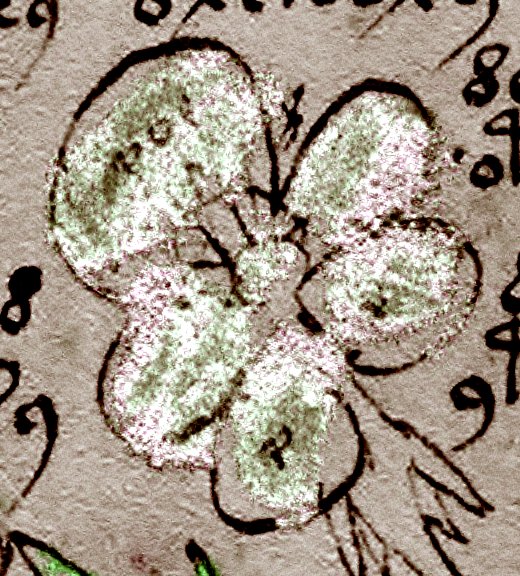
Note that even though I tried really quite hard to image process this to a satisfactory state, I didn’t really succeed to the degree that I’d hoped: but still, I think it’s good enough to see that (a) the claim that the top left petal clearly says “rot” doesn’t really hold up; (b) that there are colour annotations in at least three of the five petals in the same hand; and (c) that the colour annotations are even smaller than the Voynichese text.
Let’s move on to the claimed colour annotation in f4r’s root. In “The Curse”, I built a whole cryptogrammatic superstructure on top of my reading of this (rotated) as “TOA”, which is one possibility (though in retrospect, I do see how it seems a little hopeful). However, I also think that reading “rot” here (as a column of letters) is just as hopeful but in a completely different way.
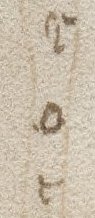
However, if you assemble these two (claimed) colour annotations onto the same page and add in the f66r and the f116v marginalia, I think you find something really very surprising indeed:-
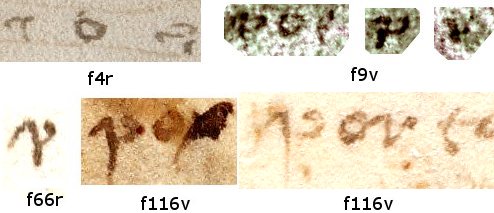
What I’m claiming is that they all seem to share the same unusual-looking “topless p with a preceding upstroke” first letter (even the supposed “portas” word, which I’ve never believed was the right reading at all). What does it mean? Was all this added by the author or by a later owner?
Update: here’s the leaf Voynichese painted over in f2r René mentions in his comment #1 below (but with the green paint removed), with the rather puzzling EVA “ios.an.on“:-
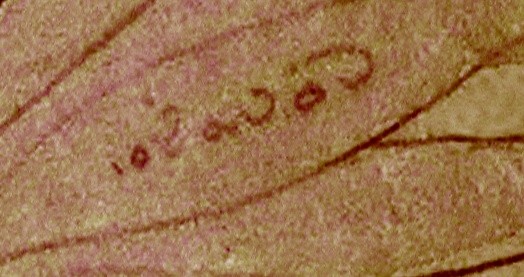
I’m not a paleographer, and I hesitate to argue about the definitive
reading of the characters in the viola tricolor, but there seems to be
little doubt possible about the reading of ‘rot’ in the root of f4r.
The key, really, is in the parallel with Vicenza MS 362, which also has
‘rot’ in roots of some plants (one I have seen), and which is from the same
time as the Voynich MS and also from N. Italy. It is one of the alchemical
herbals which Toresella has compared to the Voynich MS.
Of all the marginalia in the Voynich MS, these are the most likely to be
from the original author / scribe.
The really, really interesting corollary of all this is, in my opinion, the fact
that there is also one example of Voynichese writing in one leaf in
the same part of the Voynich MS. It is distinctly possible that this
says ‘green’ one way or another. I won’t claim that it is certain, but
it is certainly quite possible. Thus, turning (Eva) ‘ios.an.on’
(tentative reading) into green could be the key to solving the Voynich MS.
I think it highly unlikely that that stands for green – why use 7 characters on page 4 to represent what was represented by 1 character on page one – much more likely in my opinion that he broke of here temporarily and scribbled that to remind himself of something knowing it would be covered by paint later.
By the way, better images of Vicenza MS 362 are available on the net, but
they are ‘hidden’ by the fact that the MS ID for them is incorrect. They
are sold as posters of MS 320 M. Here’s a link:
http://www.bridgemanartondemand.com/art/142289/Ms_320_M_Fol31_Herba_Poleximas_from_Liber_Herbarius_una_cum
The images here can be enlarged by clicking on them. Under
‘related images’ there are a few more.
Some googling will turn
up even larger images.
The library also doesn’t understand where this invented “shelf mark”
comes from.
The sequence ‘ios.an.on’ (or something similar) is unusual ‘Voynichese’.
If the author started by making drawings before writing text, this may
also have been one of the very first words written.
But let’s explore a little (yes, it gets speculative now). What if Voynichese
is indeed like a verbose cipher, and also like a universal language at the
same time. The author could have imagined inventing a script that
could be used to write all languages. The characters describe the
shape of the letter. Thus (just as an example), ‘ios’ could
represent a handwritten ‘g’, ‘an’ a handwritten ‘r’ and ‘an’ a handwritten ‘n’.
Then it would encode the (abbreviated) ‘grn’.
This is close to what Elmar Vogt proposes at his blog.
This would go a long way towards explaining some of the features
of the Voynich MS:
– it will make it look like a verbose cipher
– it gives rise to a word structure with the an anomalous entropy
– it explains the ‘line as a functional unit’ as character shapes of
a source text at start and end of lines would be different
– it is easy to imagine how different source texts lead to A and B languages
Exploring this further would seen extremely interesting.
It couls also be a complete waste of time ;D
Leaf f2r: Are you sure it’s voynichese? It looks like “iolan[th?]on-” to me. Close to the greek iolanthos = violet (the flower). The plant doesn’t look much like a violet, but hey, maybe it was someone’s incorrect guess.
To Rene: this is a very interesting conjecture (if I’ve understood correctly) that the VMs words code for letter shapes. I did look into something similar, namely that they code for letters and groups of letters in various plaintext languages, here, but didn’t get very far. If the VMs codes map to single letters, and there are around 10,000 unique words in the manuscript, we would have too many letters – so that cannot be what you mean, exactly?
If you include Nick’s “layered cipher” theory to the stroke theory, I believe it explains why there are more different Voynichese words than letters in ordinary alphabets.
Julian, in this ‘though experiment’ I was thinking that on average 2-3 Eva
characters could represent one plaintext character. This is not at
all a new idea of course, but it would be one way how the relatively long
string inside the leaf could mean ‘green’.
That would of course depend on how you spell “green” (and in what language). 🙂
Oh, and just to muddy the waters yet further, I’d point out that it looks to me as though both of o’s in “ios.an.on” have been emended (as well as painted over). Also, I’d transcribe it as “ior.an.oin” too (i.e. “r” rather than “s”, and “oin” rather than “on”).
Yes, as I already indicated in comment #4 it is not straightforward to
read. At this magnification, image artefacts (possibly enhanced by
the post-processing) start playing a role.
Whatever langauge the ‘green’ is in, it doesn’t seem to be the main
language of the Voynich MS, it being so atypical.
Thus I further speculate that the Voynich MS main text is not in
German (or rather, not a rendition of a German source text) 😉
There is a nice “B” in the leaves of the plant on f39v, which I show on my (new) blog.
Since it appears in an unpainted area, I propose it is an instruction that the area is to be left blank.
🙂
Yay, this is my field! Etymologically it does make sense. Blank (or cognates thereof) exists or existed in most western Indo-European-derived languages, and at around 1400 it evolved the meaning of “empty space” in English. It was borrowed into English from Old French, where it also had a meaning of “white” or “colorless”, so a word reminiscent of “blank” did exist in most Western European languages in the Quattrocento and it also bore a meaning which would make sense when applied to this instance.
Good grief … and I thought I was joking 🙂
Pingback: Colour by Numbers « Computational Attacks on the Voynich Manuscript
I’ve sometimes thought the 3-twist root thingy-s look not unlike a mark that appears on Khazar pottery… They seemed to like using bows and arrows, too.
Pingback: Writings in plants « Some Voynich ideas
There’s a pun built into the picture on fol.1v which only works in a handful of languages: those which derive their word for cloves from the Latin ‘clavus’.
I won’t add a link to my own site though, unless Nick thinks it’s worth adding.
Perhaps it’s on a different post – but surely someone thought to suggest that the letters refer to the pigment which can be got from the plant/s concerned?
A particular green (e.g. for the Hajii’s turban, or for vestments etc.) could explain the one-off form.
what puzzles me is why anyone would need to write an instruction about how to fill in the colour for plants that everyone would know, such as a viola (9v), when pictures of plants unknown in medieval Europe at that time are coloured in quite complex patterns, and accurately, without any such guide.
(the banana is the one I’m thinking of – and about which I agree with various other people, as I do that 9v represents violas).
And then, of course, the violas aren’t coloured red, unless the painter’s definition of red differed from mine.
I’ve found another script with similar forms, especially that you illustrate for f.66r.
Its an old (early medieval) script. See stone-carved letters in latest ‘Voynicheriana’ picture.
http://dnodonovan.wordpress.com/2013/02/11/voynicheriana-17/
חֲסַר נִסָיוֹן = green (as raw, fresh, young)
ios.an.on
Sephardic transliteration:
KHSR NSION
or KHSR NSIUN
or KHSR NSIVN
Yiddish
KHSR NSION,
or KHSR NSIUN
I have the transliterations from Steven Morse
http://stevemorse.org/hebrew/heb2eng.html
mentioning this only because the same folio has additional text written on the flowers, in even smaller letters and this type of fine micrography is considered exclusively Jewish or Karaite.
Ashkenazi
KHSR NSION, KHSR NSIUN, KHSR NSIVN
For hidden writing aficianados, I think the plant (unidentified to me) depicts in the leaves, a use for hands and feet (five lobes) and the roots provide a clue that the use is for “fists” and “feet”. An idea for the hidden writing is “los on arch” i.e. “solution” (German abbrev. for losung” “arch” is “a [x]ch” where the last character is the Armenian for ch and contains a macron indicating a letter is missing ahead of the ch, in this case “r”. So, in brief, a solution would be used on the arch of the foot? A suspicious amount of German but many test decrypts tend to turn it up.
Thomas, if you could find any equivalent recipe in a contemporary document I hope you’ll post the reference.
Diane, There are no training wheels at this stage. Everything is “ab initio” If there were equivalent recipes somewhere in the herbal literature, royal smart people would have discovered them decades ago. There would be no mystery and the VM botanical weirdness would have been cracked long ago. If I should ever stumble upon an “arch relief” potent from some herb, I will certainly post it.
The oddness about hidden writing is that it might have gotten more and more hidden with the successive retintings. The present tinting is very crudely done. I think original green water color (or ink?) is seen on the “fouth finger” of middle leaf on right side and maybe the right-most flower bud. The fourth finger was not retinted evidently so as not to obscure what might be the name of the plant? But my printer is not quite up to those little glyphs. Maybe something like “[x]troain” where [x] might be “s”. I think the “9” with the tail indicates a scribal abbreviation and a letter precedes the “9=t”. Anyway for aficienados of hidden writing, why make the job even harder? I am guessing latter tinters were really interested in just slapping on the color willy nilly and were clueless about burying any additional information. If they really wanted to obscure things, why not go whole hog and also do that “stroain”? Baffled as always. Cheers, Tom
Dear all, A small point. Maybe the ID of the plant was allowed but not the use? So whatever the mini glyphs meant as a way of identifiying the plant of f2r was OK but not the hidden writing indicating the use of that plant? If too much hidden writing could be figured out, then maybe the way the plants were used and the coded mnemonics could also be deduced? If that hidden writing does pertain to a use or uses, it would imply that the VM was intended for even an uninitiated herbalist who could benefit from little embedded clues as to use? A pro would know.
Thomas
Your chief difficulty here is that there are so many examples of what you call ‘microglyphs’ and they occur in manuscripts of the appropriate time, and are a phenomenal skill of the Jewish scribes.
By default, on folio 9v, they must be deemed Jewish work too. I can see no way around it, in terms of the historical record.
dear thomas
there are numerous medieval texts for pharmaceutical recipes, and people who work in medieval studies and manuscript studies have added substantially to our understanding of matter relevant to this fifteenth century artefact.
Since it is, pretty plainly, not a work unique in those terms, we are more fortunate than Wilfrid, who initiated study of this manuscript so long ago.
Diane, Nothing is ruled in or out to my way of thinking.
I was just pondering one point: If the herbs or plants are so completely disguised, then what is the practical use of the VM botanical? Some part almost has to connect with reality or the thing is just totally make believe and useless. On re-examining those leaves on f2r, I noted that six exist and not the expected four if they are meant for hands and feet which I think the roots clearly indicate. The top part of the roots symbolize the prehensile grip of a hand and those little curves at the bottom of the “legs” are feet, I think. Now it will be noted that many leaves have the ends untinted and I think these are nails but honestly, if someone said, claws, I could not disagree. Back to the main point, maybe for f2r, what counts are the three blossoms? The rest is just smoke and mirrors. BTW, There are many versions of Hebrew that have been copied by Christians, like OT studies, and run LTR. Stone originally though Armenian to be Hebrew as there are some strange overlaps. But Armenian has no tittles or jots and always ran LTR..
Battle of Troy anyone? Looking again at that tiny epigraph on the right margin of f2r, with higher magnification, I see that the 9 glyph has no long extender so I am back to calling it simply a “t” and the rest follows as “troaie” which is Latin for Troy. Problem is that under high magnifcation there seems to be a period at the end. Dunno about that. You will note also that the “n” has become an “e” as it is loopier than the usual glyph (the inverted gamma) that I think is an “n”.
For Diane who cares deeply about who invents expressions, I used the one, “mini” glyphs, but “micro” is fine by me if it is already in use as I suspect it is. Anyway, If this tiny thing really has to do with Troy, then this will re-energize “b” who seems to find mythology under every rock. Who knows, maybe she is onto something? All my peeps can handle at the moment! Cheers, Tom
Another thought. Maybe the little plant of f2r (some kind of thistle?) was actually spotted at Troy? I have been to that spot (Hisarlik) in extreme Eastern Turkey which I found to be a huge disappointment. Way inland now due to river silting. Archeologists have dug it up to a fare thee well. Schliemann went right through Homeric Troy and hit some Hittite level where the gold of Troy was found. It ended at the great museum in what was East Berlin and is now in the basement of some Russian museum as a spoil of war. I suppose it is only fair as the Germans smuggled it past the Turks and into Greece and thence to Germany. Both the Greeks and Turks have a better claim to it than the Russkies.
Dear all, An “oops”. Hisarlik as the site for ancient Troy was not determined until well into the 20thC. If f2r does refer to “Troy” in that little right hand miniscule writing, then it would likely be the site identified as Homeric Troy in the times of Alexander the Great and named as Troas Alexander by him and the Greeks. That was a dud in terms of archaeology and it took an Englishman consul to determine the actual site and direct Schliemann to it, who had wasted a lot of time digging around at Troas Alexander..
Troy and Chios, a connection?
Homer is considered by many to have been born on Chios but this is conjecture, as is Columbus obtaining maps from the Genoese cartographers of Chios and even having been born there. His “house” is there, what more proof do you need?. No true Chiot would doubt either.
What is very likely is that the ships of the Greeks would have used Chios as a way station enroute to Troy, which then was a port at the head of the Aegean and controlled shipping up into the Black Sea. The Trojans were considered pirates by the Greeks and economists consider unhindered trade the basis of the Trojan war and not the abduction of Helen. Shucks, there goes another myth!
BTW, that little micrographic writing on f2r seems, on a quick scan of the botanicals,,to be the only occurrence. This seems very odd to me and maybe indicates that we should attach some greater significance to it. But what?.My first assumption was that the plant was collected in the vicinity of Troas Alexander but then why not indicate the collection sites for other plants. Troy must have had some other relevance to the Voynich creators, like fitting into some mythology of their own? As ancient Romans considered themselves tied in with the Trojans in the Aeneid. Is that in play here?
Dear all, Lord Byron learned Armenian and wrote two English Armenian dictionaries. He considered that if God were to write and speak a language, it would be Armenian! Well, allowing for some manic enthusiasm here, the Armenians did promote a lot of boosterism and a tie in with the defeated Trojans was among them. An excerpt from an Armenian history follows:
“Another wave of Indo-Europeans entered the scene around the 12th c. BC, by a race called “the people of the sea”. These are thought to be Thraco-Phrygians retreating from Mycenae and Thrace and Phrygia, probably survivors of the Trojan War, which occurred at the same time. First inhabiting the land immediately East of the Trojan kingdom in Asia Minor, the Thraco-Phrygians settled on the Western edges of the Armenian plateau and intermingled with the Haiassa-Aza, further developing Indo-European language, culture and physical features.”
Could this explain that microglyph “Troaie.” on f2r. But why next to that ho-hum thistle-ike plant?
Dear all, A plausible ID for the plant on f2r is: scolymus hispanicus or spanish thistle. It is found widespread throughout the Mediterranean and particularly in SW Europe. A charming reference that many Voynichers have no doubt used is Pliny’s 13th volume on natural history where a link in charming old English is: http://penelope.uchicago.edu/holland/pliny13.html
It has an interesting first chapter on perfumes, the evils and benefits thereof. The nonwearer achieves the benefits; the wearer less so. Also it is difficult for the wearer to avoid detection when fleeing and ending in a “tight spot”.l [my loose extracts]. Still searching for a link with the Trojan War. I think there may be one with Achilles.
Thomas,
I like the Armenian thesis – I really do. But Armenians were Christians and the Vms shows no sign of Christian, nor Muslim, thought. Even the Tuscany Herbal of 1440 shows its roots in Muslim culture, but the Vms .. none.
Also, there’s the issue of codicology. A manuscript can be dated and its place of manufacture determined, these days, by reference to how the parchment was manufactured, and the range and composition of pigments, including those with such contaminants as zinc or atacamite.
That doesn’t mean the infomation can’t have come from the *region* of Armenia, but as it is the Vms can’t be deemed an Armenian (=Christian) manuscript.
Probably excepting the inscription on f.116v, the Vms shows no indication of Latin or Byzantine Christian practice.
It contains very strong indications of non-Muslim and non-Christian culture and mores, in art at least.
This isn’t something to be explained or waved away as distraction from a preferred story. We have to deal with it, because where the imagery was gained, so too perhaps the language(s) underlying Voynichese.
imo
Diane, I totally agree that the lack of any religious context in the VM is unusual and troubling. There are two crosses in the bathing section but both look to be additions at a later time.
I came at a alleged Armenian connection mainly from a study of the enciphered text which uses a number of unusual glyphs that are of Armenian origin, like the fancy “8” like glyph that has a thick rocker at the bottom and was introduced as an “f” to Armenian in the 13th C.; the tipped question mark like glyph that is the “ch” sound in Armenian; the “8” and “9” which are used in the Armenian counting system as many other systems (Arabic, hebrew) that used letters instead of “arabic” numerals, the “4”, the “backward” S and the incorporation in medieval times of the Latin m, n, o and a. There are embedded clues in the botanical or pharma sections that point to Armenian uses, like the elephant head to repesent an “elephantiasis” cure using black plantain.. Sentences are written LTR and are free of punctuation (as was some Armenian cursive) and the glyphs are free of true diacritical marks which was true of Armenian, a phonetic language. Armenian scribes were famous and their inks (over 200 are supposed to have existed) were as well. As long as test decrypts (like “Troaie= Troy” for the microepigraph on f2r) continue to make sense, I am staying with Armenians having had some hand in this thing. I think there is clear Arabic influences also like that red symbol on f1r. It sure looks to my eye like the Arabic ligature for “Allah” and other hidden writing looks arabic. I like Chios as a port of call for the VM as I think the 9 rosette page depicts aspects of Chiostown and all the bathing pools are, I think, the above ground cisterns that Chios was famous for. Very complex irrigation systems were devised with the pumped up water in those cisterns. The color blue predominates for headwear in the VM and might indicate the VM came from an area under Seljuk control as Christians were forced to wear blue caps or scarves as a distinguishing item of clothing. The 30 day “zodiac” calendar with every day named was also an Armenian custom. Lastly, that “gator” replacing the scorpion for Scorpio can be found as a “Nhang” in Armenian folk lore from the Mesopotamia area. All for the moment; more anon on the proposed Armenian connection.
Diane, Moving up to the level of symbolism. The Armenians were sort of eastern thinking in that they bought into yin/yang symbology. Some in the botanical sections are pretty clear like the fern with yangs and many positioning of leaves (right side only or left side only) and colors (earth colors (orange, red) for yin (female); sky blue (yang) for male. leaf shapes are often clearly yin or yang but since they are really mirror images, “if it is not port, it’s starboard” and I have yet to find a way of definitively assigning male or femaleness to the herb, once the helpful little dot is removed. The translation of Amirdovlat Amasiasti’s herbal by the Russian Armenian Stella Verdanyan is useful in indicating the wide ranging interests of an Armenian physician and herbalists and herbs from Persia and Yemen are discussed. Many herbs are designated for male or female use and applications are very clinical in the area of human reproduction. His herbals were not illustrated but in the 16thC, Armenian herbalists did illustrate what essentially was A.A,’s herbals, one rudely titled “Useless for Ignorants”. The appearance of the ampersand in the VM is really puzzling as it did not really get going until the era of printing. It was used in the southern monastery that Nick and ‘B” have researched where a strange local Latin was used, whose name escapes me at the moment. “&” popped up in later Armenian cursive but it is not in Stone’s huge paleographic survey at all, despite his private note to me that it is there. It amounts to a mirror image of the Armenian “f” glyph that in turn resembles the treble clef signature. One likely scenario is that this thing was only made to look as though Armenians had a hand in it and might have been, for example, scribes writing in Czech Latin. There are elements in the VM that, to me, appear to use Czech-based Latin, i.e. many German words, no “q” and no “w” and the use of Armenian “ch” phoneme for the c with a little v diacritical introduced in Czech by Jan Huss and still remaining, for instance, as the equivalent of ch in a name like Kovac. Armenian glyphs might have found ready application in some phony baloney allegedly alchemical text. I think the apothecary’s jars are color coded for earth (green), fire (red) and water (blue). No air necessary here.
Dear all, Undoubtedly it will occur to many that if Voynich was Polish/Russian he must have known Armenian well. Did he suspect Armenian work in the VM or did that escape him? If the former, then he for sure knew it was not likely to have a Bacon connection?
Dear all, Related to the idea of ink compositions, impurities etc. that might help in dating and placing the VM. I think it would only be original inks that would be useful in this context. Most Inks/watercolors/goaches/crayons were added at dates much later than the original creationl. The somewhat good news is, I think, that original coloring can be found in many of the botanical illustrations and some of the bathing sections. The newer scanning Raman spectroscopy would help here. It would be useful also to know the animal(s) used for the vellum.
What I have read about the typical iron gall inks has surprised me in that often it degrades vellum and paper as time goes by. With the VM. whatever formula was used for the ink was well chosen as it has survived with no erosion to the vellum at all after approximately 500 yrs!
We might get lucky and find encoded the date of writing. I think that viola (f9v) might be a candidate for supplying a date but have not exactly cracked it yet. The little character outside the viola to the right and between the rightmost top petals indicates to me that the hidden writing is to be read upside down. That little glyph was a “V” over a bar but the normal glyph in the VM (e.g. f46r) is a bar ABOVE an inverted “v”. The bottom two petals read from left to right in an inverted position “a.d.” making me think the date will lie encrypted in “doa” in the top petal. It is not Hebrew, nor Arabic, nor Armenian either. Suppose it is a Gregorian date with the Armenian assignments to the letters so that a=1;o=0;delta=50; one would obtain 1050 (although that is not the method of Armenian dating). Since the Armenian calendar is related to the Gregorian by the addition of 550 yrs, this would give a Gregorian date of 1600 a.d., a bit late to be a reasonable date unless the vellum sat around for 150 yrs before being used.which is unlikely!..
Dear Thomas
The manuscript is our primary source.
Every aspect of it – from finish for the parchment to the fine micrography on f.9v to its depiction of the sun as reborn from a lotus constitutes evidence of its origin and its manufacture.
The manuscript can’t lie about these things and to consider it an unusual example of what it is suggests a presumptive attitude – a comparison with some hypothetical ‘norm’ from which it deviates.
To consider that evidence of conflict as ‘troubling’ is something I should find troubling in itself; it suggests that one may have shifted from efforts to understand the internal evidence to efforts to explain some preferred theory about the manuscript – the constant temptation and bug-bear in the history of Voynich research.
The manuscript has to be taken as the norm – and if its evidence conflicts with the hypothesis…
But I still feel fond of the Armenian-Christian theory – I followed it up myself for about a year. In the end, and reluctantly, I had to say it couldn’t explain all the phenomena and had no predictive power – which is what any theory must do.
Thomas
The oppositionality (sorry to lapse into semitoic) you describe is certainly manifest in the ms. Your description of it as ‘Yin-Yang’ is a fair metaphor, but comparable habits occur very widely. In fact the ‘open’ and ‘closed’ seems to be the most general way of referring to the underlying idea, which is manifest not only as early as the biblical story of Moses and Aaaron, but again in imagery recovered from the Oxus treasure and conventional though much of the east, short of Chinese influence. It has been associated with the Karimi, but predates them in Persian imagery. I believe it is also reflected in the inscriptions on the month-roundels, though that post to my research blog (written years ago now) seemed to find no echo among those working on the language(s) and script(s).
I agree that it is found in some parts of the ms, if not all.
Some might take it to imply a Manichaean dualism.
Diane, recall that Armenian-originated zodiac that you astutely identified as having Persian influences and I finally traced to Isfahan, Iran. Not a hint of Christian influence nor any Christian symbols that I could spot. The question seems to me to be worth exploring for other examples of Armenian secular compositions. To be sure, that zodiac was considered unusual in being secular. I have read of Armenian works on mathematics and I have some examples of Armenian “scientific” writings (whatever those are) in the compendium of Armenian cursive ed. by Stone, et al., I don’t recall that the Armenian herbal “Useless for Ignorants” by Amirdovlat Amasiasti had any Christian allusions (it was not illustrated) but base this on an extract supplied by Stella Verdanyan. The VM could just be a case of “the exception proving the rule”. At least, I consider it a logical possibility, perhaps unlikely, but still possible.
Now what about those strange glyphs on the stem of f4r? I think it is very likely that they are Arabic glyphs and the topmost is an “h” in the final position; the next one down, that appears to be an “o” with one, possible two diacritial “dots” is an “isolated” aspirated “h” and the bottom most in an “l” in a medial position. These can be assigned numbers 8, 5 and 30, respectively. The letters have to be read from bottom up and the base is the left side of the stem. What does not fit is that the “o” like glyph should be isolated and the bottom upside down “t” like glyph should be initial, not medial. Arabic is strictly cursive with glyph forms for initial, medial and final and another set for “isolated” or “standalone”. The glyphs are nearly a perfect match for Arabic script BUT the indication of their positions does not match what is expected. And so far the number assignments do not translate to a date of composition of the VM, either. Still, I do think they are Arabic. Cheers, Tom
Dear all, The two Christian “crosses” that appear in the bathing section are on f75v and f79v. Both appear later additions. For example on f79v, the nymph uppermost in the left margin, is not convincingly grasping the cross, but it just lies in her open left hand.
The nymph toward the left of the bevy appears to be holding a popular Armenian fruit, the pomegranate. On 80v in the left margin is depicted what some have referred to as an armadillo. This is an unlikely I.D. as that animal is found only in the western hemisphere. I think it very likely is the “long-eared” hedgehog found mainly in Armenia. Right below, is a nymph holding what might be another pomegranate, this time with a hint of red.
Thomas,
re: that you astutely identified as having Persian influences and I finally traced to Isfahan, Iran.
Thanks for the compliment.Not trying to be modest, but it’s what I do and that example wasn’t especially difficult: Eclectic series, but with each influence clear.
Dear all, A punctillio on the glyphs on the plant stem of f4r. In ANCIENT arabic the “o” like glyph with one, possibly two diacritical dots could be initial (one dot) or medial (2 dots), not isolated as postulated in my post of 7-1, The western equivalent is “m”. The numerical value is 40. Not much help so far in providing a calendar year for the VM creation. Looking at ancient perso-arabic next.
Dear all, My very best shot at the three glyphs in f4r is reading from the bottom up: l; m; H. Problems still persist in that the “l” is “medial”, but the medial “m” and final “H” are OK. If numbers are attached according to the conventional “abjadi” system for Arabic consonants, they emerge as l(30); m(40) and H(8). When read as a date from top to bottom, nothing is convincing.. If “840” is considered legitimate (which is not according to convention at all), then the Gregorian date of 1447 pops up from an Arabic (hijira) date.To be a proper hijira date that would fit roughly into the medieval period of VM’s likely creation, we need three SEPARATE digits for 8,4 and some other single digit. Persian Arabic is nearly identical to classical Arabic and would give the same dates. End of the road on these glyphs as likely representing anything meaningful and “lmH” is probably just something mundane like the monogram of the tinter. These have to be Arabic glyphs however!!! Maybe these provide, at least, a usefull clue as to origin of the VM anyway?? Or are they just smoke?
Hello everyone!
Looking at the image of F83 v, I see some written under the green color. Have you ever talked about it?
Dear all, Turning to the microglyphs in f28v, I have used the magnified image provided in Nick’s book, page 173 and have a few comments. It is strange to find “arabic” (really Indo-arabic) numbering here but nowhere else in the VM? I think three assignments of Nick are correct. Reading from LTR, “417” but I have a problem with the last glyph. To my eye it doesn’t look much like a conventionally written “5” but looks spot on for an arabic glyph for an isolated “ay”, (a vowel for arabic that often uses only consonants), but with a strange wrinkle! It represents one of the few instances where PERSIAN arabic differs from conventional arabic in that the “s” like glyph in normal arabic would have two dots under it but not in Persian where they are omitted. The “abjadi” number assigned to that would be 10. If this interpretation is correct, then one naturally wonders “what is a single arabic glyph doing in this context”?
I think the unusual overlap of putative “5” and the “7” was deduced by Nick and that is in itself suspicious that some attempt at disguise is going on here. Maybe it is a permutation of the number set 4175 but why the underline under 4 and why is not the “5” more like the traditional numeral? One idea occurred to me and that is another stab at dating. If the numbers are 417(10), maybe the 7 should be incremented by 10, making it 418 and maybe in this case, the date is read RTL The arabs did not do this but read numbers the same way as non arabs although the letter number equivalents are written RTL. Well if the date were 814, the Gregorian equivalent would be ca.1436 a.d. The “7” glyph of f28v, it will be noted is way different from the folio and quire equivalent in the VM for seven (Nick’s book is very helpful on this point). The “4” and “1” seem the same. The microglyph on f28v is not really “hidden” but just as cryptic as the rest of the VM! Could it be a disguised date? Nick thought so but from a different perspective. I throw out another possibility.
Dear Ruby, My eyes fail to spot any hidden writing and nothing shows up after printing out f83v. Maybe Nick can use his color subtraction program as he did with the violet above? Sorry I cannot help on this. Cheers, Tom
Dear all, I was loading the dice on that dating attempt. If 417 be incremented by 10, the number would be 517, (not 418) and the Julian date would be approximately 622+517= 1139 a.d.. I could refine the Julian date (as the calendar used by most Arabs was a lunar calendar) but only if there is other evidence that the text of the VM is ca. 300 yrs older than the vellum. Not impossible as the VM, at least in parts, is a copy, but such a huge gap in time seems unlikely .
Dept of clarification and/or exposition. The monastery I was thinking of that Nick and also B have researched a bit was Montecassino and was in the Duchy of Benevento where they used a strange version of Latin that has some similarity with elements of the VM. It was strange evidently in using for “a”: “cc” or “oc” and a strange “c” like glyph for “e”. It was however among the very earliest non-Roman uses of the ampersand, and Beneventan was used mainly as a Latin variant from the 8th to 13th C but occasionally into the 16thC. It appears also in three monasteries in Dalmatia, across the Adriatic. Well complicating things further is that the original Beneventans were evidently Lombards, like the Genoese. A further complication still is that in the Duchy of Benevento is a cathedral town called (hard to believe!) Troia and was named that by a Greek, Diomedes, who ,legend has it, founded the settlement in 1018 A.D. believing, of course, that he and the settlers were survivors of the Trojan War. The actual founder was Basil Boiannes. Incidentally, a Pope, Gregory VIII, hailed from Benevento. There is some controversy as to whether the famous library at Montecassino was looted in toto during the WW2 invasion of Italy for Goering’s benefit of whether many of the books and ms material made it to the Vatican. Anyway, Beneventan did use the “&” early on (as did the VM) and there is now a second Troy in the mix.
Dear all, Diane has commented on Armenians in Isfahan, Iran in the medieval period. The “zodiac” I found in Armenian that she recognized as having had Persian or Iranian influences actually was written ca. 1450 AD and not after the forced migration (really a deportation) from Julfa in Aziristan to Isfahan in1604 ordered by Shah Abbas I. The Armenians were permitted only 3 days to hit the road but had to cross the raging Arax river where many drowned. Then the city of Julfa was leveled. Among the great losses were over 10K khachkars (stone crosses on stellae) that first were destroyed piecemeal then bulldozed by the Azaris ca. 2005 despite the remaining 3K being declared a world heritage site by UNESCO. Most of the stellae were formularic but a few were not. One featured in a thumnail on a U-tube site of Armeniana had two lions meeting head to head but having only a single head,very reminiscent of the roots of f34v, whose weirdness got a comment from Nick on p 100 of his book. Anyway, my point is that Armenians had been in Isfahan before that resettlement and were brought in by the Shah to continue their unique crafts and skills, such as working with silk.
Thomas,
Could you provide the link to that zodiac again? Thanks.
Thomas,
I think we have wires crossed here. The Persian was *one* of several influences in that zodiac which you linked to and I commented on.
I agree I first raised the Armenian presence in the eastern sea, and its trade, but that was in the broader context of tracing origins for the plants and styles of drawing in the botanical section. In the same context, I’ve described the work of John of Montecorvino, and various forms of eastern textiles and so forth – including the Greco_Egyptian imagery found along the routes which carried eastern goods to the Med. in earlier centuries.
The trouble with an ‘Armenian’ thesis is that motifs inseparable from the Armenian style are not in the Voynich, and motifs in the Voynich are never seen in Armenian art. Armenian Christians, so far as I can discover, never adopted a system of ‘5 elements’ – which I read in one folio.
The good news for you is that (as Rene once mentioned) there is a television station… no, perhaps a magazine of some kind.. which is interested in the Armenian angle. You never know, if you persevere with your Armenian thesis, you may become another television company’s ‘Face of the Voynich’. You never know – and all good luck to you.
Diane, That link was to a U-tube presentation of a medieval Armenian zodiac.
http://www.youtube.com/watch?v=_gjN5yTmO8A
Note that the texture of some animal bodies is indicated with parallel hatching. This might have been influenced by Florentine goldsmiths or developed independently in Isfahan in the period of the composition of the zodiac (ca. 1450 A.D.),
Dear all, The definitive site for those stone crosses used by the Armenians for gravestones is: http://www.khachkar.am that has a timelined gallery off in a left hand margin. If you look under 15-17C, you will find a fine illustration of the two bodied one headed creature (3rd line from bottom at the right) and under “Jugha” another but this time with a cat like head and only 6 legs total (second row down on rt). Nick has commented (his book, p 100) on the strange roots of f34v where the head of a creature they resemble that he thinks could involve two horses , has presumably had its head deliberately defaced with a puncture. If these were indeed used in a religious context by Armenians in their khachkars, maybe this is some kind of iconclastic operation?
Thomas
Thank you.
D
Dear all, Forcing the issue a bit on those two “horses” on f34v. Just suppose they refer to two of the four horses of the apocalypse mentioned in the New Testament book of Revelations? Book 9, verse 19, even has one or more with serpent-headed tails “For their power is in their mouths and their tails were like unto serpents and had heads and with them they do hurt” (King James version). Well, no serpent headed tails here but we did see that depiction (Persian influence?) in the medieval Armenian zodiac In Revelations 9:17, the heads of the horses were “as heads of lions”. The biblical context for the roots of f34v might be a stretch but why do similar imagaes appear on Armenian khachkars and flanked by what appear to be angels?
Thomas –
an afterword on that zodiac. It looks to me like an instance of the Armenians’ effort to replace works lost during the waves of invasion and destruction that had occurred 12th-15thC. Its combining Persian with Egyptian and other imagery strikes me as reflecting a kind of cross-cultural ideal seen earlier in astronomical imagery recorded in works produced from Baghdad and i which I’m inclined to see the continuation of a practice among astronomers of Khwarsim, a region where evidence of synthesis between Hellenistic & Indian astronomy exists from the 1st-2nd C AD.