
A nice email arrived from Paul Ferguson, pinging me about Giovanni Antonio Panteo/Pantheo (i.e. not the Giovanni Agostino Panteo who wrote the Voarchadumia as mentioned here before) and his book on baths & spas that is listed in the STC as Annotationes ex trium dierum confabulationibus (printed in Venice 1505). According to The Story of Verona (1902), this balneological Panteo was “an author of various works in Latin, and a friend of all the learned men of his day“. His book begins:-
Annotationes Ioannis Antonii Panthei Veronensis ex trium dierum confabulationibus ad Andream Bandam iurisconsultum: […] in quo quidem opere eruditus lector multa cognoscet: quae hactenus a doctis viris desiderata sunt. De thermis Caldarianis: quae in agro sunt Veronensi…
There are a fair few copies around: for example, in addition to its other textual artefacts 🙂 , the Beinecke Rare Book & Manuscript Library holds one. Back in 1998, Christies sold one for £1,495, but a cheaper option is to get a microfilm copy (from NYU’s Reel #491).
Panteo’s original manuscript has been dated to 1488, and is held in Verona as MS 2072 (about a page down):-
Giovanni Antonio Panteo, De thermis Calarianis; Andrea Banda, Sylva Caldariana suo Pantheo. Manoscritto cartaceo, ultimo decennio del secolo XV; mm.300 x 200; ff.150; scrittura corsiva e littera antiqua, inchiostri bruno e rosa; iniziali miniate decorate, tre grandi disegni a penna colorati; legatura recente in cuoio. Ms. 2072
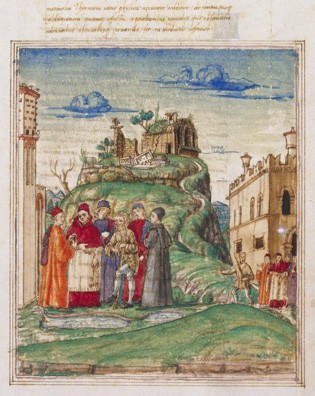
The description given there says that this is a humanistic manuscript, and that it contains three large coloured diagrams “of great interest for the attention and documentary realism with which they represented the characters, landscapes and architectural details: the unknown artist was probably aware of the stories of Saint Orsola that just in those years (between 1490 and 1495) Carpaccio painted in Venice.” However, it’s not clear if those three drawings were reproduced in the Venetian book version: or if they were, how well they transferred across.
Of course, the reason this is relevant to Cipher Mysteries is because of the baths depicted in the Voynich Manuscript: for if the vellum radiocarbon date (1404-1438) is a reliable indicator of when the VMs was written down, then we should arguably be looking closely at 15th century texts on balneology to try to place these into their historical context. This is because the 15th century saw the medicinal cult of the hot springs’ rise to prominence, as well as its fall – by 1500, people believed (according to Arnold Klebs’ book, which I discussed here) that spas and baths were the source of syphilis, causing interest in them to rapidly wane.
Unfortunately, the impression I get is that balneological historians tend not to look very hard at this period: far more effort seems to have been invested on stemmatic analysis of the many manuscripts of The Baths of Pozzuoli than on compiling synthetic accounts of the development arc of balneology in the 15th century. Please let me know of any books that buck this apparent trend!
Anyway, what is interesting is that there is actually a recent monograph on this balneological Panteo: “Prime ricerche su Giovanni Antonio Panteo” (2003 or 2006?) by Guglielmo Bottari, published in Messina by the Centro interdipartimentale di studi umanistici, ISBN 8887541272. 185 p., [2] c. di tav. : ill. ; 22 cm. Not many out there, but 40 euros buys you a copy here. Perhaps that might have more to say about this matter, and possibly even a copy of the coloured drawings in MS 2072 (which would be nice). 🙂
* * * * * *
Update: Paul Ferguson very kindly (and swiftly) passed on a link to a low-resolution scan of an illustration from Panteo’s manuscript featuring debating humanists, baths, and swallowtail merlons – thanks very much for that! 🙂
Do you believe that Panteo might have read the VMS and been inspired by it to pursue his own balneological interests (or just used it as a reference work when writing his own book), or do you suggest that the two books are in another way more directly connected than just being on the same subject?
Hi Nick,
Just found this image from the Panteo manuscript here:
http://www.cisapalladio.org/cisa/mostre_imma.php?imma=248&linguai
Paul
And here’s another book in Italian that might shed some light:
http://www.erudist.net/en/livre/?GCOI=26000100756050
Christopher: the connection is simply that they were both part of the same balneological trend that peaked during the 15th century. What is interesting about the VMs’ balneo section (or, rather, the early part of it that GC calls “Q13b”) is that it seems to maintain a sustained focus on baths and spas – most other details in the VMs that people try to latch onto are rather more fleeting or fragmentary.
Paul: thanks very much for those two links, I appended the first one to the end of the post and will be checking out “the secrets of water” very shortly. Looking forward to seeing your Voarchadumia! 🙂
First time I’ve ever looked really closely at the images in the balneological sections. As a linguist I tend to focus on the writing! However two thoughts occur to me:
1. Has anyone investigated the women’s hairstyles? Most seem to have braided hair or be wearing spotted bathing-caps. I imagine only very wealthy women would have had long braided hair at this period.
2. Has anyone looked at the Roman baths in Trier in the light of the VM?
“…swallowtail merlons”
And there was I thinking that swallowtail merlons were some kind of bird! I was looking everywhere in the picture for our feathered friends until I read the page on your Averlino hypothesis…
I remain in two minds about these swallowtail merlons (in the Voynich MS).
The statement in the ORF documentary is certainly wishful thinking:
that in the first half of the 15th C these would not have been so
widespread. I found that the ones adorning the tomb of Caecilia Metella
in Rome were added in 1302!
On the other hand, there is a walled garden in the manuscripts of the
Tractatus de Herbis. The oldest surviving MSS (14th C) originate from
S. Italy and have straight merlons on the walls. (See e.g. the cover of
M.Collins’ book). Then there is a copy made in Lombary in the first
half of the 15th C (MS Sloane 4016), where the merlons in this
illustration are ghibelline. It is on fol. 10v and this link should work:
http://www.british-library.uk/catalogues/illuminatedmanuscripts/record.asp?MSID=7796&CollID=9&NStart=4016
Rene: as you know, the choice between straight merlons and swallowtail merlons wasn’t stylistic but political, physically expressing the town’s or castle’s (or tomb’s, or herbal-writer’s!) allegiance. But as a dating mechanism, I agree that it sucks. 🙂
This is a brilliant picture; many thanks indeed to Paul.
PS Has anyone identified the building on the hill? It would appear to be a near-ruin, what with enough soil having accumulated on its curved roof that it supports grass and a fully-grown tree 🙂
The fine building to the right also seems a bit run-down, considering that the swallow-tail merlon only became popular fifty years before..
interesting.
I suppose the building on the right could be the Domus Mercatorum, which underwent several rebuilds, but it could be just an idealized landscape:
http://en.wikipedia.org/wiki/Domus_Mercatorum
BTW the hyperlink Annotationes ex trium dierum confabulationibus doesn’t lead anywhere if you click on it.
Oops, hyperlink typo now fixed – thanks Paul! 😉
Earliest example of swallowtail merlons I’ve found so far in Italy are on the main tower of the Palazzo Vecchio, which is dated to the late 13thC.
Anyone got a provenance for, or other examples of the curious chimney pots? I haven’t found any as yet in fifteenth-century Italy.
“Anyone got a provenance for, or other examples of the curious chimney pots? I haven’t found any as yet in fifteenth-century Italy.”
They look so much like chess-queens. I cannot recall seeing anything similar elsewhere.
The Ultimate Baths
http://historicaliran.blogspot.com/2009_12_01_archive.html
Paul.
At last I think I have the church in that link:
A Romanesque church, dedicated to St. Peter, built in the 8th century and reconstructed in 1138 by order of pater Uberto di San Bonifacio. The magnificent interior of the church is rich of medieval frescoes painted by the followers of Giotto School.
The massive bell tower dates from 1131 and used to serve as an defending tower. Later, in the 14th century, ghotic styled trifora was added along with a cupola.
and concerning the house, which still stands:
The San Pietro Hill always had strategic importance for the land around Verona. The first fortress thre was built in Roman times though later destroyed. In 1398 Giangaleazzo Visconti built a castle on the site of the previous fortress, naming it after the church of San Pietro in Castello (see above).
Now according to the same source, that castle was destroyed, initially by French army in 1801 and then completely demolished by Austrians in 1840; the present castle dating only from 1851, when an army barracks built for the Austrlans.
But apart from different merlons it looks extraordinarily like the older one.
Photos and info
‘The Hills around the Town, Verona’
http://www.virtualtourist.com/travel/Europe/Italy/Veneto/Verona-140824/Off_the_Beaten_Path-Verona-The_hills_around_the_town-BR-1.html
Cheers
The present look of the castle dates from 1851 when the Austrians built army barracs and the castle in that area.