
In 1931, John Matthews Manly (who was very sharp, both historically and cryptologically) pointed out that the Voynich quire numbers were written in a 15th century hand – you can tell this from the characteristic ‘4’s, ‘5’s, and ‘7’s. To be precise, even though a fair few of the VMs quire numbers appear to have been added later (most obviously the numbers for Q19 and Q20, but also those for Q6 and Q7) for reasons as yet unknown, the bulk of them are indeed 15th century.
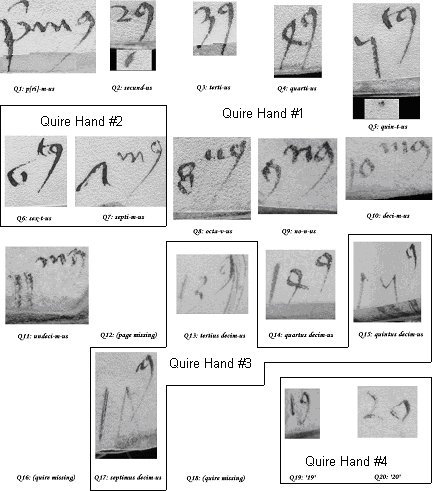
The four quire hands, from The Curse of the Voynich (2006) p.17
What isn’t widely known is that there is also a (quite different) 15th century hand in the marginalia. Even though some people like to dismiss the hard-to-understand writing on the back page of the VMs (f116v) as merely “pen trials” or “doodling”, I think you can look past the codicologically tangled mess to see that the earliest (faint) hand has distinctively 15th century letter-shapes, as underlined in green here:-
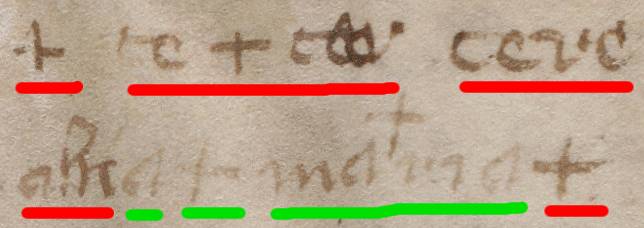
Whatever all the other words on f116v happen to read (and people will no doubt continue to debate that for a fair while yet), I’m pretty sure that this faint (but apparently unemended) section reads “a + ma+ria“, and that it is (from the distinctive shape of the three ‘a’ characters) written in a 15th century hand, one quite different from the quire numbers.
What does this tell us? Given that the Voynich Manuscript almost certainly turned up in Rudolf II’s Imperial Court in the first decade of the 17th century, and assiduous archival trawling has turned up no definite earlier reference to it, I believe that this points to two main scenarios to choose from:-
- [Real] It’s a genuine mid-15th century object.
- [Hoax] It’s a (probably late-)16th century fake, designed to resemble a genuine mid-15th century object.
To which I would further add that Voynichese is apparently designed to look like an enciphered 14th century herbal (i.e. written in a medieval simple substitution cipher, with medieval herbal illustrations, and medieval page references), even though the parallel hatching and handwriting are both 15th century in style. All of which suggests three scenarios to consider:
- [Real] It’s a genuine mid-15th century object designed to resemble an enciphered 14th century herbal.
- [Clever Hoax] It’s a (probably late-)16th century fake, designed to resemble a genuine 15th century object designed to resemble an enciphered 14th century herbal.
- [Dumb Hoax] It’s a (probably late-)16th century fake, designed to resemble an enciphered 14th century herbal, but with a number of 15th century details included by mistake.
All the same, is it really the case that one individual late-16th century hoaxer / faker was sophisticated enough to add multiple 15th century hands to the quire numbers and back page? Well… possibly: but it should be no surprise that I think the historical odds are very much against it. Your mileage may vary, of course.
(As an aside, it has recently been suggested that the VMs might have come from around 1300 (and I shall soon be posting about Patrick Lockerby’s series of VMs-related posts): but the presence of parallel hatching in the VMs would seem to be a strong indication that even 1400 would be too early a date.)
On the quire numbers:
the ‘p’ in ‘primus’ has the same open top as the first ‘p’ in the top margin of f116v,
although it lacks the serif to the left.
The descender of ‘tertius’ definitely extends to the underlying page, making it certain that
it was written when the MS was bound. The ink has the same colour, as I could
observe again last week.
I don’t think, however, that the descender of ‘secundus’ on another page, as
shown above, is real.
Cheers, Rene
Hi Rene,
Actually, I’d say that the first ‘p’ in the top of f116v is much more like the ‘p’-shape in the bottom left margin of f66r than the ‘p’ in ‘primus’. Make of that what you will! 🙂
It’s nice to have confirmation about the ‘tertius’ descender, but I think it would be incorrect to infer binding order – all that tells us is that the two pages have remained adjacent, which is a very much weaker observation.
Is your objection to my suggested ‘secundus’ overlap because it goes between (current) quires, or because you think the two are in different inks? It’s certainly in the right place (when I checked).
Cheers, ….Nick Pelling….
Hi Nick,
for the ‘secundus’ I do more get the impression that the ‘nine’ on f16v is complete,
i.e. it does not extend beyond the bottom of the page…
But I wouldn’t put a lot of money on it either way…
Cheers, Rene
Brian Clegg states :
“the emperor had been told that the manuscript must be bacons work because it appeared to be cryptically autographed by bacon. on the last page are three lines of text in a different hand from the book. they seem to provide an incomplete key to the code used in the main text. although this key is itself enciphered it uses a simple form of code already well known in the thirteenth century, so in theory this addition could have been bacons work. it seemed on decoding that the first few words read ‘To me, Roger Bacon’ – though to discover this the reader would also have to unscramble an anagram. The man who brought this inscription to the emperors attention is said to be the same man who sold it to him, a man who believed bacon to be much more than the caricature of the legend.that man was john dee”
(Clegg,B.,2003,The First Scientist: A Life of Roger Bacon,London,Constable and Robinson,pp 178)
Mark: Sadly, most anagrams of the truth are just plain false, this hopeful looking sequence from Clegg included. It’s true that there’s a fleeting attribution to Roger Bacon and a reasonably solid link to Emperor Rudolph, but everything else claimed here is almost certainly JPW (“Just Plain Wrong”). Sorry!
Hmm..i think clegg was implying that the last part was written by john dee using a thirteenth century cipher to try and ascribe the work as bacon’s in order to sell it. Dee was an avid collector of bacons work. i have twittered brian clegg to ask about his source for that part in his book – never know he may respond.
Mark: Clegg was almost certainly relying on a jumble of William Romaine Newbold and Robert Brumbaugh, both of them utterly wrong. Romantic historical accounts can persist for decades (if not centuries) if they somehow sound as though they ought to be right!