
Here’s a vogue-ish detail from the Voynich Manuscript – the (claimed) “armadillo” in the middle-left margin on page f80v. Of course, if this can be proven to be intentionally depicting an animal from the New World, then a lot of other dating evidence becomes secondary. But of course, this kind of controversy is nothing new: you only have to think of the decades-long hoo-ha over the (claimed) New World sunflowers.
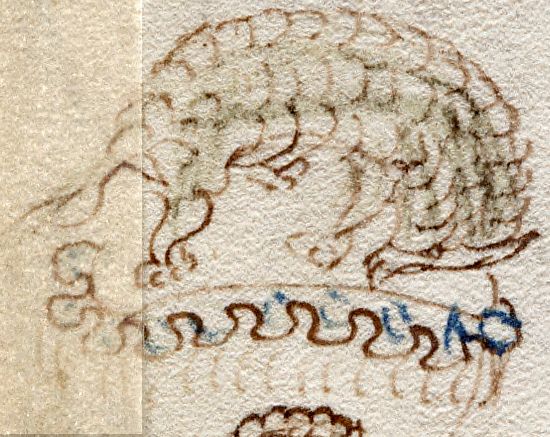
Armadillo proponents “read” this image as having a tail (on the left), three legs (with the left foreleg therefore tucked behind the head on the right), and a kind of upside-down armoured armadillo head facing backwards (with a sort of smiley cartoon mouth). Fair enough.
By way of contrast, I argue that because everything else in Quire 13 appears to be water-related (plumbing, baths, steam, rainbow, pools, etc), this is probably a depiction of a catoblepas – a fearsome creature Leonardo da Vinci (and doubtless many of his contemporaries) believed lived at the source of the Niger river, and whose bull-like head was so heavy that it permanently hung down to near the ground.
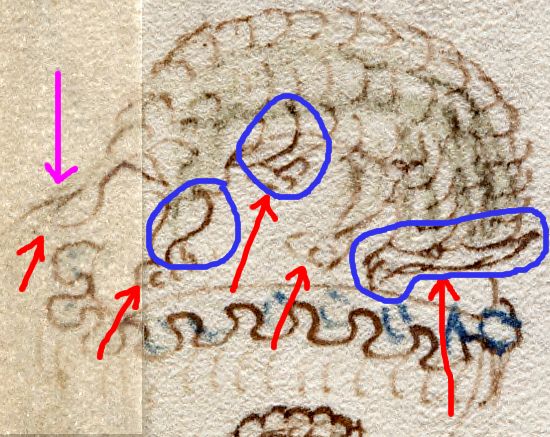
Specifically: what appears to the pro-armadillo contingent to be a tail (purple arrow), I read as a left rear leg, making all four legs visible – and what they read as an armoured armadillo head, I read as a pair of bull-like flat horns at the back of a down-turned head.
All the same, it’s not like I can’t ‘see’ the armadillo: it’s a lot like one of those optical illusions (such as the famous old lady / young girl drawing) where you can flip between two parallel readings almost at will.
But the odd thing here is that both the armadillo and the catoblepas might be equally correct. It doesn’t take a great deal of sophisticated codicology to look at the line strengths (in the areas ringed blue above) and note that a few key lines are in a darker ink, quite different from the ink used for the wolkenband-like decoration just below it. Could it simply be that some 17th century owner (for whom the catoblepas was probably never part of their conceptual landscape) thought this picture somehow resembled an armadillo, and emended it to strengthen that resemblance? I think that this is very probably precisely what happened here.
Now, this is precisely the kind of contingent, layered, conjectural historical explanation (basically, an intellectual history of art) that Richard SantaColoma has long enjoyed lambasting. Specifically, he sees any explanation that appeals to layered codicology as fully worthy of his scorn – as though it’s merely constructed as an apologium to keep the faith with the existing ‘mainstream’ dating evidence.
But actually, layered codicology hypotheses are among the most brutally (and easily) testable of historical ideas – unless two layers of ink added many decades apart just happened to use exactly the same raw materials (and in the same proportions), we will ultimately be able to differentiate them… or not.
However, unless people explicitly propose such layering hypotheses, nobody would think to do such tests – they’d perhaps spend all their codicological efforts on f116v (a valid investment, to be sure, but it’s only one of many possible areas of the Voynich Manuscript that should be tested for revealing information).
Indeed, the whole point of such historical hypotheses is not to prove historical narratives in and of themselves, but rather to lay the underlying ideas open to physical mechanisms of disproof. Bluntly put, any given hypothesis is usually of little or no value if it cannot be specifically disproved (because direct causative proof is as rare as hen’s teeth in history).
In the absence of any suitable tests on f80v, however, both viewpoints (and indeed all other fairly sensible viewpoints) remain in a suspended state of vague possibility, hypothetical kites floated carelessly into an unthreatening breeze.
Hmmm… how I long for such tests!
This Wild Beast, a bull with a boar’s head, is stampeding on a cloud, causing the rain, which is the source of the Niger. So I guess the woman below him is trying to control him with that bronze nose-ring she is holding?
/lor ar ol olor/, written in the text next to this image, strikes me as someone trying to spell out an unusual word…
Is this our smoking gnu?
Hi Myriad Falcon,
Given that the same water nymph is touching her bottom with her other hand, I think you have to be pretty wary about reading too much symbolism into these drawings. 🙂
But I’d certainly second the idea that lor ar ol olor is an unusual word, and it even seems to be slightly highlighted on the page (not sure why that should be). And as I see almost all of these as verbose pairs, I’d parse it as l.or.ar.ol.ol.or, i.e. an ABCDDB pattern. All the same, be careful because word-initial “l” is a real Currier-B phenomenon, and so probably represents something more than just a single letter. My guess is therefore that the plaintext for this will turn out to have the pattern “ B C D D B”, where all the letters encipher consonants. Unfortunately, that seems likely to be neither CaToBLePaS nor NiGRiCaPo: but feel free to come up with a better suggestion!
Sorry for not being more specific! 😮
Cheers, ….Nick Pelling….
Hi Nick! I live in armadillo country and I don’t see an armadillo here. The tail is long and thin, not like a tail interpretation of the rear appendage would suggest. The head held down isn’t typical armadillo behavior – when frightened they do roll up in a ball but they do that on their side. The shape of the ears don’t quite fit what’s seen here.
It’s interesting that German settlers in Texas called them “Panzerschwein.” That’s something we Americans could have called Germans in WWII. 🙂 We weren’t very creative or even very derogatory, we just called them “Krauts.”
Hi Dennis,
Even if I had sufficient mental agility to defend the armadillo hypothesis against all-comers (as a kind of debating society exercise), I must confess that I would still be sorely tempted to duck the challenge. 🙂
Incidentally, my only brush with the world of the armadillo was many years ago when I unknowingly ate some stewed armadillo tail… but that’s a long story. 🙂
Cheers, ….Nick Pelling….
Nick: Thank you for an interesting post. Your readers might also be interested in the page I put together, showing various armadillos in engravings and pictures, along with some other suggested interpretations. I will add your catoblepas interpretation to the page as soon as possible: http://www.santa-coloma.net/voynich_drebbel/armadillo.html
I have no interest in, or habit of, lambasting anyone’s opinion or interpretation. It may well be a catoblepas, or wolf, or pangolin, as well as an armadillo. I do not know what it is. I personally think it looks most like an armadillo. But even if I and a million people think it looks like an armadillo, it will not make it one, any more than if noone thinks it is an armadillo will make it more “not one”. It is what it is, whatever that is.
What interested me most… and I did not expect this when I first discussed the f80v animal… is the fact that overwhelmingly, those who hold a pre-columbian dating for the Voynich thought it was not (or said they thought it was not) an armadillo, while overwhelmingly, those with no knowledge or interest in the Voynich, or who held a later dating for the Voynich, thought it looked quite like one. This strongly implies that the identity of this animal is being driven by a preconception of the date range of the Voynich. I don’t mean to personally impune any one person’s well meant interpretation, only that the overall numbers practically insist on this conclusion… “in general”. It looks like a case of the tail wagging the armadillo.
The only two pre-Columbian Voynich researchers who thought it still looked like an amadillo had this reasoning: One said that it may have floated up to Europe, before Columbus, and the other pointed out that it looked “so much” like an armadillo that it probably was not one… because the art in the Voynich is generally so inaccurate.
I do not know the date of the Voynich, I do not say this is an armadillo. So don’t shoot the messenger… I am only giving my opinion of it, and my opinion of the feedback of others. You and others may well be right, and I full well respect that possibility. Rich.
My blog
post on the issue, for those interested.
Nick: When I wrote the above, I had missed the point you made, with “…and note that a few key lines are in a darker ink, quite different from the ink used for the wolkenband-like decoration just below it. Could it simply be that some 17th century owner (for whom the catoblepas was probably never part of their conceptual landscape) thought this picture somehow resembled an armadillo, and emended it to strengthen that resemblance? I think that this is very probably precisely what happened here.”
That seems to be a stretch. It adds to the three points I made in my previous points made by pre-Columbian Voynich adherents. I had washed up on the European coast before Columbus discovered the New World, and that it looked too much like and armadillo to be one… and yours, now, where you suppose it might have been modified later from a catablepas to an armadillo. To suppose that a later, 17th century artist went through the VMs and corrected this, and added that, to match their contemporary expectations, is, I think, once again projecting a complex solution to a some straightforward evidence… I prefer to simply believe the simple solution… that it is probably a newer
document
than previously believed. Rich.
Hi Rich,
The overall point I was trying to make is that different hypotheses have different (and testable) ramifications. The ramification of post-1600 dating is that everything that implies a pre-1600 date must be bogus and/or misinterpreted: that’s a stretch, too. Hopefully spectroscopy and physical dating will resolve this for you in a way that art history evidence seems not to be able to.
Cheers, ….Nick Pelling….
The catoblepas interpretation fits the creature’s posture, but I don’t think I’ve ever heard of the catoblepas being depicted as scaly.
That creature looks a bit like a dragon to me(although the long body and big scales, and the connection to rain clouds, are more reminiscent of Chinese dragons than Western ones…); there’s a dragon eating a plant root elsewhere in the manuscript, so this too could be an imaginary being.
http://en.wikipedia.org/wiki/Ole_Worm
Ole Worm’s Cabinet features an Armadillo in the upper right corner published in 1655 after Ole Worm’s death. My understanding is he kept some detail records of his finds or items he wanted.
much later than the voynich but still some evidence that they were likely collected? Your thoughts
Hi Travis,
There were all kinds of natural history collections in the late 16th and 17th centuries: if you’re interested, you could have a look at any number of books and monographs describing such collections (such as “Cultures of Natural History”), though I’m not sure what you’d be wanting to prove or disprove.
The word “armadillo” itself (‘little armoured thing, basically) apparently dates from 1569 in Spanish and 1577 in English – see “Joyfull Newes out of the Newefound World” by Nicolas Monardes, where the armadillo is first named and described – and I guess there would be drawings of it in other early books too.
Never mind that some people thinks it looks more like a pangolin, never mind a catoblepas. 🙂
Cheers, ….Nick Pelling….
Hi, I have been reading all this with fascination for a couple of days. I had never even heard of the Voynich Manuscript before and your site is really compelling & interestingly written.
Since I’m into zoology, I was very interested in this picture. I looked at some catoblepas accounts and only a few of them indicate that the animal had scales. More frequently they describe it as having not only a very heavy, but a LARGE head, and having shaggy hair on or around the head; and as being bull-shaped, which would suggest longer legs than in the picture. It also doesn’t much look like most earlier representations of the catoblepas, which look pretty wildebeest-ish (at least, the ones I could find on the internet…I’m no expert).
If the artist was indeed attempting to represent a real animal, it’s consistent with an armadillo or a pangolin (and not a perfect match for either). It doesn’t seem necessary to invoke North American animals at all to explain this picture, since (probably dead) pangolins and descriptions of them could easily have been brought to Europe from Africa OR Asia by this 1400’s, maybe with royal menagerie collections.
Thanks.
Found this post through a link in Prof. Bax’s blog, so I decided to comment in both places 🙂
What do you think of a basilisk? In his book “Promethean Ambitions” (partly available at Google Books), W.R. Newman quotes Paracelsus and Tostado Ribera who linked basilisk with “impure” (i.e. menstruating) women.
When I saw this drawing, I had no doubts what is. I’m biologist and scientific artist. For me that is quite good drawing of an Amphipod, probably freshwater Gammarus. The anntenae, uropods, telson etc, are clearly visible.
I don’t know, it doesn’t look much like an Armadillo to me.
I have seen it said elsewhere though that it could be a Pangolin (rather than an Armadillo).
Pangolin scales supposedly having medicinal properties.
When I saw this I first of all thought on a different scale…..insects. The creature could bare quite a resemblance to a wood louse or giant wood louse.
Then I looked at what the creature was standing on and came up with another angle. This could be argued to look like some kind of jellyfish, prehaps even a portuguese man o’war. So what is that on top ‘attacking it’ ? One of the few creatures able to attack and survive are sea turtles, due to their extremely thick skin. Squint a bit and you can just see it! 😉
Anton’s comment is very interesting, given the representation of a crowned figure in the ‘Cancer’ roundel.
Ideally, it would better fit the ‘Leo’ roundel, but is still worth a mention.
The ‘Cancer’ roundel shows a crowned figure who appears to be urinating or menstruating. If menstruating women are equated with the basilisk, then of course one’s first expectation would be that the star should be Regulus in Leo, whose name in the Greek is the same as that for the basilisk: i.e. basiliskos.
It properly means ‘little king’, but for the basilisk as such, or more exactly the basilisk-serpent, we have an association with North Africa. Pliny the elder says it is a “native of the province of Cyrenaica” in Libya.
I see that a star features on some Hellenistic coins from Cyrenaica, but what star might be meant as the ‘basilisk star’ I do not know.
Perhaps where we see a crab, others saw the Cyrenaica shrew? 🙂
The problem might be solved by reference to terrestrial and astronomical co-ordinates, if one were of a mind to it. Or indeed to investigate the Cyrene-ehoie according to Hesiod.
A Hellenistic coin from Cyrenaica showing the crab.
*shrug*
http://www.wildwinds.com/coins/greece/kyrenaica/SNGCop_1259.jpg
I might add that most of the emblems at the centre of these roundels find their closest comparisons on coins of the Hellenistic period – even the fairy-wand bearing figure used to represent Virgo.
It seems to me that the scales – if they are scales, are pointing the wrong way. As far as I know, all scaly animals on this planet have scales which point away from the head, which makes perfect sense when moving forward, however the scales in the Voynich drawing are clearly pointing forwards.
I have no idea what to make of that.
To me, it looks like an ordinary sheep with horns lying down. There are similar pictures in bestiaries and scenes of the Nativity. The coat of these animals mostly looks wavy like scales. And the woman over the animal looks like holding a spindle full of wool and a whorl at the tip.
I’m not sure what breed would be an ordinary sheep, and since this is not exactly like a Christian image of Christ’s birth in a stable, I’m wondering what meaning might be conveyed here. Could it be an instruction to the ladies only to do whatever they’re doing after they’ve done their chores around the farm? Or perhaps advising them to dry off using raw sheep’s wool. Could it mean that whatever-they’re-doing requires the preliminary sacrifice of an ‘ordinary sheep’ – nicely laid to rest. The possibilities are so intriguing.
Helmut,
‘fess up now – you’ve never used a drop-spindle, have you?
Diane.
there is something we call Experimental Archaeology. I have watched some women using a spindle and whorl and tried using it myself, though I was not very successful.
Helmut
In addition to the creature in question, also note directly beneath it are two meandering horizontal lines. According to *heraldry*, (see: heraldic lines of division) this is a nebuly line. A nebuly line differs from a wavy line because it is bulbous in comparison to a sine wave. The term nebuly is derived from the Latin ‘nebula’ or cloud. A much elaborated version of the nebuly line is often found in so-called cloud bands that often accompany the appearance of Christian and classical religious figures in some medieval illustrations. See Christine de Pizan and the Angers Apocalypse tapestry. Don Hoffmann has recently collected a number of such illustrations.
Not all cloud bands are nebuly lines. And not all such bands are pretty blue and white clouds. Some are fiery and solar, red, orange, yellow and gold, and they use indented and raonny lines from heraldry,
A nebuly line was also used as a cosmic boundary in the Nicholas Oresme illustration, which has been compared to VMs f 68v3 by Ellie Velinska.
VMs Quire 13 contains a number of examples of the use of simple nebuly lines. A couple plants have nebuly leaves. And in contrast, the central rosette of the Nine Rosettes illustration has a more elaborate example – with blue paint!
So what about the little creature? Do the nebuly lines figure into its identification? Do the lines mean that the creature is sitting above the clouds and that the little marks scattered about represent drops of rain? Could it be some sort of ‘rain dragon’ loosely based on a pangolin? But the rain dragons have their scales on backwards to catch the mists and collect them into droplets. Everybody knows that.
to nickpelling
your letters, remember???
lor ar ol ol or
I THINK HIS IST
lo raro e olor
OK, we all should agree that overall artistic quality of many readily identifiable Vm pics like castles, birds, fish, animals and some flora eg. is not great in accuracy or execution. So what gives with all the fussing and fueding over Senior Armadillo or Pasha Pangolin, apart from the obvious, in that on the one hand we have a set of scalelike body plates and on t’other, rooftile multi caudal scales like a pipe snake f’rinstance. We won’t benefit by going into the contested areas of respective new world and old world distribution, which from memory created some rather silly comments in Baxville some time back. One commenter obviously ignorant as to mammal skeletalia layout suggested that the presence of a raised backbone on f50v meant that it couldn’t possibly be one or t’other from memory….Getting right to the point at last, all mirth reduced to a dull roar if at all; Has anybody considered that, neither our Tex-mex and Afro-asian beasties can pass muster for the Vm apparition at all, compared to any one of several thousand known isopod crustatia bathynonomous varieties found all over the globe, even in the outer polar regions. Most intelligent Voynicherios will be aware of course that these harmless bugs include the lowly garden slater or wood lice of a centimeter or less in size, up to and including it’s giant Mexican ocean dwelling cousin of fifty cms and more…. I can’t help you here, but if one jumps over to Utube, a good hint of what I’m on about can be gleaned, by viewing one of several film clips on the creature. You can also learn how to cook one, should you wish but first, I implore you to take in the general body form, then, and more particularly the eyes and head, with which I promise, you’ll be instantly impressed, compared to our indistintive wee clouded ‘Armgolin’ or ‘Pengolarm’ mate. No need to go any further; y’all have had enough and me too.
Indeed. In my opinon it almost certainly is a catoblepas. To be fair, the first reference I found to that is by Andrew Sweeney on 13 October 2004:
= “To business: On folio 80v, in the left-hand margin, the second figure from the top appears to be a catoblepas. A catoblepas is an imaginary creature described in Pliny’s Natural History and later in medieval bestiaries. Essentially it’s an armoured bull that always looks downward”.
http://voynich.net/Arch/2004/10/msg00241.html
Then Sweeney gives two images with links that went dead by now.
However they have “catoblepas” in their url, so I don’t think they referred to the image of the Gorgon I found on the title page of “The Historie of Fovre-Footed Beastes by Edward Topsell (1607)
It shows the Gorgon (Catoblepas): https://i.imgur.com/ZBH25wb.jpg
To me it beats all other proposals since both with Voynich and Topsell it has its head down, a “regular” tail – not a fishtail, it is armoured, and it was well known in Europe of that time. Afterall it fits nicely in with the Voynich mermaid. The Topsell image would then be a copy of an earlier picture, maybe even the same image from which the VM writer had it copied…
Ger Hungerink.
Actually the wayback machine gave after trying several versions of the second of Sweeney’s links a page including the original image:
https://web.archive.org/web/20160616183014/http://www.eaudrey.com/myth/catoblepas.htm
And indeed it is Topsell’s title page illustration from 1607.
A compelling reason why the folio 80v animal is indeed a catoblepas and a picture copied from the same source as Topsell’s is the striking similarity. For ordinary real life animals that is no big deal – different artists would paint more or less the same picture – but since this is a mythical creature only fantasy dictates what it looks like. A search on the internet for medieval representations of the catoblepas shows quite a number of beasts, all totally different in design. Leaving a strong case for the Voynich and Topsell beasts being copied from the same source.
Ger Hungerink.
Ger Hungerink: thanks very much indeed for bringing up Andrew Sweeney’s post, I’ll update the catoblepas post I’m writing accordingly. 🙂
As to whether the VMs drawing and Topsell’s catoblepas drawing come from the same source, that’s a good (but difficult) question that I’m trying to answer in my post. I still have a number of 14th and 15th century sources to work my way through yet, so the chances of my posting it today seem lower than I hoped. But it’s in progress, so I’m looking forward to your comments when it goes live. 🙂
Beware of the Voynich curse.
Change of the brain with too much Voynich research.
Wish all still beautiful Pentecost.
https://www.facebook.com/photo.php?fbid=2289666014589373&set=gm.2118739738235816&type=3&theater&ifg=1
Nick: I, obviously, am not of the view that it is an Armadillo and I have no problem with the idea this it might be a Catoblepas.
However, when you say->
“Could it simply be that some 17th century owner (for whom the catoblepas was probably never part of their conceptual landscape) thought this picture somehow resembled an armadillo, and emended it to strengthen that resemblance? I think that this is very probably precisely what happened here.:”
This seems like a real leap. As far as your interpretations of the much later drawing of a part of the “animal”. You made similar kinds of arguments with respect to the drawings primarily around the central rosette of the Rosettes page, which we discussed. Whilst I generally completely disagree with Rich SantaColoma I have some sympathy for his perspective as you describe here. Whether on the 9 Rosette page or this page I am inclined to a simpler explanation. Of the same kind as I described with the Central Rosette.
I, like you, welcome the testing of the inks to confirm or discount your hypothesis for this “Armadillo” page and much more generally throughout the manuscript.
Mark: back in 2009, I was pretty sure I could see a later hand’s emendations there, but (as you would agree) this is not something that can be proven either way without a different class of imaging from what we have now. Regardless, my general hope back in 2009 was that we would soon have better images to help answer questions of this general kind, so I remain disappointed and not a little sad that this is still not the case in 2019. 🙁
Nick: I am with you when it comes to imaging. Naturally, from my point of view the more non-destructive scientific tests that can be performed the better. I would be inclined to agree you that better imaging is right up there as a highly desireable Voynich advance; giving insight into the marginalia would be very valuable. And as I have discussed elsewhere technological advances mean that new kinds of test become possible and we can certainly hypothesize as to the kind of tests that might be available in the future.
I have fantasised about the possibility of extracting DNA for the animals used to produce the vellum and even the future possibility of extracting the author’s DNA(of course, distinguishing it from the DNA of the many other people who have held the manuscript). Both of these could help provide regional markers of ethnic origin. Like you can, I daresay, I can conceive of many other possible future tests that might be applied to the Voynich productively.
If we don’t crack the Voynich maybe science will.
Armadillo — a great pet — never bites. Armadillos have soft bodies under their ‘scales’. When being threatened or frightened, they instantly curl up, tightly — and stay that way until the threat has passed on. My pet lived for three years — what it enjoyed most, was digging for (and eating) insects — even the scorpions.
bdid1dr
So
If one could sequence the author’s DNA I think it could very likely be possible to identify his closest surving relatives, yes there would be a lot of them. Who knows if on that basis one could extrapolate back to find the author from that or certainly get some geographical idea of his/her place of origin. This sounds like science fiction, but things like this are already being done, just not quite to that extent.
I am very curious about isotopes and examination of materials. We can identify where an animal came from by looking at the chemical composition of its teeth, maybe at some stage it would be possible to do the same for its skin. By looking at the precise composition of the inks one may be able to say where their component parts originated such as where they were mined.
In the coming decades if the Voynich manuscript remains undeciphered I think scientific procedures will gradually chip away at the context of the manuscript.
Famous VM researchers!
Based on my theory, yes!
https://www.facebook.com/photo.php?fbid=2289863454569629&set=gm.2119291521513971&type=3&theater&ifg=1
They have become very good at extracting DNA from small samples and from surprisingly old samples, the technology is miles ahead of what it was a couple of decades ago, but a manuscript that has been handled by dozens of people and is hundreds of years old is not likely to have much sweat or saliva (possibly no saliva was ever on it) from the original handlers.
The odds of there being anything identifiable from the original scribes is e.x.c.e.e.d.i.n.g.l.y low.
The skin itself might yield more information, however, depending on the kind and sensitivity of the tests. Of course… this costs money.
JKP: There may be the author’s DNA in places no other DNA reached, such as under the pigments. The DNA might have been sealed there by the ink that the author added where subsequent DNA would not reach due to the presence of the ink. There may be other places the author’s DNA was sealed or methods of differentiating the author’s DNA from the mass of other DNA. I think it is very possible that at some future stage people may be able to isolate the author’s DNA in the manuscript. Then once the DNA is sequenced it would be open to a barrage of techniques which in the future might be able to tell us a lot about the individual such eye and hair colour, ethnicity, gender (of course), genetically inherited medical complaints/deficiencies(e.g. heart problems), general physical appearance and plenty more.
JKP: These kinds of techniques are getting cheaper and more sophisticated all the time. I am not saying this can or should be done now, but within 20 years maybe it will be perfectly feasible. I doubt there is no surving DNA from the author anywhere within the manusxript. Even if there are fragments obviously once sequenced the fragment data can be joined to produce a complete DNA sequence. Obviously extracting the DNA with very minimal damage to the manuscript, as was the case with the carbon dating, is vital. I think it is probably a case of, as is typical, not if I will be possible to do it, but rather when will it be possible to do it and at a reasonable cost and importantly with the approval of the people at Yale. We could be talking 20 years or 30 years.
Trying to get to the origin of the Gorgon print (Catoblepas) on the title page of Topsell’s four-footed beasts (1607) I found a similar work by Gesner (1551) who is mentioned by Topsell as his main(?) source. The catoblepas is extensively described there too, but with no picture. From another promising writer, Michaël Herus [De Quadrupedibus], I found his Vierfüßige Tiere, but no catoblepas.
On a sidetrak I found Jan Jonston (1603) has another well known picture of the catoblepas. Two other pictures of a (cat)oblepas (1496 and 1536) are in Julia Czapla but not like Topsell’s.
https://hungergj.home.xs4all.nl/catoblepas/Gesner%20etc.htm
Previous post:
https://hungergj.home.xs4all.nl/catoblepas/catoblepas.htm
Ger Hungerink.
Sometimes such stories are really interesting.
For someone from the interior that was probably not to understand.
A head like a lion, has fins like a fish in the back, floats in the water and has 2 hands like a duck in front. For someone from the Alps, that was a monster. For a northman, just a sea dog.
How would you describe a wolverine?
https://de.wikipedia.org/wiki/Datei:Conrad_Ges(s)ner_Wolverine_Vielfra%C3%9F_Mark_Benecke_printed_in_Heidelberg_year_1606.jpg
https://de.wikipedia.org/wiki/Datei:Wolverine_on_rock.jpg
On my post of 11 June read instead:
“Two other pictures of a cat(oblepas) from 1491(!) and 1536 are in Julia Czapla but not like Topsell’s.”
Having done some photoshopping, please have another look at the f80v creature which I think looks very much like the Topsell Gorgon aka Catoblepas.
https://hungergj.home.xs4all.nl/catoblepas/catoblepas-tail.htm
The pictures were shadow corrected.
In the first image move the mouse over the picture to see an accentuated tail, or off it for the actual drawing.
It does look like a hairy tail…
Added are two rotated pictures of the Catoblepas for a better view at its head. It has a pointed snout and pointed ears or horns? No discussion as to it having its head down. According to legend, ready to look up and kill with its breath or eyes…
Ger Hungerink.
To understand what it really is, you have to go back to the year 1315. This is a medical sensation from that time. The edited version did not come into print until around 1500, and was valid until the 2000th century. To date, few documents have surfaced online by students or scholars present. It is certainly not an animal, nor a myth. It also has nothing to do with the other animals in the VM.
These animals follow exactly the texts from other books. (Not only people, but also other creatures should be helped.) I even go so far as to say that a closer person (grandfather, great-uncle, or others) in the environment of the VM author at the University of Bologna 1315 was present. It’s just a bad copy of a sketch.
https://wikivisually.com/wiki/Mondino_de_Luzzi
The catoblepas/katobleps seems spot on; the dropped head, for instance. I’ve looked at earlier medieval paintings of it and there are no scales. According to this site its look can kill, like the basilisk.
https://www.theoi.com/Thaumasios/Katoblepones.html.
However: according to the following site, Edward Topsell of the late 16th early 17th c. depicted a creature in his bestiary he called “the Gorgon” with lowered head; you find it depicted with loops on its body like scales. Oh, I see that Ger has already mentioned this. I’ll post it anyway because I think the basilisk, Gorgon, and Katobleps are being confused:
http://grimoriodebestias.blogspot.com/2014/01/catoblepas.html
If the basilisk and the catoblepas were confused, this may explain the scales, as the basilisk is a serpent. The Gorgon, too. Could this also be an earlier confusion? The association of the basilisk with menstruation (mentioned above by Diane) is very interesting. I’m wondering if that comes from the association of the catoblepas/basilisk with Medusa. It reminds me of the “menstrual eye,” the polluting gaze of the woman who is menstruating, found in classical and medieval pseudo-science and folklore–and all over recent academic explorations of this.
It should not be forgotten that VM has a similar, logical structure to other herbal books. Planting, cultivation, processing, recipes.
Exactly at this point, (pharmaceutical processing) would be a being from the mytology absolutely out of place. Even other animal products such as (Bibergal) highly unlikely. If anything, they would be on page v116 +.
And while I’m at it, Quire14, with the exception of the rosette, probably acts on the diet.
Grundliegen darf man nicht vergessen, dass VM hat einen ähnlichen, logischen Aufbau wie andere Kräuterbücher. Pflanzen, Anbau, Verarbeitung, Rezepte.
Genau an dieser Stelle, ( Pharmazeutische Verarbeitung ) wäre ein Wesen aus der Mytologie absolut fehl am Platz. Selbst andere tierische Produkte wie ( Bibergal ) höchst unwahrscheindlich. Wenn überhaupt, dann wären sie bei Seite v116+ zu finden.
Und wenn ich schon dabei bin, Quire14, ausgenommen der Rosette, handelt vermutlich von der Ernährung.
Sarah Hiley: “According to this site its look can kill, like the basilisk.
https://www.theoi.com/Thaumasios/Katoblepones.html ”
The picture there is commonly erroneously given as Jacob van Maerlant’s catoblepas from his “Der Naturen Bloeme” [ca 1350].
Actually it is the “Alches”: Because its upper lip is that long it needs to walk backwards while grazing.
Van Maerlant’s “Cathapleba” is given here:
https://hungergj.home.xs4all.nl/catoblepas/catoblepas.htm
Ger Hungerink.
Ger, you’re right. I just went to the original manuscript to check (it’s a while since I’ve looked at it, but I should have remembered because that’s where I found long-necked Taurus)… the names are under the pictures rather than over them, and the one above Alches is an Ethiopian deer.
So it is Alches in the picture and Van Maerlant’s Cathepleba looks very cat-like, not like most depictions.
And for interest’s sake… here’s a very bovine-looking castor (“bever” – beaver) from Von Maerlant:
https://galerij.kb.nl/kb.html#/en/dernaturenbloeme/page/51/zoom/3/lat/-11.178401873711772/lng/-17.314453125
Ger Hungerink: yes, you are correct that the Maerlant image widely described as a “catoblepas” was no such thing. I’ve found the correct image of a catoblepas from the same manuscript, and have updated both image and link on this page accordingly. All fixed now, thanks! 🙂