
Following my recent post on modern per-degree astrology, Rene Zandbergen very kindly left a comment here pointing to online scans of a 15th century German translation of some of Pietro d’Abano’s works on astrology. While idly flicking through that, I noticed (starting on folio 132r) a short book by Johannes Hartlieb on ‘Namenmantik’ (onomancy, using names to tell fortunes). Dating right to the middle of the 15th century, this shows circular volvelle-like things that remind my eye of Alberti’s speculum (his rotating code wheel):-
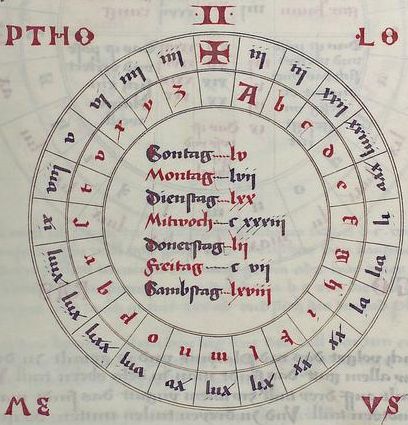
Cod. Pal. germ. 832 Heidelberger Schicksalsbuch, folio 132r
Given that this kind of thing was in the air round that time, was it mere chance that Alberti happened to devise it first? It’s true that Hartlieb’s ones (like the one for Ptolemy above) probably didn’t rotate at all… but all the same, I do honestly think it wouldn’t have involved a vast leap of mid-Quattrocento imagination to make them do so.
But the mention of Hartlieb reminded me of another research strand I’ve been meaning to blog about – flying potions. You see, it was Hartlieb who first wrote (in 1456) about witches’ flying potions, in his puch aller verpoten kunst, ungelaubens und der zaubrey, i.e. on “forbidden arts, superstition and sorcery”.
Reading up again on this subject just now, I was somewhat disappointed to discover that Ioan Couliano’s colourful account of how the handles of broomsticks were used to administer the hallucinogenic unguent turns out to be only supported by a single (and fairly unreliable) source. Mainly, the ointment seems more likely to have been administered to the armpits and absorbed into the bloodstream from there. Still, it probably beats flying cattle class on a charter flight, right?
To me, the bizarre thing about the historical sequence is that in the early Middle Ages it was heretical to believe witches’ descriptions of flight (because they were clearly delusional), while during the Early Modern period it became heretical to disbelieve witches’ descriptions of flight (because they were clearly possessed by the Devil). So much for the continual march forward of knowledge! 😮
For much, much more on this fascinating subject, I heartily recommend Shantell Powell’s set of pages on flying potions. Enjoy!
Hi Nick! The German Ms is very interesting. I notice some letter embellishments in it that are rather gallows-like, too.
Ah, the fly in the (flying) ointment! That’s a fascinating topic too. I had read (in James Blish’s novels on black magic) that you had to apply the flying ointment over your whole body. That would probably be fatal with a hallucinogenic vegetable alkaloid, though.
It’s also timely to read of the noted pre-modern handbook of enhanced interrogation techniques, the Malleus Maleficorum. Since then the methods have been made much more deniable, but the value of the information thus derived appears to be much the same. Glen Claston and I had an excellent discussion of this.
I remember seeing on Wiki that the phrase “enhanced interrogation techniques” was actually coined by the Gestapo, but I can’t find it ATM.
Dennis
So… you’re comparing the witch-hunting madness of the Malleus Maleficarum with Gestapo interrogation and CIA waterboarding etc, in that they all abused people to gain information of no practical value?
Blimey, mate – if a non-American posted that, he or she would be extradited within days.
There are several other highly interesting manuscripts in the
Heidelberg collection. This is a good starting link:
http://www.ub.uni-heidelberg.de/helios/digi/codpalgerm.html
For example, Pal.Germ.552 has lots of fascinating circular
diagrams (which I would not relate with the Voynich MS though)
while the artist of Pal.Germ.314 seems to have dropped out the
same art class that the Voynich author did.
Some nice frogs on p.67 🙂
The lobsters on p.108 (don’t they look familiar? ) are drawn quite
well, though…
Sorry, one more…
Possibly fitting best with the subject of this blog is Pal.Germ.597.
Now this is a clear example of a MS where cipher has been used to
hide secrets. It leaves me with the question:
Why does the Voynich MS not look like this?
My tentative answer: the Voynich MS isn’t actually just a cipher MS. FWIW.
Unfortunately, the enhanced interrogation techniques practiced by the witch hunters, Gestapo, NKVD/KGB, and CIA did indeed produce information of practical value; it’s just that the value lay in identifying convenient scapegoats rather than genuine perpetrators. 🙁
Thanks, René, for the German Ms. Pal.Germ.314 does indeed look like the VMs Author’s animal illustrations, quite a bit! That’s a find! Pal.Germ.597 does indeed contain cipher. I’d say it doesn’t resemble the VMs because both the subject matter and the cipher are different. I wonder what Adam Maclean would have to say about this Ms?
Hi Rene,
Cod. Pal. Germ. 597 is definitely something that deserves a place on the Cipher Mysteries blog. The Karl Bartsch catalogue entry for it is here (marked 287). It’s also briefly mentioned on p.355 of the 1994 book “Geschichte der deutschen Literatur von den Anfängen bis zur Gegenwart” (it’s in Google Books).
Cheers, ….Nick Pelling….