
For years, it has been suggested that the structure of the Voynich Manuscript’s “zodiac” section (where each 30-degree sign has 30 nymphs / 30 stars linked to it) might be encoding some kind of per-degree astrology information. Famously, Steve Ekwall claimed that an “Excitant Spirit” had told him the types of star here denoted the outcome of conception (i.e. a male birth or female birth). This would have been either from the precise degree that the moon was passing through at the time of conception, or from the precise time when the question was asked of the astrologer.
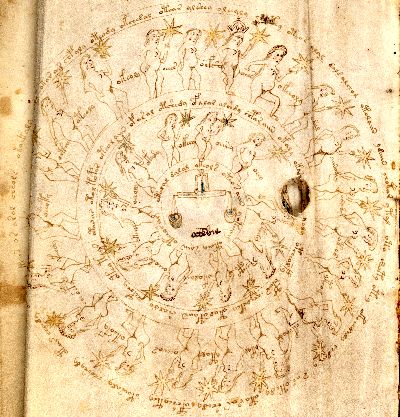
Voynich Manuscript page f72v1 – Libra (contrast-enhanced)
Interestingly, there is also a substantial modern literature on per-degree astrology, usually known as “Sabian Symbols”. The best-known set of these was drawn up by Marc Edmund Jones in San Diego in 1925 (you can see it on pp.10-26 of this Italian PDF): this was later refined and popularized by Dane Rudhyar (and others).
Yet Jones was building (to a certain degree, one might say) on the work of two nineteenth century astrologers / psychics: Charubel [John Thomas] (1828-1908) and the colourful Theosophist Sephariel [Dr Walter Gorn Old] (1864-1929). There’s a 1998 biography of the latter by Kim Farnell called “Astral Tramp” (Blavatsky’s nickname for Walter Old). [Review] Charubel & Sephariel’s 1898 “The Degrees of The Zodiac Symbolized” contains two 360-degree lists that are, it has to be said, wildly different.
On the surface, this would appear to be two completely parallel, relatively modern, and entirely unconnected re-inventions of the sort of (probably originally Arabic) per-degree astrology described by Pietro d’Abano – and so something Voynich researchers should perhaps strive to walk around rather than to engage with.
Certainly, Charubel’s list was specifically described as having been channeled: yet Sephariel claimed that he had actually translated the symbols from a very old book called “La Volasfera”, by Antonio Borelli (or Bonelli) – and so there is, right at the core of the whole modern Sabian Symbol tradition, a very specific claim to a lost Renaissance parentage. Unfortunately, nobody has (as far as I can tell) since tracked down this lost author or this lost book, so Sephariel’s claim might… just… possibly… not be entirely truthful. Really, it’s hard to say, particularly as Sephariel was so, well, unreliable. Oh well!
If you want to read more about Sabian Symbols, there is a surprisingly large amount of literature: the Astrological Center of America maintains a pair of webpages (here and here) listing numerous books on Sabian Symbols and on other per-degree systems (respectively).
Finally, here’s an example of modern astrologers’ describing and using Sabian symbols, which might help make it clear how they are broadly intended to be used.
Just a little bit more about the ‘older’ per-degree astrology:
this goes back to classical times, and have come down to us in
Arabic. Pietro d’Abano, while in Spain, translated this into
Latin in the 13th C, and a German translation was made in the 15th
C. A copy of the latter is in Heidelberg, and has been digitised for
us all to see: http://diglit.ub.uni-heidelberg.de/diglit/cpg832
Browse page by page or download the 98 MByte PDF.
Hi Rene,
Thanks for the link! I originally planned to blog about both old & new per-degree astrologies here, but ended up having to restrict attention purely to the new stuff, which (paradoxically) Voynich researchers probably wouldn’t otherwise know about. 🙂
Cheers, ….Nick Pelling….
Actually comes from the work of an Indian astrologer, whose work al-Biruni used extensively.
Romanisations for the title differ but the author’s name was Varahamihira, and the title is often written as
[the] Brhat samhita.
Dang! It finally dawned on me to increase the magnification so I could get a better look at the circular chart.
I’m back in the harem again! That object in the middle of the diagram sure looks like the bathing tubs (fountains, into which bathers would dip their various cloths, sponges, scrapers,etc. The two objects at the base of the “fountain” appear to fit the description of the baskets (two each) that bathers would bring with them to the baths. One basket would have grooming supplies (soap, scrapers, depilating utensils…..), and the other basket would have a change of clothing.
It it were a large family (harem) (seraglio) some scheduling would probably have had to be done to “keep the peace”, besides keeping records of the various pregnancies in progress. (?)
Evidence? Have we any time-tables in writing for bathing rosters, or pregnancy rosters? Why would bathing need a time-table? By the look of the baths that were in the womens’ quarters of istanbul, dozens could take their swim at the same time.
Hi, Diane!
Based on the study of ancient medical astrology, which was in common practice up until the mid-sixteenth century, anything and everything in medical practice is “timed:” charts are drawn for the ideal time to plant herbals, harvest them, and apply them to the patient by whatever treatment method (bathing included). The time of the patient’s birth is seldom or never used in medical astology; the time a question is asked may be used, but only as a starting point for diagnosing the patient and evolving a method of treatment, which will call for a distinct timing of treatment according to the placement of the planets.
If there is a prescibed time for bathing, it would be determined by the purpose of the treatment rather than the size of the pool. There are several useful resources on medical astrology which may serve as precedents. I rely on William Lilly and Richard Saunders because they took ancient sources and translated them into the vernacular– English–preserving the techniques considered the most effective toward the end of the Golden Age of astrology.
Hypothetically, in this context, women who wished for a female child might be instructed to bathe at a different time than those intending to concieve a male child.
Hope this is helpful.
Let me know if it raises any questions and I’ll try to answer them from what I know of medical astrology. If I can’t answer, I’ll be sure to let you know.
I’ll look for some other online resources and see what I can find. If I locate anything pertient, I will post it here.
–Pam
Traditional Degree Influences, Including Gender:
http://www.skyscript.co.uk/deginf1.html
According to William Lilly in CA.
Note: Light and Dark Degrees also named on this chart.
Pam
anything and everything in medical practice is “timed:”
If you had some documentary evidence from your preferred region securely dated to before 1430 I’d be interested to read it.
I think it’s important when composing an idea as “if…then” not to forget the “…else” – which sometimes rewards investigation.
So *if* there were prescribed times for bathing… but were there? Is there any evidence of time-tabling baths by reference to astrology rather than convenience, court-routine or anything else (any evidence for time-tabling at all?).
William Lilly is a good example of later practice, but since you say that his “ancient sources” were not translated till then, it raises issues about chronology.
What if the images interpreted as bathing women are not meant that way at all? As, for example, medieval imagery of a monk climbing a vine offer a metaphor for the stages of scholarship, the ‘vineyard of the text’ being a common medieval image of study?
In the same way, you find figures of abstractions or personifications such as justice, wisdom etc. given female form, though they’re not pictures of real women.
I think Nick’s calling them ‘nymphs’ nicely covers the range of possibilities, since nymphs were not real people but classical baths were sometimes known as Nymphaea.
Cheers.
Hi, Diane
My professional background is in interpretation of one language to another. We tend to take a view of the most comprehensive possible goal of the speaker, the intention. We bear this in mind as we break down the specific increments of communication. Detail tends to support goal, not the other way around.
That’s why I’m looking first to the possible purpose or intention of the document before deciding what I think the little ladies mean.
Although we can agree the figures seem diminutive, we don’t know to what degree the artist found it necessary to distort the frames of these at least probable human forms to fit them all onto one page. The artist doesn’t seem too concerned about a high degree of realism in either the figures or the flowers.
I agree that the hypothesis limits the field of study. If I hypothesize something specific, I am at least temporarily not regarding other possibilities. Let’s not throw the ladies out with the bath water! There are other suggestions that real women may have been treated in these baths–such as the emphasis on springtime found in the astrological charts, which in at least one known culture (Celtic) meant anticipation of human fertility.
The Celtic beliefs also emphasized reincarnation, which may explain the interest in attaching potential mothers to specific stars. Plato explained a similar star-bound concept of reincarnation in the Myth of Er, in his tenth book of The Republic, although the Greeks were not known to practice rituals to attach mothers to stars, as far as I know.
Physicians had read and used the materials later translated by Lilly on a continuing basis since the ancients in their original languages of Latin, Greek, Arabic, etc. They were in constant use up until his time. The translation I refer to is simply convenient for moderns like me, although some perplexed individuals refer to his quaint phrasing as “Old English,” which it surely isn’t!
Lists of astrological information are ubiquitous since ancient times.
http://en.wikipedia.org/wiki/Ephemeris
Sailors relied on such lists for navigation, which is how Columbus was able to predict a lunar eclipse.
Since I’m considering Celtic culture, here is a source that may prove of interest, thought to date to the 2nd century CE:
http://en.wikipedia.org/wiki/Coligny_calendar
I hope this helps explain my starting point.
Cheers from the other side of the pond!
Pam
Pam
I tend to move from the known to the unknown, and as far as I can tell, the usual assumption about the diagrams’ being astrological charts is an unknown.
What is known is that it shows star-flower forms, held as by strings, in the hands of figures given male and female form. We know that in both western and eastern traditions, human form does not necessarily indicate a human being, and also that the ‘star-holder’ or ‘star-grasper’ was the etymology accepted for the word astrolabein. (modern ‘objective’ etymology vs folk etymology scarce matters here: what people think is what they depict.)
As I’m sure you know, the list of stars indicated on astrolabes that are pre-sixteenth century can vary greatly, and the number of uses for an astrolabe are very many indeed – certainly not limited to astrological calculations.
So while it is possible – only possible – that these are intended to show which stars from astrolabe or planisphere were visible at a given latitude in a given month, as yet there is insufficient reason to assume any more.
So far, no match has been found between labels for these stars and any known system of star-names so far as I’m aware.
So it’s too early yet, in my opinion, to speak of astrology at all, let alone to speak of “per-degree” astrology, which is neither more nor less than the representation of an earlier Indian system – not European and not really ‘ancient’ in the sense that it had to be dug out of some deeply hidden ancient library. It was, and is, a living tradition in India and not termed ‘per degree’ there except in modern works
Diane
PS
Pam –
if you think I’m avoiding giving my personal conclusions about these folios, you’re right.
🙂
Hi, Diane
With all respect, I’m sure you have many reasons for reaching your own unspoken conclusions. I’m glad you have come so far in your own understanding. Unfortunately, we can’t support or rebut unspoken theories, which leads me to return to my own.
Everyone brings presuppositions to an attempt to phrase a hypothesis. The varied uses of astrology are familiar to me as a student of medieval astrology. Again, if these pages are communicating ideas based on astrology, it will be worthwhile to develop an understanding of some of the transcultural applications of astrology:
From this article by Robert Zoller:
http://new-library.com/zoller/features/rz-article-medicine.shtml#1
In the 13th century Roger Bacon wrote that if a doctor is ignorant of astronomy (and thus astrology), his medical treatment will be dependent upon chance or fortune. He further stated that “It is manifest to everyone that celestial bodies are the cause of generation and corruption in all things.”
Astrology held so prestigious a place in the Age that even in that stronghold of orthodoxy, the University of Paris, the faculty of medicine was designated the “Facultas in Medicina et Astrologia.” A similar situation existed at Bologna. In fact, in 1437, there was a controversy at the University of Paris as to what days were favourable for blood letting and the taking of laxatives. The issue was resolved by arbitration. The judges deciding that it was not the day of the week that was of importance but the zodiacal sign in which the Moon was placed which mattered.”
The article is very instructive for those who are curious about the purposes with which astrology was aligned in medieval times, and in the various cultures (Greek, Arabic, Roman) which contributed to medieval European astrology.
Diane, several sources claim that Indian astrology and Celtic astrology are more alike one another than they are like Hellenistic astrology. My understanding is that Indian remedies, such as talismans made from gemstones, are prepared according to astrological timing, although I have not personally studied Vedic astrology in any depth.
Pam
Dear Pam,
I am a great advocate of hypotheses as a way to explain known and certain phenomena. As tectonic plates or natural selection offered new hypothetical models to explain established and documented data.
However, that’s quite a different matter from posing a scenario – which is what novelists rightly do, and too many researchers tend to do, mistaking the ‘scenario’ for an hypothesis.
An hypothesis about why there are pages cut and/or lost from the manuscript seeks to explain what is certainly so.
An idea that the manuscript is about some mythical villa in which mythical women swim in mythical pea soup is, on the other hand, a novelettish scenario, no matter how green the paint, or how naked the ladies pictured in the Vms.
Similarly, positing Irish-Indian astrology as the basis for the month-roundels must, in my opinion anyway, count as a scenario not an hypothesis – at least until your basic assumption of astrological reference can be considered firmly established fact, and not speculation – as is the case now.
I do like the idea of an Irish element here – but the Irish in Ireland were terribly fond of interlace of which there’s not a sceric in the imagery, and Celts in France were rather fond of their anthropoform deities – of which I think there have been none recognised so far. So on stylistic grounds, it’s all a bit shaky on the irish side. Same for the Indian actually – they mayn’t have been that much interested in interlace, but most were expert at picturing human figures – so where have these small-breasted, near-invariably deformed figures come from?
Puzzles like this make the study positively addictive, don’t they?
D
Nick, I am very curious about correspondences asserted for places or regions and constellations of the zodiac. Not necessarily astrological as such, though I expect that will be part of it.
Can you think offhand, of anyone likely to know much in detail about this fairly arcane corner of medieval thought?
I still have my copy of Manilius, so that’s a start, but would love to be able to talk with someone who really knows their medieval astronomical lore… any suggestions? Do pass on my email address to anyone who is willing.
Regards.
The lost author in question is Antonio Belloni. See note 237 in Michel Giovannini’s “Accademie e astrologia” (2014). Belloni was associated with the Renaissance Italian jurist Tiberio Deciani.
Andrew: thank you very much, that was an unexpected lead. Have you read the Casella article mentioned in the footnote? I presume that Giovannini does little more than refer to / recapitulate Casella?
Nick: No, I have not read that article. It can, however, be accessed here:
http://www.academia.edu/25242531/Tiberio_Deciani_e_Antonio_Belloni_figure_della_cultura_giuridica_udinese_del_Cinquecento_in_Tiberio_Deciani_1509-1582_a_cura_di_M._Cavina_Udine_2004_pp._37-50
Unfortunately, I have yet to find a reference to the original version. But I have no doubt it exists — somewhere!